

Audio By Carbonatix
Young climate advocates are raising concerns that Ghana’s recurring flood crisis is being driven as much by human behaviour and weak enforcement of sanitation laws as by climate change and inadequate drainage systems.
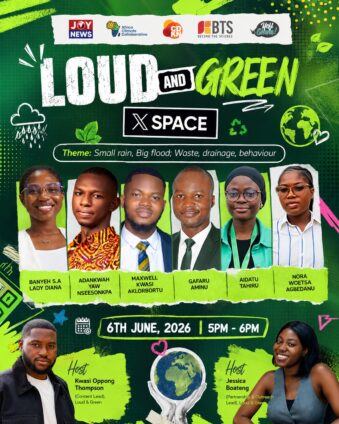
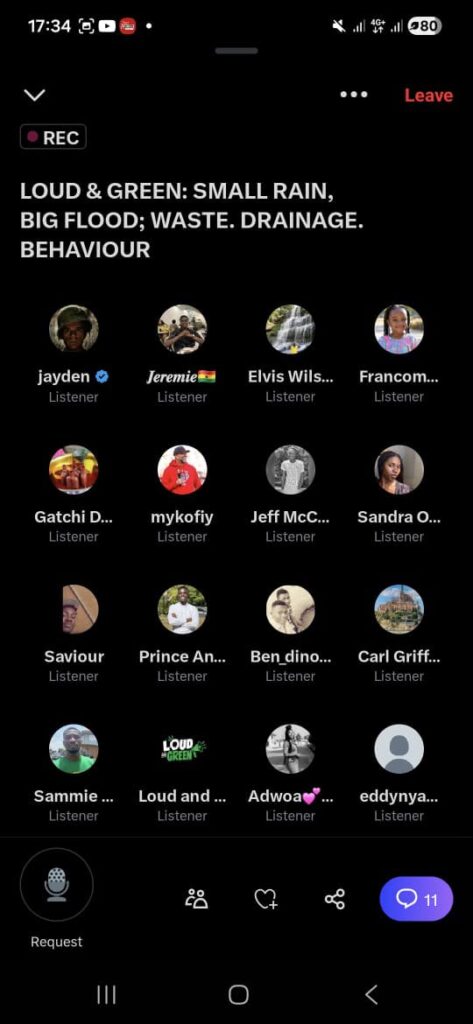
The concerns were shared during the maiden edition of the Loud and Green XSpaces on JoyNews X, held under the theme “Small Rain, Big Flood: Waste, Drainage and Human Behaviour.”
Participants argued that years of indiscriminate waste disposal, poor urban practices and weak enforcement have normalised environmentally harmful behaviour across communities.
Climate communicator Maxwell Aklorbortu described an incident during a trip from the Volta Region to Accra in which a passenger reportedly threw a plastic bottle out of a moving vehicle.
He said when he challenged the act, the individual—whom he described as a military officer—reacted angrily, underscoring what he sees as a broader societal disregard for environmental responsibility.
“Ghanaians have been able to normalise what is abnormal to the extent that we see no wrong with it,” he said.
Mr Aklorbortu noted that improper waste disposal directly contributes to flooding, as plastics and refuse block waterways and alter natural water flow patterns.
“Water flows through its natural course. When you block it with plastics or structures, it will find another route, and that route may be through people’s homes,” he explained.
Youth climate reporter Lady Diana Banyeh also shared her experience of being trapped in floodwaters around Madina Zongo Junction after a recent downpour.
She said traders continued dumping waste into drains even as water levels rose, worsening the situation and creating hazardous conditions for commuters and residents.
“Businesses were closed, homes were flooded and you couldn’t even tell the difference between the road and the gutter,” she recalled.
Climate activist Gafaru Aminu, however, cautioned that individual behaviour must be viewed alongside systemic challenges, arguing that leadership and infrastructure play a key role in shaping public conduct.
He stressed that without accessible waste disposal systems and strong institutional support, even well-meaning citizens may eventually adopt poor environmental habits.
“Once leadership decides to be intentional about these issues, the structures will be put in place,” he said.
The discussions formed part of the launch of the youth-led Loud and Green initiative, which seeks to amplify young voices in climate advocacy and make environmental conversations more accessible.
Participants agreed that without behavioural change and stricter enforcement of environmental laws, Ghana risks continuing its cycle of “small rains, big floods” across urban communities.
Latest Stories
-
Glasner suffers loss on Selhurst return as Palace beat Forest
58 minutes -
WAFU B U17: ‘We won but I expected more from my boys’ – Kassim Ocansey
1 hour -
Man City cruise to statement win over 10-man Liverpool
1 hour -
Be careful with cross-border lending, foreign currency exposures – BoG to financial institutions
4 hours -
GPL 2026/27: Medeama go three clear as Hearts of Oak recover and Bechem stage stunning comeback
4 hours -
Ntiamoah Foundation launches “BEYOND 20” anniversary campaign
4 hours -
Credit Risk Management Directive: BoG to begin implementation for banks, others from July 1, 2027
4 hours -
Ghana Brands Awards 2026: Leading brands, business trailblazers to shine on November 20
5 hours -
T-bills auction: Demand improves as government exceeds target by about 76%; interest rates soften
5 hours -
Ziope undertakes initiative to build a technologically inclined community, commissions self-help ICT lab
5 hours -
ECG announces power outage in parts of Tema, Central Region due to network fault, maintenance
6 hours -
When the Gospel Becomes a Weapon: The church, blackmail and the abuse of faith
6 hours -
JoyNews’ Jacqueline Ansomah Yeboah selected for UK Media Excellence for Emerging Technologies Fellowship
6 hours -
Mental Health Alliance urges government to operationalise Mental Health Fund
6 hours -
Ghana–Holy See agreement heads to Parliament after Cabinet approval
7 hours