

Audio By Carbonatix
The 2026 Mid-Year Fiscal Policy Review counts things. It counts 24,000 pieces of medical equipment distributed to clinics. It counts 1,840 tractors, ploughs and harvesters procured through an escrow account at the Bank of Ghana. It counts three cardiology centres now rising at Korle Bu, Komfo Anokye and Tamale. Then search the same 107 pages for the word textbook, or kindergarten, or desk, or E-Block, and the document falls silent. Every one of those was promised, in numbered detail, in the Budget that Parliament passed eight months ago.
The silence has a cost, and it is not a theoretical one. Free secondary education opened the school gate to a generation that would otherwise have stopped at fifteen, and enrolment has since risen faster than classrooms could be built to hold it. That is why, by September 2024, Government had recorded 1,084 emergency senior high school projects across all sixteen regions. The World Bank now projects a shortfall of more than 850,000 places in Ghana's public secondary schools by 2040. Every party in Parliament accepts that this pressure must be relieved, and every party has promised buildings to relieve it. The 2026 Budget was this Government's answer, and it was specific to the last kindergarten and the last desk. The mid-year statement answers with a list of payments.
That substitution is the core argument of this op-ed. Government has told Parliament, in impressive detail, how much money left the centre. It has not told Parliament what the money bought. The distinction is not pedantry, and it is non-partisan. A disbursement is a promise that a classroom will exist. It is not the classroom.
Let me begin with what the Review does establish, because fairness is the precondition of credibility. Government reports paying GH¢76 million in capitation grants, GH¢46 million for BECE registration, GH¢104 million in teacher trainee allowances, GH¢537 million under the No Fees Stress Policy, GH¢4.2 billion to the GETFund and GH¢1.8 billion to Free Secondary Education. It absorbed examination fees for 478,699 BECE and 407,271 WASSCE candidates and paid the first-year fees of 165,143 tertiary students. Roughly half the capitation line and the whole of the No Fees Stress allocation had gone out the door by 30 June. These are real transfers reaching households, and even the fiercest critics of the Government would acknowledge that.
The trouble begins where the Budget promised buildings rather than payments. Parliament approved a GH¢1.1 billion secondary education programme running over 2026 and 2027, under which government would upgrade 10 Category B schools to Category A, lift 30 Category C schools to Category B, and finish 30 E-Blocks that the Budget itself described as abandoned. The Review announces something quite different. Financed now by a $300 million World Bank credit, Government says it will undertake 210 interventions comprising ten new schools, 150 rehabilitations, 30 Category C upgrades and twenty Category B upgrades. The Category B target has doubled. One hundred and fifty rehabilitations have appeared from nowhere. The 30 E-Blocks have simply vanished, and nobody has explained where they went. The operative words are "will undertake", which is a statement of intention, not a record of delivery.
The mismatch runs deeper than just numbers. The World Bank project approved in Washington on 16 June, known as STARR-J, is not a building programme at all. It is a system-wide intervention reaching 2.2 million students in almost 1,000 schools, covering teaching quality, digital skills, technical and vocational relevance, teacher deployment and data systems as much as bricks. From that broad project, the Review extracts one infrastructure package and presents it as delivery of a programme Parliament financed on entirely different terms. Parliament approved the credit itself on 16 July, seven days before the mid-year statement, along with a counterpart obligation of US$31 million that Ghana must find from its own resources. The Review mentions neither the project by name nor the counterpart bill. Members were asked to approve both halves of this arrangement without ever being shown how they fit together.
The basic education programme fares worse still, because it has disappeared entirely. The Budget committed Government to build 200 junior high schools, 200 primary schools, 200 kindergartens, 400 teachers' bungalows and 400 places of convenience at a cost of GH¢2.0 billion, creating room for more than 200,000 additional learners every year. A further GH¢3.0 billion was set aside for textbooks, two million desks and chairs, 200 buses, 200 pick-ups and fifty saloon cars. Six hundred schools. Two million desks. Not one of these commitments appears anywhere in the mid-year account, in any form, at any level of detail.
Something else has moved in the meantime, and it moved quietly. The Minister told the House he was seeking no supplementary estimate and that the appropriation stands unchanged. His speech then explains that GH¢5.0 billion has been allocated to buy gold for the reserve accumulation programme, and that foreign-financed capital spending has been cut by GH¢3.0 billion to help pay for it. The appendices show the rest. Total capital expenditure falls by GH¢5.0 billion, and the missing GH¢2.0 billion comes out of the domestically financed Big Push, a cut the speech never mentions. Government's own summary table records recurrent spending rising and capital spending falling by matching amounts. Ghana has, in effect, traded five billion cedis of building for five billion cedis of bullion. That may well be a defensible choice for a country rebuilding its reserves. What is not defensible is that the reduction is published by financing source and never once by programme, so that no member of the Education Committee can tell whether the 600 schools survived it.
Two smaller puzzles sit in the same document. It reports GH¢4.2 billion paid to the GETFund, while its own appendix records GH¢3.481 billion, a gap of some GH¢719 million left unexplained fifteen pages apart. And GH¢915 million is reported for Ministry of Education goods and services, said to include sanitary pads and capitation, even though capitation, examination fees and tertiary fee relief are itemised separately within that very vote. Bundling of this kind does not merely inconvenience auditors. It makes verification difficult.
Government has a reasonable defence, and it deserves an answer. Mid-year statements are fiscal instruments, not performance audits, and six months is early in the life of a building programme. Both points have force. Neither is sufficient, for two reasons. The first is that the law already provides the missing document. Section 34 of the Public Financial Management Act requires the Minister to lay before Parliament, by 30 July, a report on programme performance by each minister. That deadline is four days away, and it is where every question raised here belongs. The second reason is simpler. The same Review found the means to count medical equipment, tractors, Farmer Service Centres and hospital construction. Education alone received the payments-only treatment. No ministry is uniquely incapable of counting classrooms.
Four things should follow. Publish the section 34 report on time, with an education annexe naming every promised facility, its site, its contractor, its contract value and its stage of completion. Reconcile the two GETFund figures and break open the GH¢915 million. Lay before Parliament a plain reconciliation of the programme it financed in November against the one now proposed, saying which commitments survive, which have been substituted and how the $31 million counterpart bill will be met without touching the appropriation. And publish the GH¢5.0 billion capital reduction ministry by ministry, so that the country can see what was given up to buy the gold.
Ghana's education debate has for too long been conducted in the currency of announcements. A child cannot sit on an appropriation, read a disbursement or shelter under a press release. A receipt is not a school, and Parliament should stop accepting one in place of the other.
*******
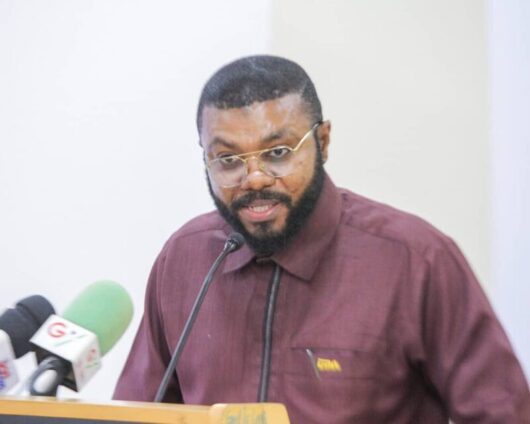
Dr Prince Hamid Armah is Co-Chair of the NPP Education Sector Policy Committee and a Lecturer at the University of Education, Winneba. He previously served as Director-General of the National Council for Curriculum and Assessment (NaCCA) and as Vice Chairman of the Parliamentary Select Committee on Education. His expertise spans education policy, curriculum reform, education financing, governance and public sector leadership.
Latest Stories
-
Drug cartels may be seeing Ghana as easy route – Lenin Anane Agyei
35 minutes -
Ghana risks gaining notoriety as drug-trafficking hub – Bobby Banson
44 minutes -
Government dismissed my drug trafficking warning, then tried to arrest me – Ntim Fordjour
46 minutes -
Day Two: 3rd Republic Bank-JoyNews Habitat Fair Clinic underway at Junction Mall
46 minutes -
NACOC addressing inherited gaps in fight against drug trafficking – Deputy Director-General
59 minutes -
Taekwondo goes to school as GTF launches five-region youth campaign
1 hour -
The issues Mourinho is struggling to fix at Real Madrid
1 hour -
Hundreds throng EducationUSA College Fair in Kumasi in pursuit of abroad studies
1 hour -
Drug bust: NACOC should be part of port inspection team – Twum-Barimah
1 hour -
Ward appointed Liverpool’s sporting director
1 hour -
This isn’t the first cocaine bust; NPP must stop the politicisation – NACOC deputy boss
1 hour -
Drug bust case: Only Customs officers, MPS officials in scanning room – NACOC
2 hours -
I don’t mind being insulted; I have a crocodile skin – President Mahama
3 hours -
Samson’s Take: Verify the badge – and verify the story
3 hours -
President Mahama explains why Ghana must rethink regulation of TikTok, other new media platforms
3 hours