

Audio By Carbonatix
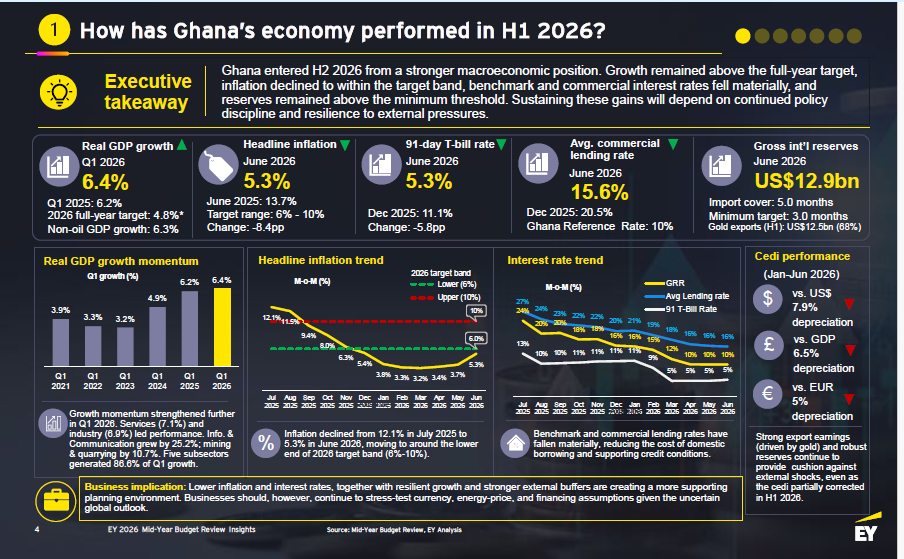
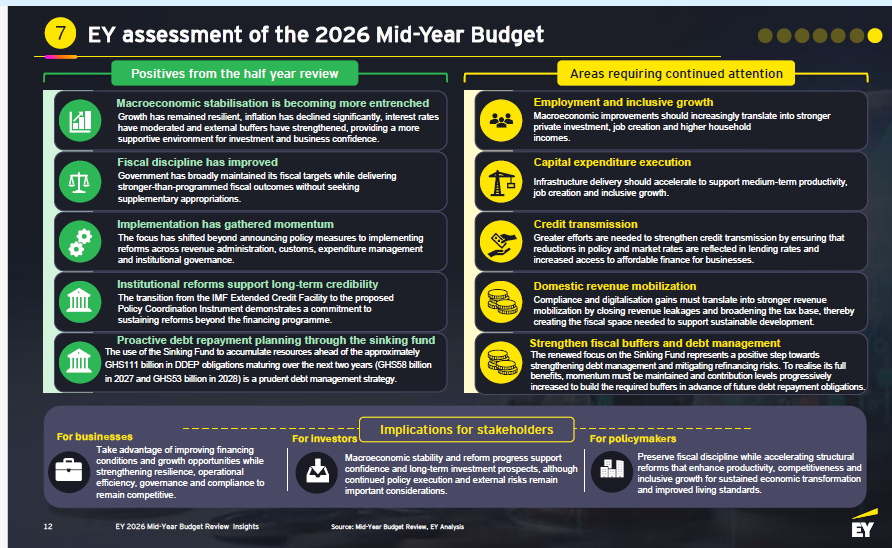
Ghana’s economic recovery is becoming increasingly entrenched, with stronger fiscal outcomes, moderating inflation, improving external buffers and resilient economic growth providing renewed confidence for businesses and investors, according to EY’s latest assessment of the Government’s 2026 Mid-Year Budget Review.
The analysis, published in the 2026 Mid-Year Budget Insights, notes that Ghana has made significant progress in restoring macroeconomic stability during the first half of 2026.
EY observed that economic growth has remained resilient while inflation has declined substantially, interest rates have moderated and the country’s external position has strengthened, creating a more supportive environment for investment and business activity.
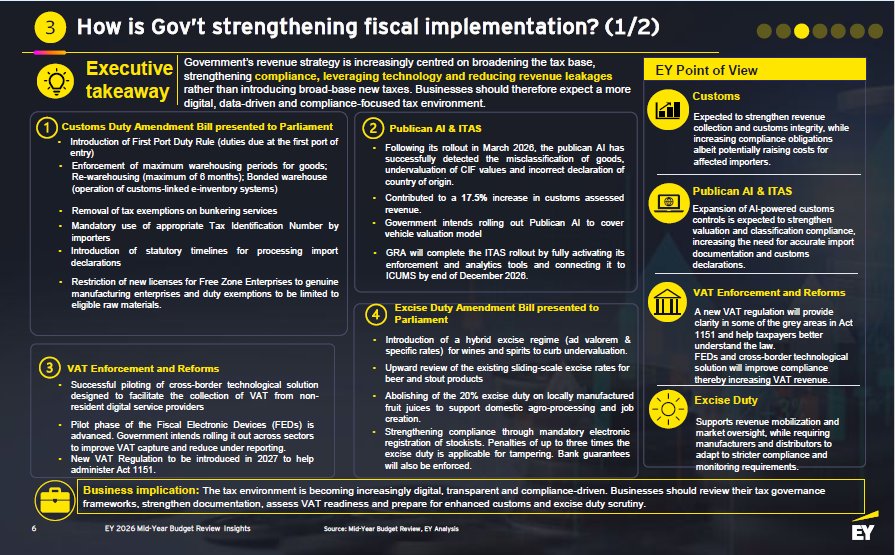
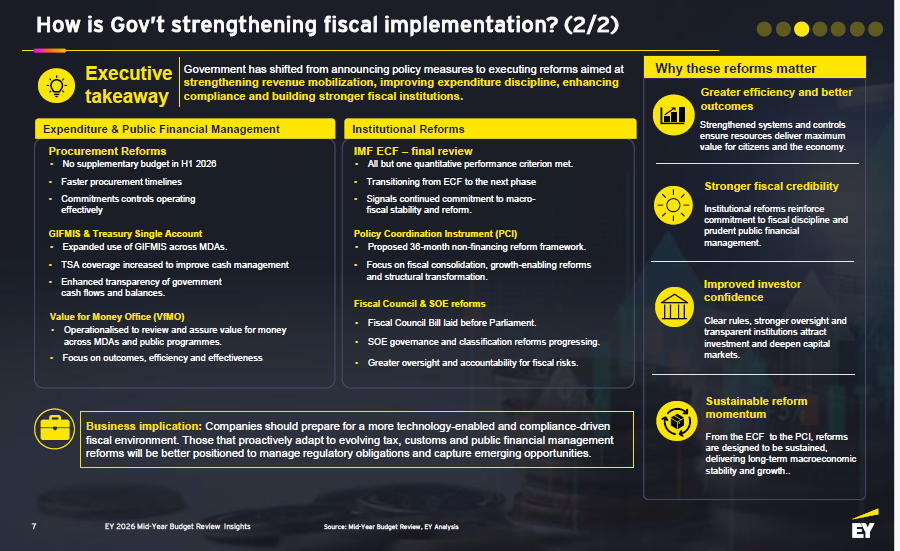
Speaking to the broader significance of the Mid-Year Budget Review, the publication notes that attention is increasingly shifting from policy announcements to policy execution. Reforms across revenue administration, customs, expenditure management and institutional governance have begun to move from design to implementation, signaling a stronger focus on delivering measurable outcomes.
Fiscal Discipline Delivering Results
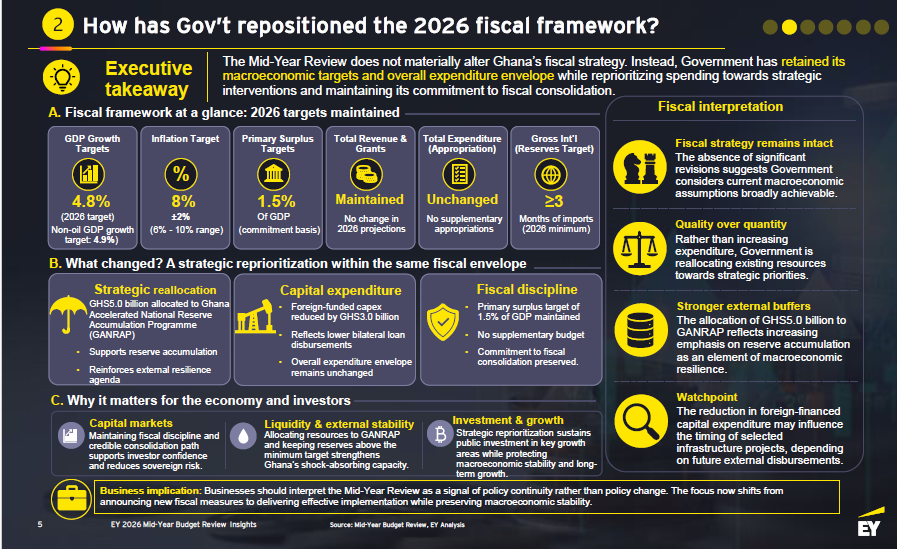
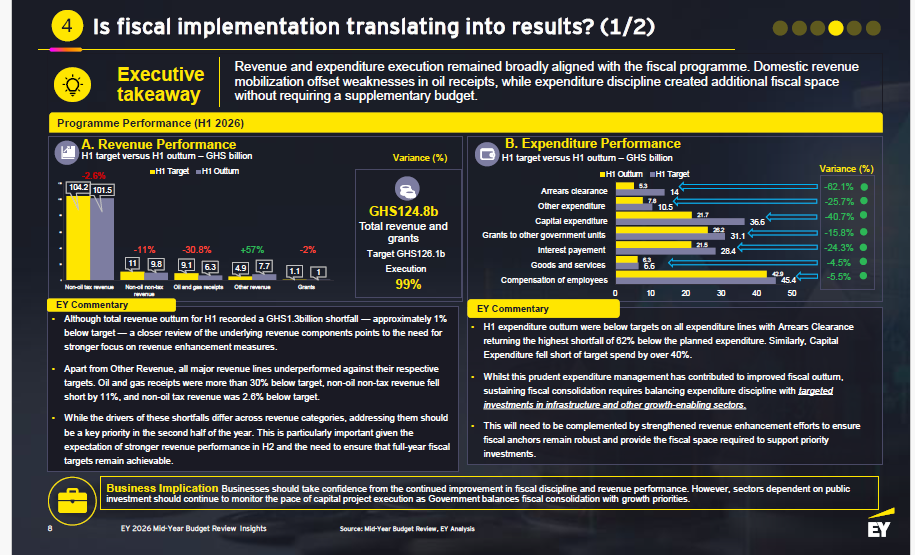
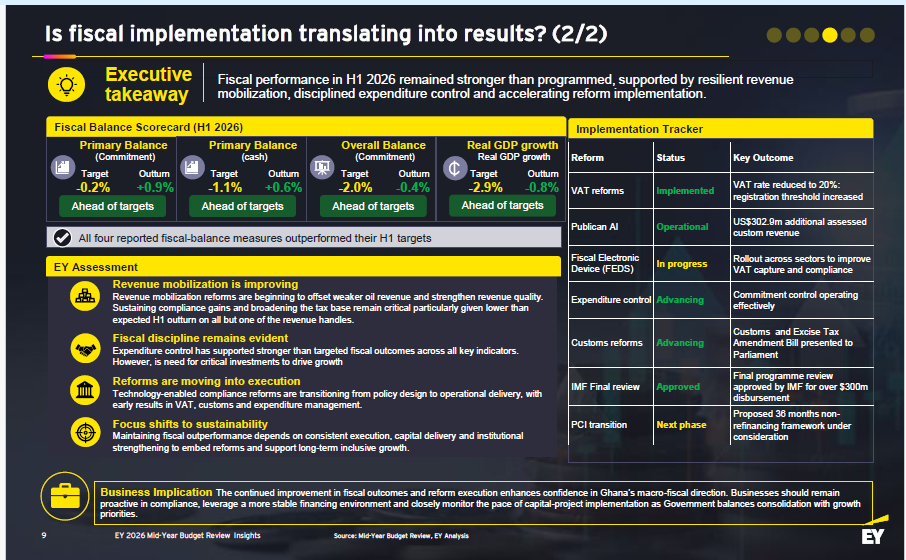
A key highlight of the review is the government’s continued commitment to fiscal discipline. According to EY, a number of fiscal performance measures exceeded H1 targets without the need for supplementary appropriations. A key driver of this improved outcome has been disciplined expenditure management as evidenced by the outturn in major expenditure lines falling below the H1 Targets.
EY cautions that, whilst this prudent expenditure management has contributed to improved fiscal outturn, sustaining fiscal consolidation requires balancing expenditure discipline with targeted investments in infrastructure and other growth-enabling sectors. This will need to be complemented by strengthened revenue enhancement efforts to ensure fiscal anchors remain robust and provide the fiscal space required to support priority
The report also points to institutional reforms that are expected to strengthen long-term economic credibility. In particular, Ghana’s planned transition from the IMF Extended Credit Facility programme to a proposed Policy Coordination Instrument is viewed as evidence of the Government’s commitment to sustaining reforms beyond IMF-supported financing arrangements.
Opportunities and Risks Remain
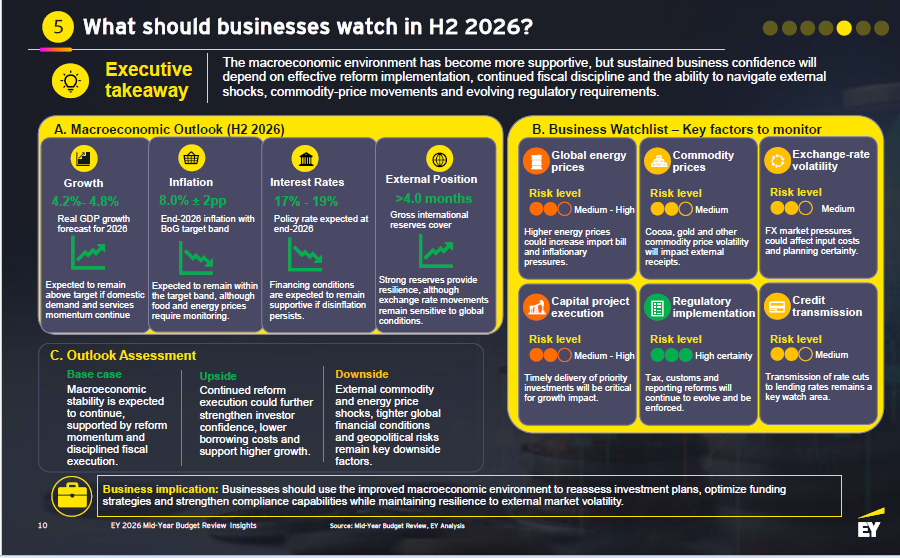
Despite the positive trajectory, EY cautions that several areas require continued attention if the gains achieved during the first half of the year are to be sustained.
Among the key priorities identified is domestic revenue mobilization. While recent compliance and digitalization initiatives are encouraging, EY notes that these efforts must translate into stronger revenue performance particularly in H2 as Revenue witnessed mixed performance in H1 with most of the revenue handles reporting below the H1 targets.
The report also highlights the need to accelerate capital expenditure execution. Infrastructure delivery remains essential for raising productivity, stimulating private sector growth and supporting employment creation. EY argues that stronger implementation of capital projects will be important in translating macroeconomic stability into broader economic transformation.
Access to finance remains another concern. While interest rates have begun to decline, businesses continue to face challenges in obtaining affordable credit. EY therefore calls for improved transmission of monetary policy easing into lower lending rates and expanded access to financing for enterprises.
Strengthening Debt Management Through the Sinking Fund
One of the most significant policy developments highlighted in the report is the government’s renewed focus on the Sinking Fund as a debt management tool.
EY describes the strategy as a prudent approach to managing upcoming debt obligations, particularly under the Domestic Debt Exchange Programme (DDEP).
The report notes that approximately GHS111 billion of DDEP-related obligations are scheduled to mature over the next two years, comprising approximately GHS58 billion in 2027 and GHS53 billion in 2028. The accumulation of resources in the Sinking Fund ahead of these maturities is expected to reduce refinancing pressures and strengthen investor confidence.
According to EY, the renewed emphasis on the Sinking Fund represents a positive step toward strengthening fiscal buffers and reducing debt-related vulnerabilities. However, the firm emphasizes that continued commitment and disciplined implementation will be necessary for the strategy to realize its full benefits.
Implications for Business, Investors and Policymakers
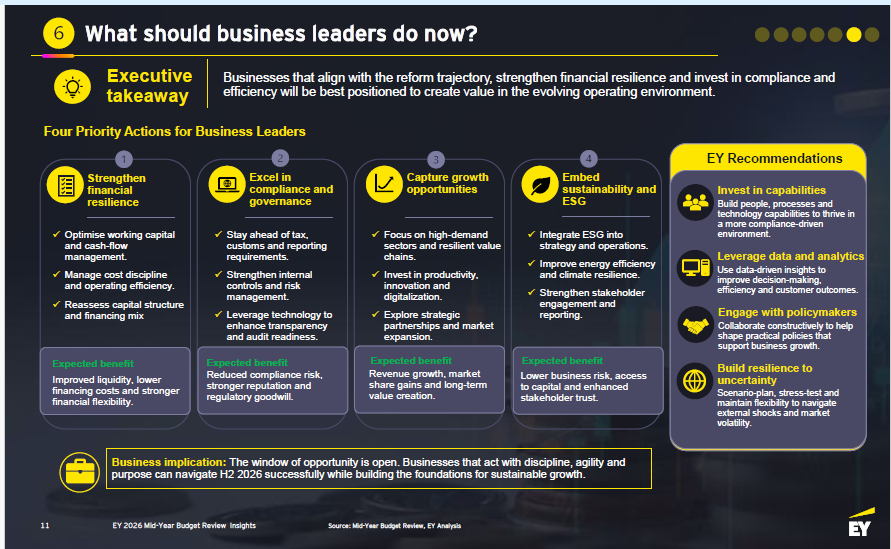
The report concludes that the improving macroeconomic environment presents important opportunities for stakeholders across the economy. Businesses are encouraged to capitalize on improving financing conditions and growth opportunities while strengthening operational resilience, governance and compliance frameworks.
The report added that investors may find increased confidence in Ghana’s reform trajectory and improving economic fundamentals, although they are advised to remain mindful of execution risks and external uncertainties. Policymakers, meanwhile, are urged to preserve fiscal discipline while accelerating structural reforms that improve competitiveness, productivity and inclusive growth.
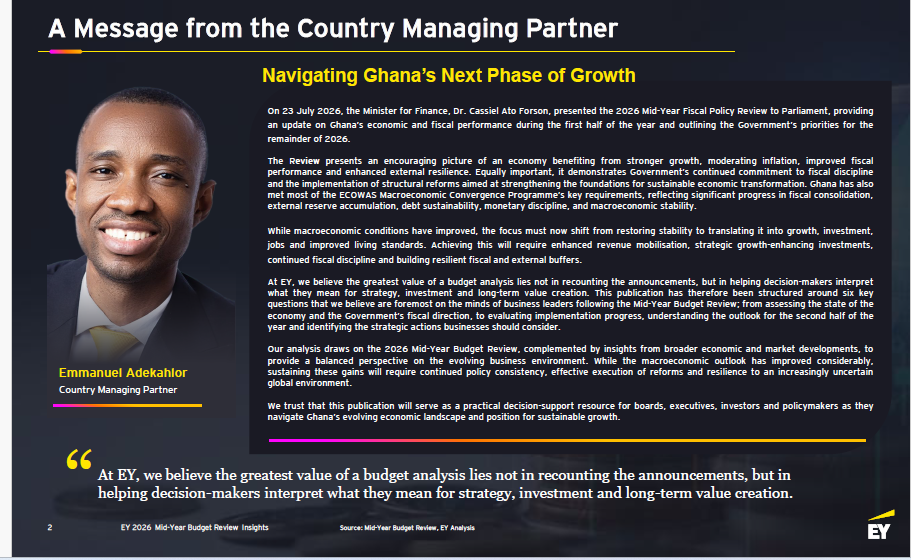
Looking ahead, EY believes that the challenge for Ghana is not only to maintain macroeconomic stability but to ensure that the benefits of recovery translate into higher private investment, stronger job creation and improved living standards. "Sustained reform implementation, enhanced revenue mobilisation, prudent debt management and increased investment in productive infrastructure will be critical in determining whether the country can successfully navigate its next phase of economic growth".
Latest Stories
-
Richmond Quarcoo appointed Ghana’s Chef de Mission for 2028 Olympics
33 minutes -
‘Our missing players are more important’ – Gambia coach fires shot at Ghana
2 hours -
Today’s front pages: Tuesday, September 29, 2026
2 hours -
Ghana ‘showing up differently’ on global stage – Joyce Bawah Mogtari
2 hours -
Ghana’s tuna industry in crisis as 20 hook-and-line vessels collapse
3 hours -
South Tongu MP launches apprenticeship programme for 159 young people
3 hours -
The Pusiga connection behind Gertrude Atongi’s work in New York
4 hours -
Teachers took promotion exams in December to beat government clearance deadline – GNAT
4 hours -
NPA launches 2026 staff welfare week with focus on teamwork and employee wellbeing
4 hours -
Ghana, Saint Kitts and Nevis sign labour deal to strengthen protections for Ghanaian nurses
4 hours -
Delayed promotions put teachers’ retirement benefits at risk – GNAT
4 hours -
No ‘Bawumia candidates’ in NPP executive elections – Anthony Karbo
4 hours -
Over 3,000 displaced as flooding overwhelms Hohoe communities
4 hours -
Sunyani East NPP executives begin reconciliation drive ahead of 2028 polls
4 hours -
Agric Minister engages Ga Mantse on agriculture transformation agenda
4 hours