

Audio By Carbonatix
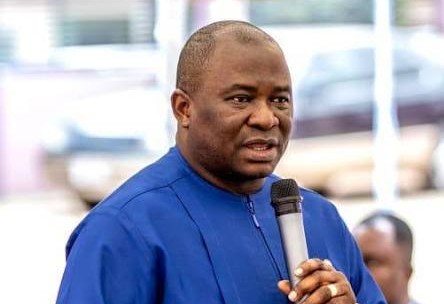
The Member of Parliament for Akim Oda, Alexander Akwasi Acquah, is demanding explanations over the reported US$1.7 billion loss associated with the Bank of Ghana’s Domestic Gold Purchase Programme (DGPP).
According to the NPP MP, the reported loss, equivalent to about GH¢22 billion or 1.5% of Ghana’s GDP, cannot be ignored and requires an explanation from the managers of the programme.
Speaking on Joy FM’s Top Story on Wednesday, August 19, Mr Acquah said the findings contained in a recent International Monetary Fund (IMF) report reinforce concerns raised by the Minority about the financial implications of the gold purchase programme.
“This assertion has been buttressed by the IMF report that was recently released. Bank of Ghana is the backbone of the GoldBod operations.
"And so, if the IMF is saying that the operations of the DGPP has resulted in the loss of $1.7 billion, which is about 1.5% of our GDP, approximately GH¢22 billion, clearly this is as a result of the activities of GoldBod,” he said.
He challenged the Chief Executive Officer of GoldBod, Sammy Gyamfi, to explain how the losses occurred and what measures are being taken to prevent a recurrence.
“And so, if the GoldBod Chief Executive has any answers for Ghanaians, he has to tell us how come we have made these losses,” Mr Acquah said.
The MP further pointed to losses recorded under the gold purchasing programme in the previous year, arguing that the reported US$1.7 billion loss should be subjected to further scrutiny.
“So the $400 million is attributable to the activities of the Gold Purchase Programme. But the $1.7 billion as reported by the IMF cannot be attributed to Sammy Gyamfi's GoldBod. Is that what we are saying?” he asked.
Mr Acquah argued that the change from the previous gold purchasing arrangement to GoldBod does not, in his view, alter the nature of the programme.
“We are talking about $1.7 billion losses as reported by the IMF as a result of the Domestic Gold Purchase Programme, which is a programme managed by GoldBod. It is just a change of name. It's just a nomenclature,” he said.
He stressed that the reported losses should not be dismissed without a detailed explanation of the transactions and decisions that resulted in the figure.
According to him, the explanations are necessary not only for accountability but also to help Ghana avoid similar financial challenges in the future.
“I do not understand why we're having this hue and cry on this whole issue. Whatever it is, we need to have some explanations so that it guides us in the future of our operations,” he said.
Mr Acquah insisted that the issue should remain on the national agenda until the figures and circumstances surrounding the reported loss are properly explained.
“This cannot be swept under the carpet. It cannot be swept off. We still have to talk about it. That is an IMF report. So, we are expecting some answers. How did we get here? Losing GH¢22 billion,” he added.
Latest Stories
-
Kwabena Boamah appointed Board Chair for Impact Investing Ghana
3 minutes -
Striking teacher unions to meet Fair Wages and Salaries Commission on October 6
17 minutes -
EOCO working with AG to arraign Nana Baffour Awuah before weekend court
20 minutes -
Duraplast reassures customers after fire, announces October 5 reopening
28 minutes -
Call off strike, gov’t will not renege on promotion arrears pledge – Haruna Iddrisu appeals to teacher unions
30 minutes -
Committee set up to validate teachers eligible for 20% deprived-area allowance – Education Minister
34 minutes -
Five-member committee to search for new Black Stars coach after Sports Ministry-GFA meeting
1 hour -
Pinktober: Breast cancer survival exceeds 90% when detected early – Breast Society of Ghana
1 hour -
TCDA to adopt Upper West’s MATCO mango farm as northern prototype, issues warning against felling shea trees
1 hour -
‘Fear delegates’ tag: Afoko touts genuineness among delegates ahead of NPP delegates conference
1 hour -
John Boadu: The leader our party needs at this time – Amb. Edward Akwasi Boateng
2 hours -
Baffour Awuah: EOCO arrested, detained MP after hours of waiting, questioning – Afenyo-Markin
2 hours -
EOCO court warrant authorised search of Baffour Awuah’s law firm, not residence – Afenyo-Markin
2 hours -
NPP delegates conference: 3,000 to 4,000 police personnel deployed for security in Kumasi – Anthony Karbo
2 hours -
KGL Foundation commits $200,000 to support juvenile football for the next two years
2 hours