

Audio By Carbonatix
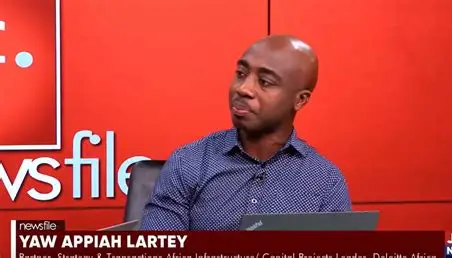
Partner and Africa Leader for Infrastructure, Capital Projects and Real Estate at Deloitte Africa, Yaw Appiah Lartey, has welcomed aspects of the government’s Mid-Year Budget Review, particularly measures aimed at improving the financing of capital projects, while urging authorities to strengthen revenue mobilisation and avoid duplication in the implementation of flagship programmes.
Speaking on JoyNews’ Newsfile on Saturday, July 25, Mr Appiah Lartey said Ghana’s economic recovery efforts must go beyond expenditure controls and focus on sustainable revenue generation, efficient project financing and targeted interventions.
His comments come after the Finance Minister’s Mid-Year Budget Review highlighted falling inflation, a stronger cedi, improved fiscal discipline and renewed confidence in the economy.
However, the Minority in Parliament has argued that the positive macroeconomic indicators do not fully reflect challenges such as reduced spending, delays in implementing flagship programmes and questions over government priorities.
Mr Appiah Lartey said one of the longstanding challenges with public infrastructure projects has been the absence of dedicated funding arrangements before projects begin, resulting in stalled works and accumulated debts owed to contractors.
“There may be some concern that has been raised. The first is that, historically, some of our capital expenditures have not had earmarked funds. We incur them and we have issues with contractors not being paid,” he said.
He described the move towards ensuring that projects have identified funding sources before implementation as a positive step.
“For me, this is positive because you have a situation where the construction starts, it gets stuck in the middle of the way and there’s no fund debt,” he stated.
According to him, establishing a financing framework for projects would prevent situations where government begins construction only to search for funding after work has commenced.
“You will have to have some form of sinking fund for the debts that we are incurring for the programmes that we plan. So it’s a positive thing, in my view, because a project starts and doesn’t have to get to the middle before we start looking for funding,” he added.
The Deloitte executive said while government’s efforts to control expenditure were important, more attention should be paid to revenue generation.
He noted that although government missed its revenue target, the shortfall was relatively small, and the focus should now shift towards improving areas where Ghana has historically underperformed.
“We should also look at the revenue aspect. So yes, there’s been some control on expenditure, but on the revenue side, we missed our target, albeit about 1.1%, which is good,” he said.
Mr Appiah Lartey argued that Ghana has often focused on introducing new taxes while failing to maximise existing revenue sources, particularly property taxation.
“We kept introducing new taxes, not mentioning e-levy, forgetting that we had low-hanging fruit,” he said.
He welcomed efforts to improve property tax collection, noting that making property bills more accessible could help increase compliance.
“Now property bills come to your home like ECG bills. That’s an important development because we are focusing on what we have been taxing over the years, forgetting that they are low-hanging fruit,” he said.
He questioned whether Ghana could improve revenue performance by expanding property taxation rather than continuously introducing new levies.
“We keep talking about widening the tax net, but this was low-hanging fruit, property taxes. Can we outperform that?” he asked.
Mr Appiah Lartey also highlighted corporate income taxes and oil revenues as areas that require closer attention.
“If corporate income taxes are increasing, then it means that there’s production going on,” he said.
He called for stronger systems to capture economic activities taking place online, particularly transactions involving non-resident digital platforms.
“There are people who are making money in Ghana here using online. How are you tracking them? Can you make business or make money from the United States online without being taxed? If elsewhere you cannot do that easily, then we should also look at it,” he said.
The Deloitte executive also argued that Ghana should maximise the benefits of the national identification system by linking the Ghana Card to tax compliance.
“We have gone through the rigorous process of registering Ghanaians. We should be able to tax them,” he said.
He noted that the Ghana Card is already required for several services and argued that tax compliance should be integrated into that system.
“It applies in the courts. It applies in the bank. You need a Ghana Card to do everything. Why don’t we follow that up to ensure that everybody who has a Ghana Card, any Ghanaian who has a Ghana Card, is tax compliant?” he asked.
He pointed to tax compliance practices in countries such as the United States, where citizens are required to file tax returns, as an example Ghana could consider.
Mr Appiah Lartey welcomed proposed tax reforms, including the planned review of income tax legislation and adjustments to VAT registration thresholds.
He said some tax laws had become outdated and needed to reflect current economic realities.
He supported the increase in the VAT registration threshold from GH¢250 to GH¢750, arguing that the previous threshold was no longer appropriate.
“GH¢250 was many years ago. And today, a trader making GH¢250 is still like someone in a shop or a container. You don’t put that person through the cost of trying to register for VAT. You have to increase that,” he said.
He also welcomed proposed reforms to excise duties, particularly the planned removal of the 20% excise duty on locally manufactured food products, saying it could help local industries compete with imported goods.
Mr Appiah Lartey criticised the duplication of government initiatives, arguing that some flagship programmes have struggled because they create new structures instead of strengthening existing institutions.
He cited programmes such as One District, One Factory and One Village, One Dam, saying some challenges were linked to the creation of separate secretariats alongside existing ministries and agencies.
“There are a number of problems with those initiatives, which doesn’t make them successful. One is that we duplicate them. We duplicate existing institutions and agencies,” he said.
“Why would you have a One District, One Factory secretariat when you have a Ministry of Trade and Industry? They have all the data. They have all the resources to run it,” he added.
According to him, creating parallel structures can lead to delays and institutional conflicts.
“We create a secretariat. So we spent about two years creating a policy and office initiative to run the department. Then we have, my entrepreneurship lecturer will say, six months of power play. The minister fights with the CEO of the secretariat. And then another three months of injury time after the fight,” he said.
He urged government to rely more on existing institutions and agencies instead of establishing new administrative bodies for every major initiative.
Mr Appiah Lartey also called for a more focused approach to the government’s proposed 24-hour economy programme, warning that broad initiatives may struggle without clear sector priorities.
“My problem with some of these initiatives is that they are expansive and too wide. Let’s focus on sectors where we can make transformation happen,” he said.
He cited the Cassava Starch Initiative under former President John Agyekum Kufuor as an example of a targeted intervention linked to a specific industrial objective.
“President Kufuor started the Cassava Starch initiative and there was a factory established to support that,” he said.
On the 24-hour economy policy, he asked: “What are the key sectors that we are focusing on and how are we making them function to optimise the benefits?”
Mr Appiah Lartey said initiatives such as the Women’s Development Bank should also be implemented effectively while avoiding unnecessary duplication of existing institutions.
Latest Stories
-
Drug cartels may be seeing Ghana as easy route – Lenin Anane Agyei
36 minutes -
Ghana risks gaining notoriety as drug-trafficking hub – Bobby Banson
45 minutes -
Government dismissed my drug trafficking warning, then tried to arrest me – Ntim Fordjour
47 minutes -
Day Two: 3rd Republic Bank-JoyNews Habitat Fair Clinic underway at Junction Mall
47 minutes -
NACOC addressing inherited gaps in fight against drug trafficking – Deputy Director-General
59 minutes -
Taekwondo goes to school as GTF launches five-region youth campaign
1 hour -
The issues Mourinho is struggling to fix at Real Madrid
1 hour -
Hundreds throng EducationUSA College Fair in Kumasi in pursuit of abroad studies
1 hour -
Drug bust: NACOC should be part of port inspection team – Twum-Barimah
1 hour -
Ward appointed Liverpool’s sporting director
1 hour -
This isn’t the first cocaine bust; NPP must stop the politicisation – NACOC deputy boss
1 hour -
Drug bust case: Only Customs officers, MPS officials in scanning room – NACOC
2 hours -
I don’t mind being insulted; I have a crocodile skin – President Mahama
3 hours -
Samson’s Take: Verify the badge – and verify the story
3 hours -
President Mahama explains why Ghana must rethink regulation of TikTok, other new media platforms
3 hours