


Audio By Carbonatix
Ukrainian President Volodymyr Zelensky has called off a high-profile briefing with US lawmakers amid an impasse over future US funding for the country.
Virtual appearances in the Senate and House had been scheduled for Tuesday, but were cancelled at the last moment.
It came after a top Ukrainian official warned they are in danger of losing the war against Russia if more US military aid is not approved.
Senate leader Chuck Schumer did not explain why Mr Zelensky did not show.
The chamber's Democratic leader said that Ukrainian president was occupied with a "last-minute" matter, without providing further detail.
Mr Zelensky's chief of staff, Andriy Yermak, said earlier on Tuesday there was a "big risk" of Ukrainian defeat without continued US support.
"It will be difficult to keep in [the] same positions and for the people to really survive," he added, in a speech at the US Institute of Peace in Washington DC.
Mr Yermak's dire assessment was given just hours before Mr Zelensky pulled out of a scheduled video conference with US senators to brief them on the war effort.
Ukraine's embassy in Washington DC did not immediately respond to a BBC question asking for further explanation for the cancellation.
It comes on the heels of a renewed push by the White House for additional support for Ukraine. The US Congress, however, is still not close to a deal on a compromise spending package that would help fund the war effort.
"We are out of money - and nearly out of time," wrote Shalanda Young, the White House budget director, in a letter to Republican and Democratic leaders published on Monday.
She warned that a failure by Congress to approve more military aid to Ukraine before the end of the year would "kneecap" the nation in its fight against Russia and that there was no "magic pot of funding" left to draw from.
On Monday, however, the Republican Speaker of the House of Representatives, Mike Johnson, seemed dismissive of the latest pleas to provide tens of billions of dollars more in funding.
"The Biden Administration has failed to substantively address any of my conference's legitimate concerns about the lack of a clear strategy in Ukraine, a path to resolving the conflict, or a plan for adequately ensuring accountability for aid provided by American taxpayers," he wrote on social media.
The funding impasse comes as fighting on the frontlines appears to have reached a practical stalemate.
Ukraine's much anticipated counter-offensive in the south appears to have slowed down, while Kyiv's forces are struggling to maintain a foothold they had established on the east bank of the vast Dnipro river.
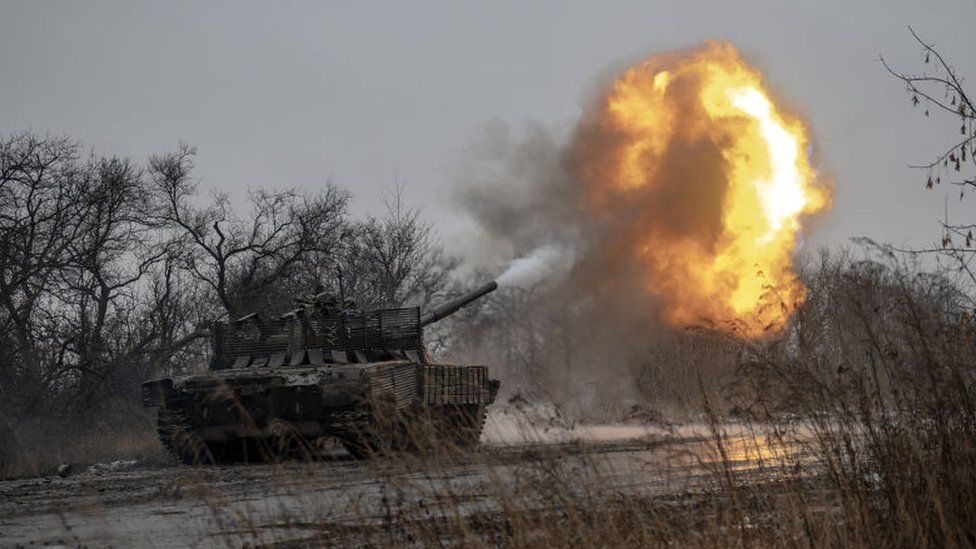
Since the war began in February 2022, the US Congress has approved more than $110bn (£87bn) in military and economic aid to Ukraine. The Biden administration has warned for months, however, that most of that money has already been distributed.
According to Frederick Kagan, director of the American Enterprise Institute's Critical Threats Project and a former professor at the US Military Academy, the funding delays are already having very real consequences on the Ukrainian battlefield. The current counter-offensive against Russia is being scaled back, and future operations to regain lost territory are in doubt.
"The Ukrainians have to make a hard choice here," he said. "If they are not confident that they're going to get anything else from the United States, then they have to conserve what they have."
What the Ukrainian military needs, he said, is tanks, armoured personnel vehicles, fighter planes, drones and long-range weapons - and the US is the only country that can provide this hardware quickly and in the amounts that Ukraine requires in the coming year.
There continues to be bipartisan majorities in both chambers of Congress for additional US aid to Ukraine, even if it does not reach the $61.4bn level that the White House has requested. Turning that congressional support into legislation that the president can sign into law, however, has proven to be a sizeable challenge.
Republicans and Democrats in the US Senate are currently negotiating an even-larger $106bn spending package that includes aid to Ukraine along with military support for Israel and Taiwan and increased funding for security on the US-Mexico border.
It is this last component of the package, however, that has caused the most political heartburn. Democrats have balked at proposed immigration policy changes, including altering how asylum-seekers at the border are processed and tightening the requirements necessary to qualify for entry into the US.
"In return for providing additional funding for Ukraine, we have to have significant and substantial reforms to our border policy," Republican Senator Tom Cotton of Arkansas said in a television interview on Sunday.
Democratic Majority Leader Chuck Schumer has said he will bring a military aid bill to a vote in the chamber this week, but it is unclear if it will have sufficient Republican support without an agreement on immigration measures.
Even if Ukraine aid clears the Senate hurdle, its outlook in the House of Representatives is equally murky. While Speaker Johnson has said he supports additional funds for Ukraine, he was one of 117 Republicans in the chamber who voted on 28 September to block just $300m in additional security assistance for that country.
If he brings a Senate-backed massive aid package to a vote in the chamber, relying on Democratic support to win passage, he could sharply divide Republicans and threaten his own grip on power before another round of acrimonious budget negotiations early next year.

"The United States is going to run in excess of a $2.5 trillion deficit this year," Republican Congressman Matt Rosendale of Montana told BBC World Tonight's James Coomarasamy on Tuesday.
"So why should the people of the United States borrow money from China to give it up to Ukraine? That is not in our best interests."
In a possible attempt to shore up congressional support, the White House has been pitching additional Ukrainian aid in economic as well as national security terms. In her letter to Congress, Ms Young noted that the requested funds would be used to manufacture armaments at factories located across the country.
"We will modernise vital munitions and equipment like Javelins made in Alabama, Guided Multiple Launch Rocket Systems made in West Virginia, Arkansas and Texas... and artillery shells made in Pennsylvania, Arkansas and Iowa and many other states," she writes.
As an election year approaches, the White House may be hoping that members of Congress are looking for ways to tout how their actions are helping the local economies in their home districts.
Mr Kagan said he was not surprised that Ukraine funding had become a more controversial topic of political debate in the US as the conflict approaches its third year.
"The American people deserve to have hashed out by their representatives exactly what America's interests are, and to have real debate on distribution of what is after all the large amount of money," he says.
In the end, however, he said the stakes were clear.
"The outcome of this war is going to be determined primarily by what the Ukrainians can do, but a very close second by what the United States chooses to do."
Latest Stories
-
Bobby Banson condemns EOCO’s attempted arrest Nana Agyei Baffour Awuah
2 minutes -
When Kumasi begins to look like somebody is in charge
3 minutes -
Parliamentary probe into cocaine seizure would be a waste of time – Inusah Fuseini
9 minutes -
Cocaine seizure: Focus on Ghana’s reputation, not partisan blame – Osae-Kwapong
15 minutes -
Two Invitations, Three Interrogations: Did Baffour Awuah tell the whole story?
25 minutes -
Drug cartels may be seeing Ghana as easy route – Lenin Anane Agyei
1 hour -
Ghana risks gaining notoriety as drug-trafficking hub – Bobby Banson
1 hour -
Government dismissed my drug trafficking warning, then tried to arrest me – Ntim Fordjour
1 hour -
Day Two: 3rd Republic Bank-JoyNews Habitat Fair Clinic underway at Junction Mall
1 hour -
NACOC addressing inherited gaps in fight against drug trafficking – Deputy Director-General
2 hours -
Taekwondo goes to school as GTF launches five-region youth campaign
2 hours -
The issues Mourinho is struggling to fix at Real Madrid
2 hours -
Hundreds throng EducationUSA College Fair in Kumasi in pursuit of abroad studies
2 hours -
Drug bust: NACOC should be part of port inspection team – Twum-Barimah
2 hours -
Ward appointed Liverpool’s sporting director
2 hours