


Audio By Carbonatix
WHO has long maintained Covid-19 is spread via larger respiratory droplets and dismissed possibility of aerosol route.
More than 200 scientists called for the World Health Organization to acknowledge the coronavirus can spread in the air - a change that could alter some measures taken to stop the pandemic.
In a letter published in the journal Clinical Infectious Diseases, two scientists from Australia and the US wrote that studies have shown "beyond any reasonable doubt that viruses are released during exhalation, talking and coughing in microdroplets small enough to remain aloft in the air".
That means people in certain indoor conditions could be at greater risk of being infected than was previously thought.
The WHO has long maintained that COVID-19 is spread via larger respiratory droplets, most often when people cough or sneeze, that fall to the ground. It has dismissed the possibility of airborne transmission, except for certain high-risk medical procedures, such as when patients are first put on breathing machines.
In a statement on Monday, the UN health agency said it was aware of the article and was reviewing it with technical experts.
'Lack of recognition'
WHO has been criticised in recent weeks and months for its seeming divergence from the scientific community. The organisation for months declined to recommend mask-wearing, partly out of supply concerns and also continued to describe the transmission of COVID-19 from people without symptoms as "rare".
The letter was endorsed by 239 scientists in 32 countries from a variety of fields. It stated the issue of whether or not COVID-19 was airborne was of "heightened significance" as many countries stop restrictive lockdown measures.
The authors cited previous studies suggesting germs closely related to COVID-19 were spread via airborne transmission, and "there is every reason to expect" coronavirus behaves similarly.
They also cited a Washington state choir practise and unpublished research about a poorly ventilated restaurant in Guangzhou, China - each of which raised the possibility of infections from airborne droplets.
"We are concerned that the lack of recognition of the risk of airborne transmission of COVID-19 and the lack of clear recommendations on the control measures against the airborne virus will have significant consequences," the scientists wrote. "People may think they are fully protected by adhering to the current recommendations, but in fact additional airborne interventions are needed."
Scientists around the world have been working furiously to understand the new virus. The US Centers for Disease Control and Prevention said it is thought to mainly jump from person to person through close contact, but added, "We are still learning about how the virus spreads."
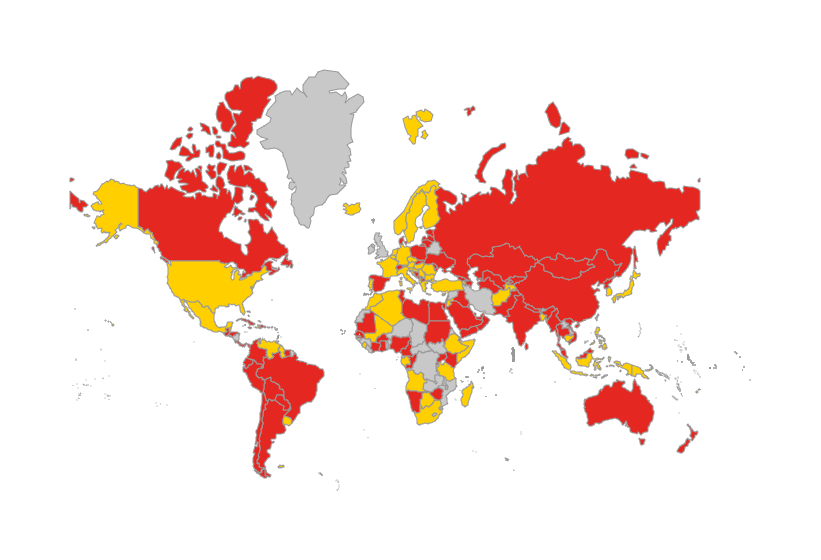
Countries that have closed borders due to COVID-19
Super-spreading events
Martin McKee, a professor of European public health at the London School of Hygiene and Tropical Medicine who was not linked to the letter, said the scientists' arguments sounded "entirely reasonable".
"Part of the problem is that everybody at WHO was moving with the paradigm of influenza, even though we know there are lots of differences between influenza and coronaviruses," he said.
McKee noted with the UK's recent reopening of its pubs, restaurants and salons, the possibility of airborne coronavirus transmission might mean stricter interventions are needed indoors, including more mask-wearing and continued physical distancing.
"We're getting accumulating evidence about super-spreading events happening in indoor spaces where there are large numbers of people in confined spaces," he said. "Many of these are in exactly the circumstances that governments now want to open up."
The extent to which the coronavirus can be spread by the so-called "airborne" or aerosol route - as opposed to by larger droplets in coughs and sneezes - remains disputed.
Any change in the WHO's assessment of the risk of transmission could affect its current advice on keeping one-metre (three-feet) physical distancing.
Governments, which also rely on the agency for guidance policy, may also have to adjust public health measures aimed at curbing the spread of the virus.
"Especially in the last couple of months, we have been stating several times that we consider airborne transmission as possible but certainly not supported by solid or even clear evidence," Benedetta Allegranzi, the WHO's technical lead for infection prevention and control, was quoted as saying by The New York Times, which first reported the letter's existence.
Latest Stories
-
David Selassie Anthony declares bid for NDC Deputy National Organiser
51 minutes -
Amin Adam proposes 13 measures to strengthen Ghana’s debt transparency and market confidence
1 hour -
Mahama announces $2bn annual investment to accelerate industrialisation
1 hour -
Amin Adam urges monthly disclosure of Sinking Fund as Ghana prepares for DDEP repayments
1 hour -
Stronger banks will fuel business growth and jobs – ADB MD
1 hour -
Galamsey: ‘Rivers that fed our grandparents now run the colour of chocolate milk’ – Sam Jonah
2 hours -
We have been scammed by NDC, government is only doing PR – Abanga Fuseini
2 hours -
Republic Bank–JoyNews Habitat Fair opens in Ho today
2 hours -
BoG pledges stability to attract investment, urges stronger Africa–Asia partnerships
2 hours -
Amin Adam warns treasury bill dependence could expose Ghana to refinancing risks
2 hours -
Ghana better placed to withstand commodity price shocks – IMF
2 hours -
GAPTE intensifies efforts to increase bus availability for Aayalolo contra-flow
2 hours -
Amin Adam warns cedi depreciation could reverse Ghana’s debt relief gains
2 hours -
Fiscal discipline crucial for pension fund investments – Finance Minister
2 hours -
BoG Governor rallies IMF to back Africa’s digital sovereignty
2 hours