


Audio By Carbonatix
Japan's famous bullet trains may have revolutionised high-speed rail travel, but there are still many travellers who prefer a scenic slow ride on one of the country's old-fashioned regional trains.
In the wintertime, few Japanese rail journeys are as magical as the historic "stove train," operated by the Tsugaru Railway Line.
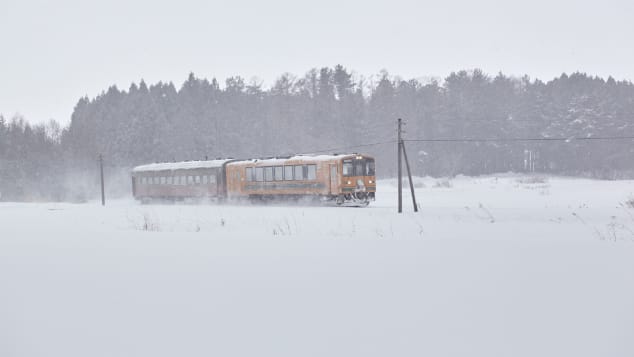
From December until the end of March, it runs along a snow-covered stretch of farmland in Aomori Prefecture's remote Tsugaru Peninsula.
Winters in Aomori, on the northern tip of Honshu island, are bitter cold. Last year, more than six and a half meters (21 feet) of snow fell here.
But you won't feel the chill onboard Tsugaru's train. Conductors warm the 1950s-era passenger car by burning embers in potbelly stoves at either end of the train.
Maintaining Japan's rail traditions
The first of three daily trains depart from the one-room Tsugaru Goshogawara station at 9:30 a.m.
For the next 45 minutes, the train meanders northbound through a winter wonderland of small villages and frozen farmland.
The ride is loud, rickety and there's definitely no WiFi.
And with top speeds of just 50 kilometres per hour (around 31 miles per hour), it's also much slower than Japan's ultra-fast Shinkansen. In comparison, the newest Japanese bullet train can reach a whopping 603 kilometres per hour (374 miles per hour).
But that's part of the charm.
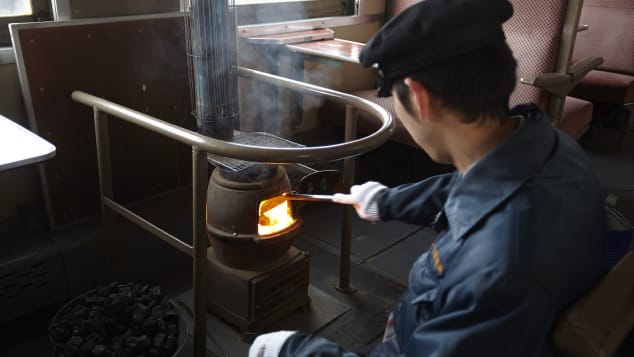
The stove train is a trip through time, offering passengers a sense of nostalgia that's increasingly hard to find in a country known for its technological advances and modern cities.
"For me, this train is all about maintaining tradition," says Shinya Saito, one of the stove train's engineers.
Onboard, customers can sample Aomori food and culture.
After collecting the 1,250 Yen (roughly $11) fare for the ride, conductors grill squid on top of the warm iron stoves.
Attendants also pass through the single car pushing an old metal cart to sell plastic bags of dried squid and locally produced sake.
Attracting new riders
Yutaka Takahashi, a self-described densha otaku, or train geek, travelled nearly five hours by high-speed rail to Aomori just to experience the short ride aboard the stove train.
"This is really unique," he says. "You can enjoy riding with strangers. And it's fun."
The Tsugaru Railway Line opened in 1930 to connect Aomori's less-populated northern communities with the larger cities to the south.
But the number of passengers has declined steadily in the past few decades, due to increased motorization and the construction of new highways in Aomori Prefecture.
That's one reason the seasonal stove train is still in service -- to attract new riders. And it may be working.
The number of tourists taking the train each year is on the rise, according to officials at Tsugaru Railway Line.
At the end of the line, visitors can disembark at the Tsugaru Nakazato station.
Most get off on the sleepy platform, take a few pictures, and get right back on board for another ride as the stove train begins its return journey.
Latest Stories
-
Let The Constitution direct Chieftaincy to deliver “All Development Is Local”
13 minutes -
Ghana explores centre of excellence for hearing, communication and cochlear implant care
2 hours -
Schizophrenia-related disorders lead mental health cases recorded in Ghana
2 hours -
Dutch authorities enlist Ghana in hunt for fugitive drug lord Bolle Jos
2 hours -
Ghana housing finance conference adopts communiqué to improve affordable housing access
7 hours -
Special Initiatives Minister urges Wa Technical Institute to enrol more girls as EU-backed solar training lab opens
7 hours -
In the matter of my first year at the Bar
7 hours -
ActionAid Ghana calls for an end to child marriage, greater investment in girls’ rights
8 hours -
Newsfile to tackle World Cup visa scandal, beach demolitions, education strikes, BRICS bid
8 hours -
UK-Ghana Trade & Investment Summit: Trade Resource Centre to help businesses maximise UK-Ghana trade opportunities
8 hours -
Embassy of Denmark celebrates World Maritime Day
8 hours -
Linking LEAP to productive inclusion could cut extreme poverty by 2030 – UNICEF
9 hours -
Trade Ministry backs use of creative arts to rehabilitate prison inmates
9 hours -
Negotiations with government to continue despite strike suspension – GNAT
10 hours -
‘Ghana cannot afford to waste public resources; every cedi has a job’ – Ato Forson
10 hours