

Audio By Carbonatix
Tens of thousands of women took part in the 1994 genocide in Rwanda but their role is rarely spoken about, and reconciliation with their family is hard. Journalist Natalia Ojewska has been talking to some female perpetrators in prison.
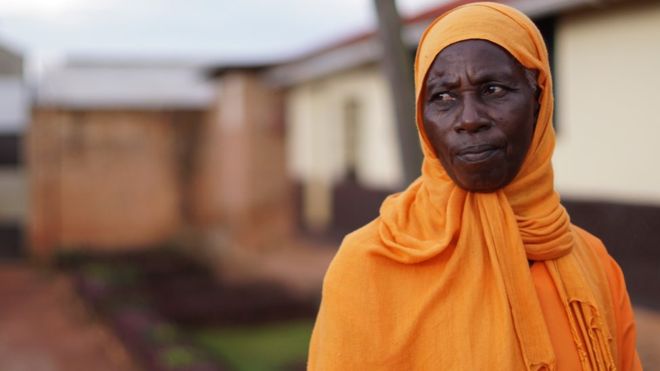
What started as a mundane trip to fetch water for breakfast ended with Fortunate Mukankuranga committing murder.
Dressed in an orange prison uniform and speaking in her dimmed, calm voice, she recalls the events of the morning of Sunday, 10 April 1994.
As she was on her way, she came across a group of attackers beating up two men in the middle of the street.
"When [the two] fell to the ground, I picked up a stick and said: 'Tutsis must die!'. Then I hit one of them and then the other one... I was one of the killers," the 70-year-old says.
Haunted by killings
These were two among 800,000 murders of ethnic Tutsis and moderate Hutus that took place over 100 days.
After her involvement in the slaughter, Mukankuranga, an ethnic Hutu, returned home to her seven children feeling deeply ashamed. Flashbacks from the crime scene would not stop haunting her.
"I am a mother. I killed some children's parents," she says.
Just a few days later, two terrified Tutsi children, whose parents had just been butchered with machetes, knocked on her door asking for refuge.
'Tide of guilt'
She did not hesitate and hid them in the attic, where they survived the massacres.
"Even though I have saved the children, I have failed these two men. This help will never turn the tide of guilt," says Mukankuranga.
She is one of an estimated 96,000 women convicted for their involvement in the genocide - some killed adults, like Mukankuranga, some killed children, and others egged on men to commit rape and murder.
On the evening of 6 April 1994, an aeroplane carrying Rwanda's Hutu President Juvenal Habyarimana was shot down as it was approaching the airport in the capital, Kigali.
Although the identities of the assassins have never been established, Hutu extremists immediately accused Tutsi rebels of carrying out the attack. Within hours, thousands of Hutus, indoctrinated by decades of hateful ethnic propaganda, joined in with the well-organised killing.
The women's participation challenges a stereotype in Rwanda of women as protectors and providers of a calming voice.
"It is very difficult to understand how a mother who loves her children, would go to her neighbours' [home] to kill their children," says Regine Abanyuze, who works for Never Again, a non-governmental organisation promoting peace and reconciliation.
Yet, once the spark for the atrocities was lit, thousands of women acted as agents of violence alongside the men.
Pauline Nyiramasuhuko, former minister for the family and women's development, was one of the few Rwandan women who took on a powerful leadership position in the male-dominated political scene. She played a critical role in orchestrating the genocide.
In 2011, the International Criminal Tribunal for Rwanda found her guilty of genocide. She remains the only woman ever to have been sentenced for rape as a crime against humanity.
Nyiramasuhuko bore command responsibility over militiamen who raped Tutsi women at the Butare Prefecture Office.
But while she sat at the apex, some ordinary Rwandan women were also inciting men. Others did not hesitate to use every available weapon to butcher their neighbours.
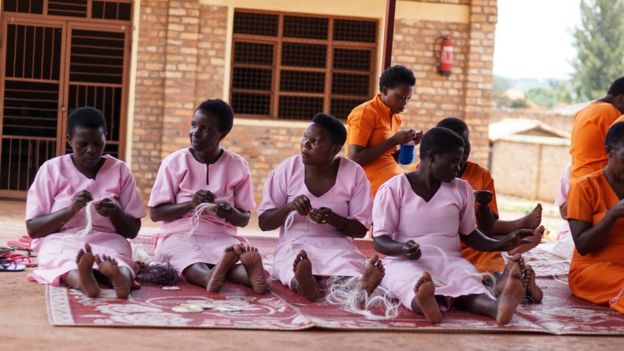
There are no separate rehabilitation programmes for female genocidaires and many struggle with reconciling what they have done with traditional perceptions of a woman's role.
Two views of a massacre
Martha Mukamushinzimana is a mother of five children, who secretly carried the burden of her crime for 15 years, before she decided to report herself to the judicial authorities in 2009 as she could no longer live with the burden of her crimes.
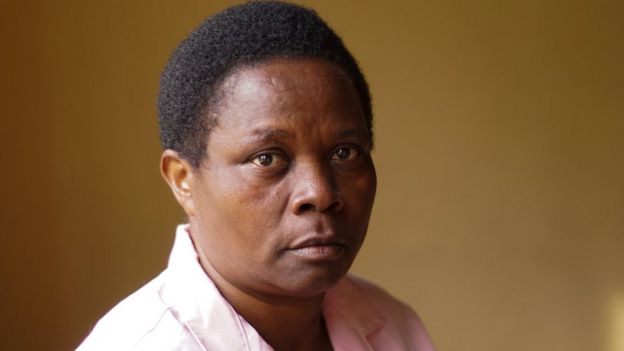
Defining themselves through the prism of motherhood, many are too overwhelmed with shame to admit to their loved ones that they failed in their role as caregivers.
"Time is the main rehabilitation tool we use. We want to give them as much time as necessary to listen to them and to slowly bring them to the point of confession," says Grace Ndawanyi, director of the prison for female inmates in Ngoma, in Rwanda's Eastern Province.
"Because my house was located near the main road, I heard all the whistles and saw my Tutsi neighbours being rounded up and taken to the church," says Mukamushinzimana, sitting in a small, bare prison room and sometimes crying.
Thousands of Tutsis, crammed in and around the Nyamasheke Parish Catholic Church, fought for their lives for a week. Stanislus Kayitera, now 53, was one of the few survivors. His forearm bears a large and irregular scar from grenade shrapnel.
"I remember women collecting stones and giving them to the men, who were throwing them at us. Men were also shooting, throwing grenades and pouring fuel over people and then setting them on fire.
"Then, they stormed the church and started to kill us with clubs," says Mr Kayitera, who survived by hiding under the dead bodies.
Mukamushinzimana says she felt compelled to follow the orders.
"I took my baby on the back and joined the group collecting stones used to kill people hiding at the church," says Mukamushinzimana, who had given birth just two weeks earlier.
When she was jailed in 2009, not one of her relatives was willing to take care of her five children.
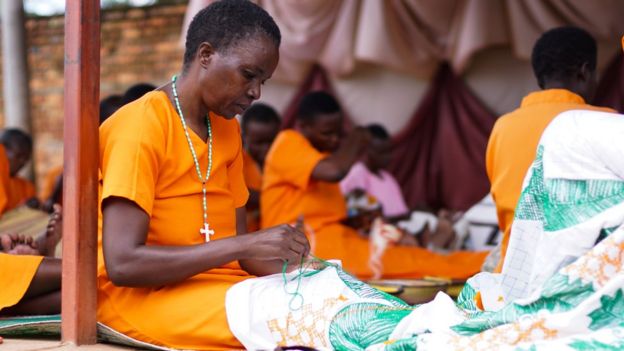
"Genocide is a crime against whole communities. It damages not only the dignity of the victims, but also that of the perpetrators. And those people need healing as well," says Fidele Ndayisaba, executive secretary at Rwanda's National Unity and Reconciliation Commission.
Female genocidaires who revealed the truth are encouraged to write letters to their families and relatives of their victims in order to regain the lost trust step by step.
Once released from prison, female genocidaires face very different challenges on their path to reintegration to the men.
Some of their husbands have remarried and disinherited them from their property. Their home communities do not welcome them and they struggle with rejection by their closest family.
But there is a lot of emphasis that healing takes time and there are still some prisoners reluctant to reject the ideology of ethnic hatred.
"Yes, we have some people denying their crimes. They are those hard ones, but their number is declining," says Mr Ndayisaba.
'I couldn't hold back the tears'
Fortunate Mukankuranga only found the courage to confess to her crimes four years after her conviction in 2007.
She remembers feeling nervous before asking the son of one of her victims for forgiveness.
Against her expectations "he was happy and enthusiastic when he met me and I couldn't hold back the tears as I embraced him," she says.
Mukankuranga now looks cautiously at the future, hoping she will be able to rebuild the fragile ties with her loved ones.
"When I go back home, I will live in peace with my family and I shall be more loving and caring about people. I am paying now for the consequences of my crime. I wasn't supposed to be in prison as a mother," she adds.
Latest Stories
-
Power restoration fault suspected in Kumasi Central Market fire
5 hours -
The 7-foot giant of Ngleshie Amanfro: Seven-foot Ghanaian Ephraim Saawa dreams of joining the national basketball team
6 hours -
Government promises support for Kumasi Central Market fire victims
6 hours -
Vibes The Movie: Big Ghun’s Ghanaian film earns five nominations at 2026 REFFA
6 hours -
‘I’m a fulfilled man’—Justice Korbieh on missing out on Supreme Court despite two nominations
7 hours -
MamaCare CEO warns unresolved conflicts among health workers could undermine maternal and neonatal care
7 hours -
Health professionals urged to translate medical knowledge into practice to save mothers
7 hours -
Retired judge Justice Francis Korbieh charges 1,568 new lawyers to uphold integrity
8 hours -
Conflicts among care providers linked to maternal, neonatal deaths – Expert
8 hours -
GIS marks 10th TIME conference, champions improved teaching practices
9 hours -
BRICS Or Balance? What Ghana’s bid really means
9 hours -
GPRTU wants full TRAFFITECH-GH implementation to start in 2027
9 hours -
How 10-mile walks for basic education birthed a 50-year legal career for Justice Korbieh
9 hours -
Mahama announces plans to import electric wheelchairs for PWDs
9 hours -
KGL U17 Colts 2026: Western beat Prempeh Elite Academy to set up final final with Greater Accra Region
10 hours