

Audio By Carbonatix
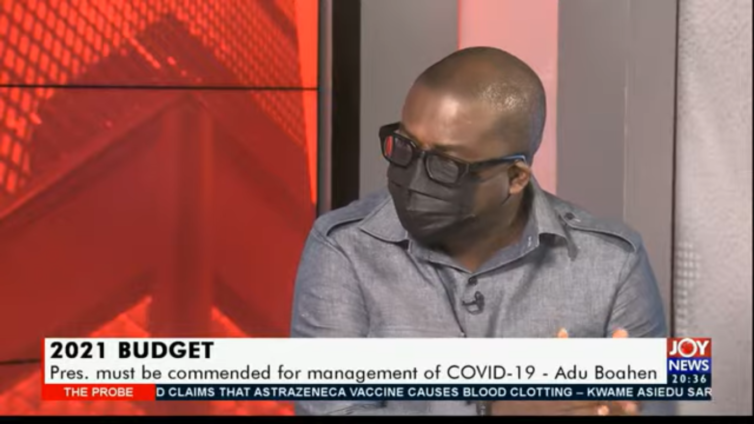
The President’s Representative at the Finance Ministry Charles Adu Boahen has justified government’s decision to introduce new levies.
Speaking to JoyNews’ Emefa Apawu, he intimated that the only solution to recovering the economy is to introduce new levies and not borrow money.
According to him the levies proposed by government if approved will help restore the country’s economy following the dire effect Covid-19 pandemic on the country.
“Somehow we have to find a way to share the burden. We can’t borrow anymore we have borrowed to the hilt so what we have to do is we have to look at the revenue side of the equation and that is why we are looking at the compliance of introducing new levies.”
The caretaker Finance Minister Osei Kyei-Mensah-Bonsu during the 2021 budget statement, Friday hinted at government's decision to introduce new taxes as steps to revamp the economy amidst the pandemic.
The new taxation includes a 1% Covid-19 levy, sanitation levy and increment in prices of petroleum products.
However, the announcement of the new levies by Mr Kyei-Mensah-Bonsu has since been rejected by several Ghanaians insisting that the new taxes will impact negatively on their finances and increase hardship in the country.
Reacting to the outcry of citizens on the increment of petroleum prices, Charles Adu Boahen indicated that, the pandemic had a great toll on the energy sector, hence the need to introduce a petroleum levy.
In his justification of the new taxes, he insisted that the increment of the petroleum levies by 5.7%, will still be less than what Ghanaians had been paying in the past years.
“The fuel levies we have proposed will increase the pump by only 5.7%, less than 6% and so when you look at it in that sphere you realize that in fact fuel prices are going down by almost 7 or 8 per cent last year due to Covid because oil prices went down.
“The prices of fuel at the pump today is less than what it was in 2019, so we have been paying more for fuel in the past,” he stated.
He further stated that the high earning class are likely to be affected more than a low-income citizen with a 5.7% petroleum levy.
“In a nutshell, it’s only a 5.7% increase in the pump I think the biggest people who will bear the branch of that tax are the people with big 4x4 Landcrusiers whose engine takes a lot of fuel and they will be the one paying a bunch of it.”
Latest Stories
-
NPP UK branch calls for independent audit into gold purchasing operations and parliamentary probe
17 minutes -
Zanetor Agyeman-Rawlings pledges decisive action on climate change, galamsey and environmental degradation
21 minutes -
Bawumia was brainchild behind Domestic Gold Purchase Programme – Samuel Jinapor
23 minutes -
Fuel prices set to go up from September 1, Petrol to sell at GHC 16.69 and Diesel, GHC 17.90 – COMAC
25 minutes -
Our World Our People withdrawn due to curriculum duplication, not politics – Adutwum’s spokesperson
27 minutes -
GANRAP is essentially a rebranding of Domestic Gold Purchase Programme – Abu Jinapor
34 minutes -
I am tired of being in opposition, my goal is to win in 2028 – Boakye Agyarko
45 minutes -
Ghana’s road maintenance funding gap deepens as only 37% of needs met – World Bank
45 minutes -
Roland Europe Group appoints Opoku Sanaa as Head of Sales, Middle East & Africa
47 minutes -
Sammyflex TV’s Roland Amartey girds up for 2026 Ghana Music Awards UK coverage
59 minutes -
U.S. bank queried payments for Ghana ambassador’s residence renovated by company owned by embassy’s IT officer
1 hour -
GoldBod to generate US$1.4bn in FX in September
2 hours -
GAF 2026/2027 enlistment opens September 3 for degree holders
2 hours -
Reparatory justice: Mahama announces high-level UN side event in September
2 hours -
Bosome Freho Assembly invests first tranche Common Fund in water and education projects for 19 rural communities
2 hours