

Audio By Carbonatix
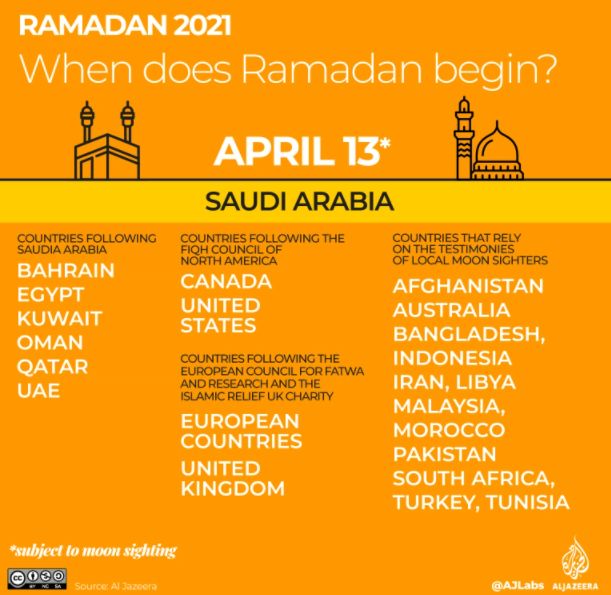
The first day of fasting for the holy month of Ramadan, which is determined by the sighting of the new moon, is likely to be Tuesday, April 13.
To declare the beginning of Ramadan, Saudi Arabia and other Muslim-majority countries depend on the testimonies of local moon sighters.
Bahrain, Egypt, Kuwait, Oman, Qatar and the United Arab Emirates are all expected to follow Saudi Arabia’s sighting of the new moon.
Other countries have independent sightings, but Indonesia, Lebanon, Morocco and Syria are also likely to begin fasting starting Tuesday while countries further east and west will commence as the moon is sighted.
When can we see the new moon?
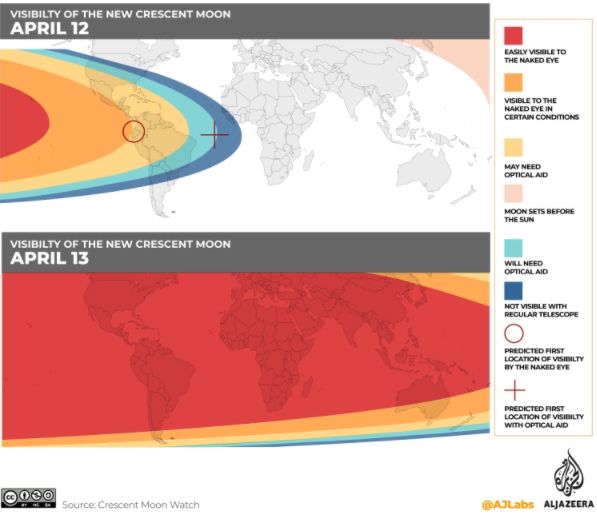
The Qatar Calendar House (QCH) has announced that Ramadan’s new moon will be born on April 12 at 02:31 GMT, according to astronomers. On that day, the moon might be visible in parts of North, Central and South America. On April 13, the moon will be easily visible in most parts of the world.
The actual visibility of the crescent will depend on factors such as atmospheric conditions, cloudiness and the distance between the sun and the moon on the horizon.
The moon phases of Ramadan
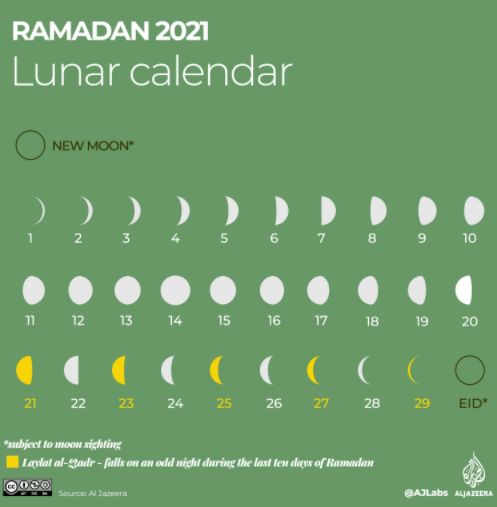
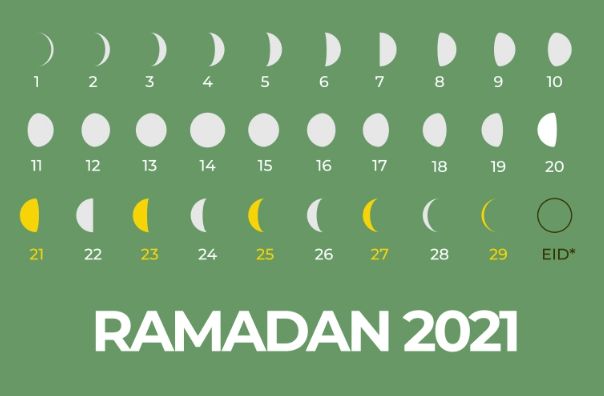
Lunar months last between 29 and 30 days, depending on the sighting of the new moon on the 29th night of each month. If the new moon is not visible, the month lasts 30 days.
Why is Ramadan holy?
For Muslims, Ramadan is the month in which the first verses of the Quran, Islam’s holy book, were revealed to Prophet Muhammad more than 1,400 years ago.
Throughout the month, observing Muslims fast from just before the sunrise, or Fajr, prayer to the sunset prayer, Maghrib.
The fast entails abstinence from eating, drinking, smoking and sexual relations to achieve greater “taqwa”, or consciousness of God.
Fasting is one of the five pillars of Islam, along with the Muslim declaration of faith, daily prayers, charity, and performing the Hajj pilgrimage to Mecca if physically and financially capable.
In many Muslim-majority countries, working hours are reduced, and many restaurants are closed during fasting hours.
“Ramadan Mubarak” and “Ramadan Kareem” are common greetings exchanged in this period, wishing the recipient a blessed and generous month respectively.
Last year, fasting hours across the world ranged from 10 to 20 hours a day.
At the end of Ramadan, Muslims celebrate Eid al-Fitr. In Arabic, it means “festival of breaking the fast”.
Depending on the actual start date of Ramadan and the new moon sighting on the 29th night of Ramadan, Eid al-Fitr this year is likely to fall on May 12.
Latest Stories
-
Mzbel faces backlash over comments about 19-year-old man
4 minutes -
Youth Employment Agency setting up EV ‘bike’ delivery brigade
4 minutes -
Russian stadium says it won’t host Kanye West gigs
12 minutes -
EOCO, Engage Now Africa rescue 20 Burkinabè nationals from suspected trafficking network
16 minutes -
Women could take over the world in 10 to 15 years – Ahuofe Patri
18 minutes -
Vigilante mobilisation has moved online through social media, encrypted chats – National Security
22 minutes -
Trump envoy calls for Sudan-wide arms embargo as drone attacks escalate
25 minutes -
Self-reliance driving Rwanda’s governance and service delivery — Paul Kagame
29 minutes -
NSMQ 2026: One-Eighth stage beckons as 81 schools chase national glory
33 minutes -
UCC launches Africa Ocean Institute to tackle growing coastal challenges
33 minutes -
George Dela Coffie elected Ghana YMCA National President
38 minutes -
Prudential Bank’s CIO calls for AI literacy and human‑centred skills at Ghana AI Summit
40 minutes -
Ghanaian politicians, wake up: The old communication playbook is obsolete
41 minutes -
Invincible Lives: 13-year-old Emma dreams of school but poverty forces him to beg for survival
44 minutes -
I’m not on NDC gov’t payroll; my work is sacrifice for nation-building – KSM
59 minutes