

Audio By Carbonatix
When a simple test rewrites a lifetime of love, the question is no longer science; it is survival of the heart.
Imagine raising a child with unwavering love, sacrifice, and pride only to discover, in a single moment, that the bond you believed was biological is not. No warning. No preparation. Just a result on a screen that changes everything.
This is not fiction. It is a growing reality confronting man across the world.
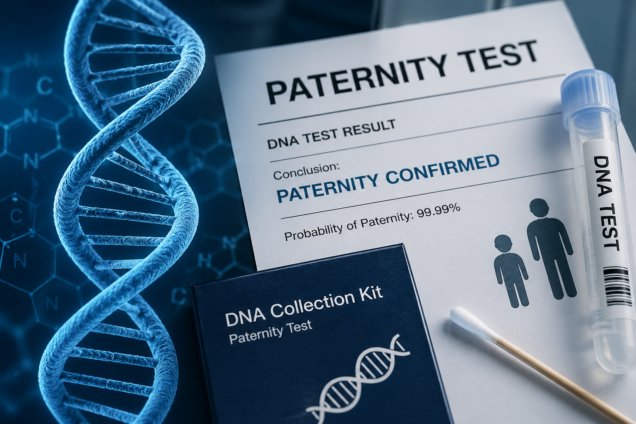
The rise of Deoxyribonucleic Acid (DNA) testing has ushered in a new era of truth, one that is precise, scientific, and often unforgiving. What was once hidden by time, trust, or assumption is now being exposed with clinical certainty. And for many men, that truth is devastating.
In Ghana and beyond, stories have surfaced of respected public figures who believed they were fathers only to learn otherwise. Cases involving personalities such as Odartey Lamptey and Kwadwo Nkansah have sparked national conversations about paternity, trust, and the emotional cost of deception. Gospel musician Kweku Gyasi also reportedly faced a similar moment of reckoning, one that only DNA testing could resolve.
These are not just celebrity headlines. They reflect a deeper, quieter crisis affecting ordinary men, many of whom suffer in silence.
Take the case of Marcus Vale.
For years, he believed he was the father of his son, Zayden Cross. But lingering doubts about differences in physical traits, the absence of family markers led him to seek answers. What began as a seemingly harmless at-home genetic test turned into a life-altering revelation: he was not the biological father.
“I lived my whole life believing I knew,” he said, grappling with disbelief. “And just like that, everything changed.”
The emotional toll of such discoveries cannot be overstated. For many men, fatherhood is not just biological; it is deeply psychological and spiritual. It is built on years of care, responsibility, and identity. When that foundation is shaken, the consequences ripple through marriages, families, and entire communities.
What follows is often confusion, anger, heartbreak and difficult choices.
Do you walk away from the child you raised? Do you confront your partner? Do you remain silent to preserve what is left of your family? There are no easy answers. Only deeply personal decisions, each carrying its own burden.
Beyond individual pain, the issue raises broader social and ethical questions.
Is paternity fraud knowingly misrepresenting a child’s biological father, a form of injustice that society has failed to address? Should there be legal protections for men who unknowingly assume lifelong responsibilities under false pretences? Or does the emotional bond between father and child outweigh biological truth?
These are uncomfortable questions, but necessary ones.
The conversation becomes even more complex when DNA testing extends beyond the home into state systems. In Canada, for instance, the Canada Border Services Agency has, in certain cases, used DNA testing to help establish the identity and nationality of migrants when other methods fail. By analysing genetic links and ancestry data, authorities attempt to determine origins, sometimes influencing decisions on detention or deportation.
While officials maintain that consent is obtained, the practice has sparked concerns about privacy, ethics, and the potential misuse of genetic data. It highlights a broader reality that DNA is no longer just a personal matter; it is becoming a tool of governance.
And yet, at its core, the issue remains deeply human.
In communities across the diaspora, particularly among migrants, stories of disputed paternity are becoming more visible. Some men, after years of sacrifice, discover through DNA testing that they are not the biological fathers of the children they have raised. Others live with suspicion, uncertain whether to seek the truth or preserve peace.
This silence is part of the problem.
Cultural expectations, fear of stigma, and the desire to protect family unity often discourage open discussion. But ignoring the issue does not make it disappear. If anything, it allows it to grow unchecked and unresolved.
Some have even suggested making DNA testing compulsory at birth, a proposal that, while controversial, reflects the depth of concern surrounding the issue. Supporters argue it would prevent deception and protect all parties involved. Critics warn it could undermine trust, invade privacy, and reduce family relationships to mere biology.
So where do we draw the line?
Science has given us the power to know the truth. But it has not told us how to live with it.
Because fatherhood is more than DNA. It is present. It is a sacrifice. It is love. Yet biology, for many, still matters, especially when truth is replaced with deception.
This is not a call to break families.
It is a call to build them on honesty.
Trust is the foundation of every relationship. Once broken, it is difficult to restore. And when that breach involves something as fundamental as paternity, the consequences can last a lifetime.
Men are suffering quietly, deeply, and often alone.
It is time to bring this issue into the open. To have honest conversations. To seek truth, not to destroy, but to heal. To ensure that future families are built not on assumptions, but on certainty and trust.
Because in the end, the question is not just “Who is the father?”
It is, “what happens when the truth finally answers?”
To be continued…
Latest Stories
-
Manasseh Writes: The shift in the NPP
16 minutes -
The price of a seat: Financial barriers and the structural quality of Ghana’s Parliament
21 minutes -
Government targets October 16 for first tranche of teacher arrears – Haruna Iddrisu
25 minutes -
Daily Insight for CEOs: The CEO’s role in driving innovation
29 minutes -
Audit existing sanitary sites to address waste management land shortages – WasteCare CEO urges assemblies
31 minutes -
Two-bin household waste system could support waste-to-energy in Ghana – Waste Care Associates CEO
37 minutes -
Dealing with political and social media insults
40 minutes -
Essi Donkor urges stronger support for girls’ education, announces GH¢2,000 BECE reward
40 minutes -
Ghana still needs landfills but Accra should prioritise waste-to-energy – Waste Care Associates CEO
48 minutes -
Godwin Mahama declares bid for NDC Greater Accra Regional Secretary
51 minutes -
Bawumia unveils NPP plan to scout parliamentary candidates capable of winning parliamentary seats
55 minutes -
NPP Chairmanship race: How APL’s survey made a near-perfect prediction
56 minutes -
Remember Adomako-Boateng: Aduana right-back regains consciousness after collapsing during a league match
56 minutes -
Today’s front pages: Monday, October 5, 2026
56 minutes -
Families still selling homes, exhausting savings to pay for specialised care – GMTF Administrator
1 hour