

Audio By Carbonatix
The latest Ebola figures from the Democratic Republic of Congo appear to offer some hope after the number of cases was dramatically scaled back.
At one point the authorities were talking of more than 1,000 suspected cases and nearly 250 suspected deaths.
They are now reporting around 380 confirmed cases in DR Congo, including 60 deaths, plus another 15 confirmed cases and one death in neighbouring Uganda.
However, the key difference is that the authorities are now talking about confirmed, rather than suspected, cases as before.
So it would be a mistake to assume that the fall in numbers means the outbreak is suddenly less dangerous.
The decline reflects better data, as laboratories were able to rule out many patients who had fever but were suffering from other conditions such as malaria which is common in DR Congo.
The director general of the World Health Organization (WHO) Dr Tedros Adhanom Ghebreyesus has said the outbreak had a "big head start" but response teams are now "catching up".
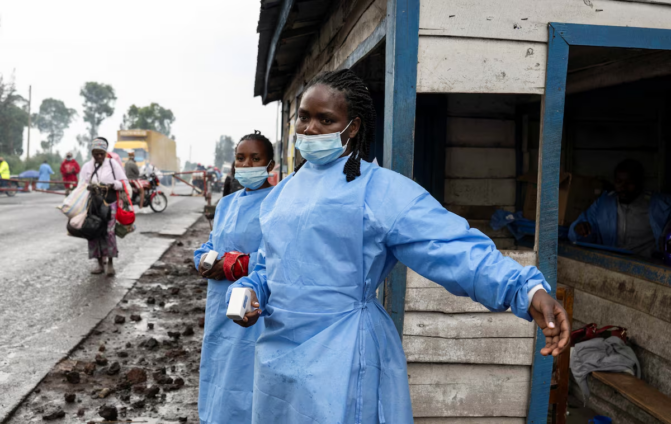
However, one of the biggest concerns remains contact tracing. Only about 45% of people in direct contact with an Ebola patient are currently being followed up, partly because the epicentre of the latest outbreak is in an area hit by conflict.
The WHO says at least 90% of contacts must be traced to bring an outbreak under control.
Another challenge is mistrust among some communities. An Ebola burial team was reportedly attacked this week in South Kivu province, forcing responders to abandon a coffin and raising fears of further transmission.
Traditional burial practices often involve washing and touching the body, and funerals typically draw large crowds - all high risk for Ebola, which is spread from one person to another by contact with infected bodily fluids.
Tedros said building trust with communities was critical to bringing the outbreak under control.
The Ebola outbreak is concentrated in three provinces of eastern DR Congo, an area roughly the size of the United Kingdom, much of it rural, remote and difficult to reach.
It is also unfolding in one of the most volatile regions in Africa, with many armed groups operating.
The latest outbreak is caused by the Bundibugyo species of Ebola, which has only occurred twice before. Because it is much rarer than other types of Ebola, there is no vaccine or proven treatment, although various teams are trying to develop them.
Speaking on the BBC's Today programme, Tedros said that earlier this year he had urged foreign ministers planning to increase defence spending not to forget about the "invisible enemy".
He said the Covid pandemic had resulted in around 20 million deaths - far more than any recent conflict.
However, he stressed that he did not expect Ebola to spread worldwide because the virus is not airborne, unlike coronavirus.
The WHO assesses the risk from Ebola as very high within DR Congo - this is the 17th outbreak in the country where it was first discovered 50 years ago - high in the region, but low globally.
On Friday, US Centers for Disease Control and Prevention said its model scenarios showed that without strong public health intervention the current outbreak could become as large - or even larger - than the outbreak in West Africa in 2014-16.
Separately, the US said it would provide an additional $38m (£28m) for Ebola "response efforts", bringing the total direct funding to more than $200m.
Earlier this week British government officials said they had ruled out introducing temperature checks at UK airports for flights arriving from affected regions because of their limited effectiveness.
More than 12,000 passengers were screened at five UK airports during the 2014 outbreak in West Africa, but these failed to pick up the only case, that of nurse Pauline Cafferkey.
Latest Stories
-
Nana B passport claims a diversionary tactic — Abu Jinapor
10 minutes -
Pope Leo diagnosed with cancer as doctors remove lobe of lung, Vatican says
11 minutes -
Legal Aid Commission takes free legal services to Techiman main lorry terminal
15 minutes -
Nana B denies seeking passport favour, accuses Ablakwa of failing to account for GH¢16.4m
20 minutes -
Young girls demand climate action, stronger protection against child marriage
32 minutes -
Ex-gang boss sentenced to 40 years for orchestrating Tupac Shakur’s murder
32 minutes -
From near-deferral to three awards: UMaT graduate’s academic journey
34 minutes -
Atta Akyea denies seeking presidential pardon for Wontumi in galamsey case
1 hour -
Photos: Mahama commissions 85-bed Police Hospital ward, donates two ambulances
1 hour -
GTEC directs Ghana’s public universities to reopen by October 16 and begin lectures on October 19
1 hour -
Star Oil donates GH¢1million towards construction of new CID facility
1 hour -
Court hands Adjetey Sowah, two others lifetime bans after Amputee Football legal dispute
2 hours -
NDC appoints Julius Kwame Anthony as a Deputy Communications Director
2 hours -
Ghana repatriates 120 Nigerians rescued from suspected cybercrime centres
2 hours -
NPP rejects Emelia Agbenyo’s appointment as Deputy EC Chair, demands withdrawal
2 hours