

Audio By Carbonatix
A public health expert at the Kwame Nkrumah University of Science and Technology, Prof Ellis Owusu-Dabo is calling on the government to adopt a mobile phone-based IVR system to complement and strengthen existing health information system for early detection of childhood illnesses.
He believes the system has the potential to improve child survival in line with Sustainable Development Goal 3.
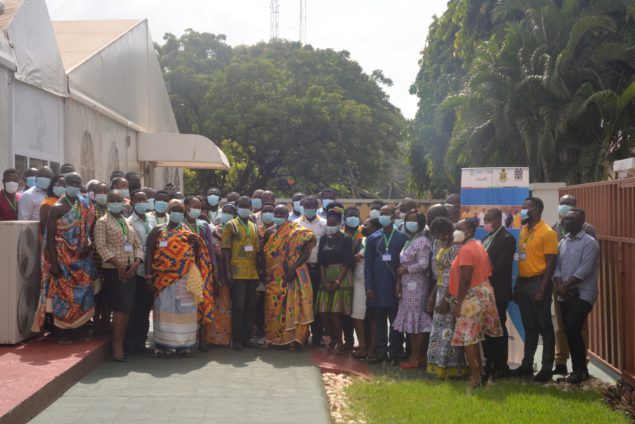
Prof. Owusu-Dabo said this during a stakeholder meeting in Kumasi.
The current under-five mortality rate in Ghana stands at 60 per 1000 live births.
These deaths are largely due to preventable diseases including malaria, upper respiratory infections, diarrhoeal-related diseases, prematurity, and asphyxia.
One of the principal factors for these deaths results from delays in health-seeking behaviour among caregivers. These caregivers lack the capacity to identify and pick up early symptoms of disease in their children for early intervention.
Meanwhile, a well-functioning health system with a robust Health Information System (HIS) could easily respond and deliver real-time data to manage most of these preventable childhood illnesses, amid increased mobile phone use in Ghana.
The MobChild intervention study sought to address these gaps in health-seeking behaviour by utilizing the multi-purpose function of a Mobile Phone-based Health Information system (MHIS).
This was designed with an Interactive Voice Response (IVR) technology to empower caregivers to identify health problems of their children for early intervention.
This programme was rolled out from January 2019 – December, 2021 with a team of experts from Kwame Nkrumah University of Science and Technology, Ghana Health Service and some other stakeholders from the Asante Akim North District of Ashanti Region.
The results show that a total of 2,045 calls were recorded by the system. Of the registered calls, there was an overall uptake of 66% (580/880).
Again, out of the total calls made to the system, over 1400 were unregistered-without prior registration by the system but managed to make calls for help.
All caregivers accessed the system for health advice regarding what to do with their sick children.
For diarrhoeal diseases, a 6-monthly survey revealed a decrease in the incidence from 14.9% at baseline, to 17.4% at first follow-up, 6.6% second follow-up and 4.5% at end line respectively.
While for fever, the results were correspondingly as follows; 17.2%, 16.8%, 13.7% and 29%, respectively.
Additionally, for our other principal symptom of disease-cough, the corresponding figures were 17.4%, 17.0%, 8.6% and 6.7% respectively.
The stakeholder meeting is meant to share the findings of the project.
The meeting also discussed the future of MobChild project and its implementation in the healthcare system in Ghana.
Latest Stories
-
Photos: Jama, chants and school pride as NSMQ 2026 grand finale heats up
2 minutes -
Supreme Court oath is ‘consequential, not ceremonial’ – Mahama
5 minutes -
ATLF2026: Tourism industry players honoured at event in Limpopo, South Africa
6 minutes -
Obuasi SecTech closure leaves newly placed students in limbo as Adansi group demands reopening
6 minutes -
Livestream: NSMQ 2026 Grand Finale, PRESEC, AUGUSCO and Accra Academy battle for national glory
12 minutes -
Best Assurance donates GH¢100,000 to GETFund to support education
15 minutes -
Uphold Constitution, administer justice without fear or favour – Mahama to new Justices
23 minutes -
Mahama urges Supreme Court justices to protect public trust in judiciary
24 minutes -
Dumelo wishes NSMQ finalists well ahead of contest
30 minutes -
Let your reasoning and fairness define your legacy – Mahama to new justices
32 minutes -
Mahama charges new Supreme Court justices to protect judicial independence
42 minutes -
Mahama swears in three new Supreme Court justices
47 minutes -
TUC calls for urgent review of Labour Act to strengthen workers’ rights
1 hour -
AMA proposes city-to-city partnerships with Russian cities
1 hour -
Ghana pushes China for deeper mining partnerships, value addition
1 hour