

Audio By Carbonatix
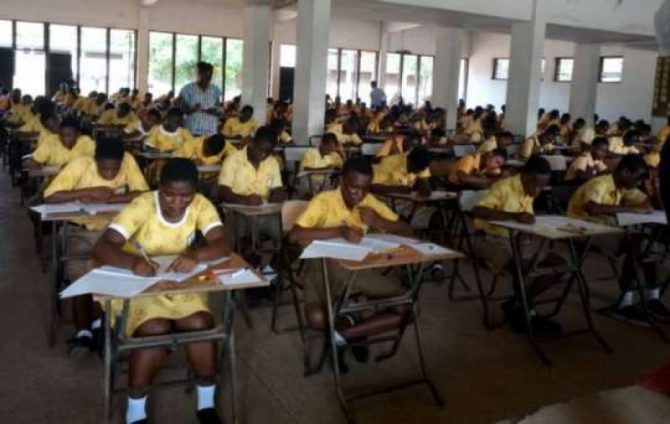
A total of 470,768 primary pupils are expected to participate in the 2021 National Standardised Test today.
The national test will enable the Ministry of Education generate data on the performance of pupils in English Language and Mathematics.
According to the Education Ministry, the NST will help to build a strong educational system in the country by enhancing the learning outcomes of pupils while reducing the issue of learning poverty.
The test is not meant to grade pupils in primary four but to improve teaching and learning in the basic schools across the country.
Currently, the national test will be conducted in only public schools; however, there could be a consideration for enrolling private schools in subsequent ones.
Spokesperson for the Ministry, Kwasi Kwarteng, said in an interview on Prime Morning that the conduct of the test will aid in highlighting learning gaps to shape future educational policies.
“It’s nothing new, apparently because if you look at it we have a similar test already in our system. The BECE, for instance, gives us a test of a national significance and so at the end of the day, it’s an assessment regime where you have to test students and then know the policy response in terms of resource allocation interventions that you are giving to such students.”
“If you look at the test regime, based on the Education Strategic Plan and the assessment framework we’ve drawn at the Ministry, you realize that the test is supposed to be conducted among students in Class 2, Class 4 and Class 6; it is the commencement that starts with Class Four. So when students write in Class Two, by the time they get to Class Three, you’d be able to generate the data and know the learning gaps and then profess whatever interventions that you are able to come up with,” he added.
The NST falls within the ‘Education Strategic Plan’ which started in 2018 and is expected to end in 2030.
The first edition of the national assessment will be administered by the West African Examinations Council (WAEC) and the Ghana Education Service (GES).
It will address the challenge of many school-going children who have limited knowledge in numeracy and literacy, thereby helping to meet the United Nations Sustainable Development Goal 14, the Ministry had added.
There would be 2,850 examination centres with 200 pupils per centre. 15,391 schools will be participating.
Latest Stories
-
GSE showed strong performance in August 2026 despite recording more stock losses
41 minutes -
If CJ needs ethics law to know SOE comments were wrong, he may not be worthy of office – Arthur Kennedy
2 hours -
Stop touring state agencies and focus on the Judiciary’s problems – Arthur Kennedy to CJ
2 hours -
Apologise and don’t do it again – Arthur Kennedy to Chief Justice over SOE comments
2 hours -
Chief Justice remains committed to judicial independence, justice and equality – Judicial Service
2 hours -
Ghana concludes evacuation of citizens from South Africa; total returnees reach 1,900 – Ablakwa
3 hours -
Africa must define its own green transition path – Prof Fatima Denton
3 hours -
WASSCE 2026: English Language performance falls to 62.4% – WAEC
3 hours -
WASSCE 2026: Social Studies records sharp rebound as Maths, Science also improve
4 hours -
2026 WASSCE entry rises by 11% as 512,862 candidates sit exams
4 hours -
WASSCE 2026: English Language performance falls to 62.4% – WAEC
4 hours -
WAEC cancels 2026 WASSCE results of 8,295 candidates over examination irregularities
4 hours -
WAEC releases provisional 2026 WASSCE results for 512,862 candidates
5 hours -
CJ’s remarks on SOEs were made in good faith, not to undermine judicial independence – Judicial Service
8 hours -
Bright Future Alliance pays courtesy call on Akufo-Addo, invites him to African Leaders of Influence Lectureship Series
8 hours