

Audio By Carbonatix
The Nigerian government has hailed an increase in local rice production as a key achievement, and says the country is actually exporting the grain.
But the opposition has challenged this claim, saying production figures have been inflated.
Has production been exaggerated?
The opposition Peoples Democratic Party (PDP) says it believes the ruling All Progressives Congress party is exaggerating the growth in local rice production.
"If indeed there has been an increase in local rice production, that should be reflected in the marketplace [prices]," PDP spokesman Debo Ologunagba told the BBC.
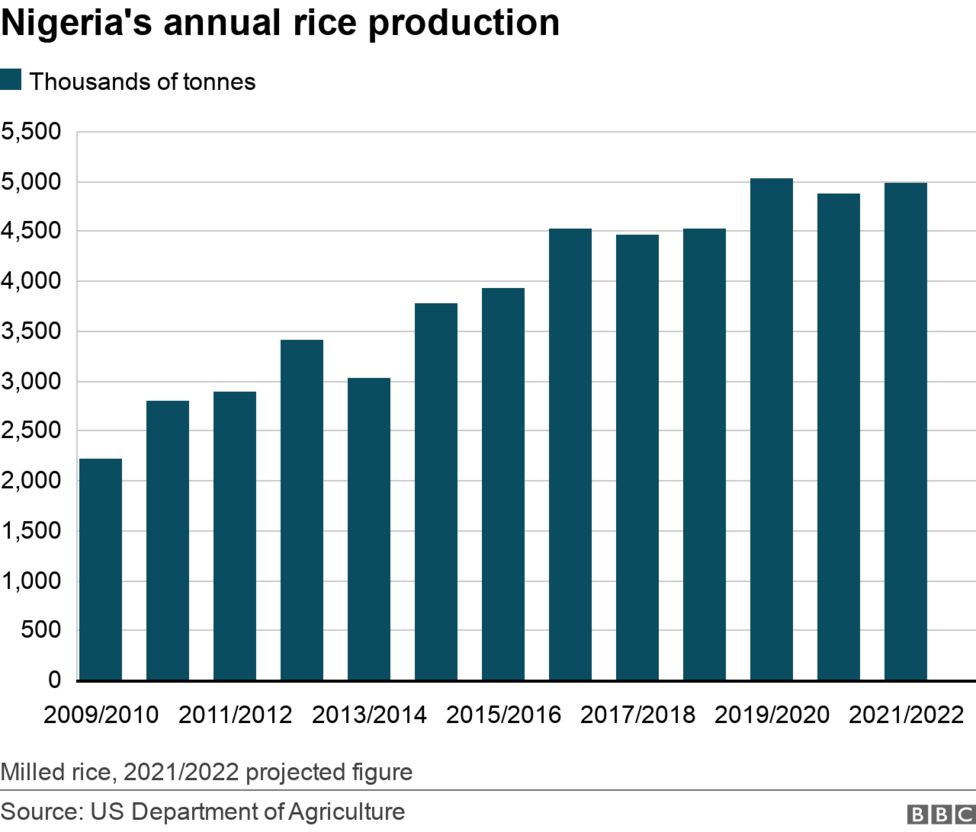
The most recent reliable figures for production come from the US Department of Agriculture, which has projected that Nigeria's rice production will reach five million tonnes in 2022, slightly above the previous year.
The US data show a significant increase in production between 2015 and 2017, which then slowed before another jump in 2020 when production reached a high point of 5.04 million tonnes.
The Nigerian government has data on rice production also showing a big rise between 2015 and 2016. But it does not have any figures for the last few years.
What is behind rising production?
The area under rice cultivation has expanded.
It grew from about 3.1 million hectares (7.7 million acres) in 2015 to 5.9 million hectares in 2018, and then dropped to 5.3 million hectares in 2020 - the latest year for which we have UN Food and Agriculture Organization (FAO) data.
The government has been providing improved seedlings and fertiliser to smallholder farmers, and invested in irrigation schemes.
In 2014, a scheme to help farmers hire machinery was introduced to improve mechanisation, and in some states, regional governments have granted land concessions as an incentive to large commercial farmers.
In November 2015, the Central Bank of Nigeria launched a programme, under which farmers receive loans at favourable rates. Farmers can opt to pay them back with part of their produce.
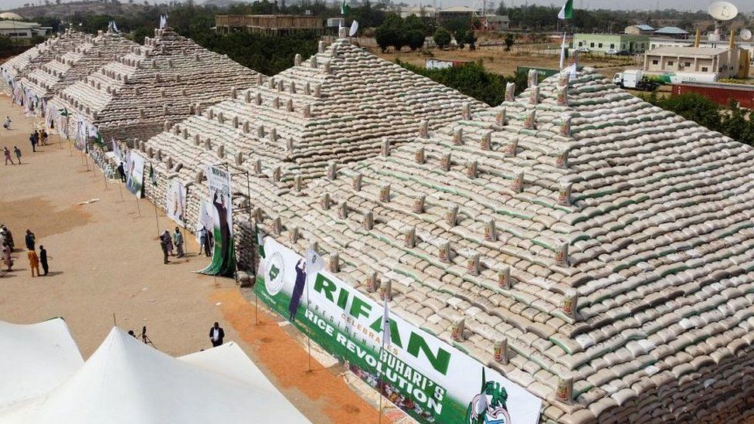
The recent display of rice pyramids in Abuja to showcase the success of rice production evoked earlier times when Nigeria's groundnut (peanut) production was a key part of the economy.
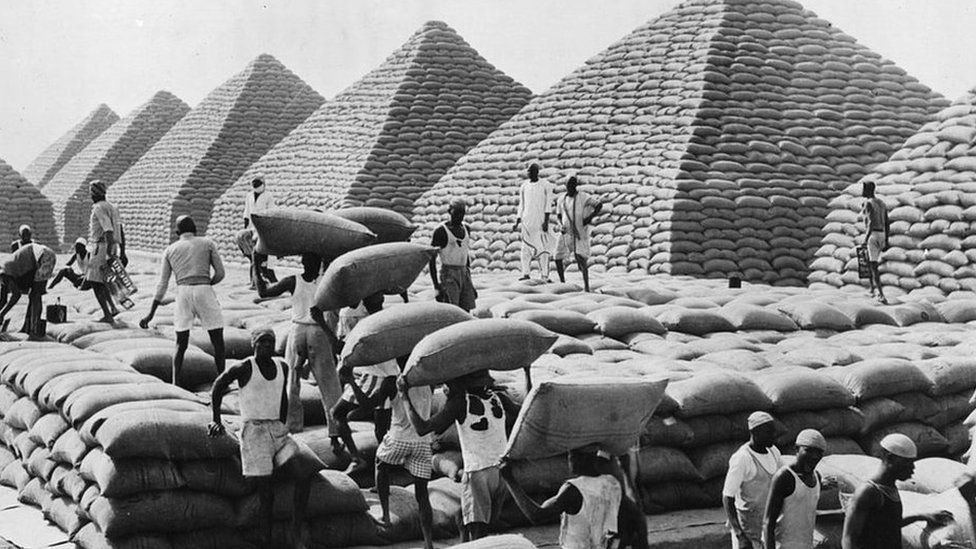
Similar structures were built from sacks of peanuts, and were viewed as a tourist attraction and a symbol of the country's wealth.
So why are rice prices rising?
President Muhammadu Buhari has said improved production "will aid our efforts at reducing the price of rice in Nigeria".
But the price of rice - which is now one of the country's staple foods - has been rising.
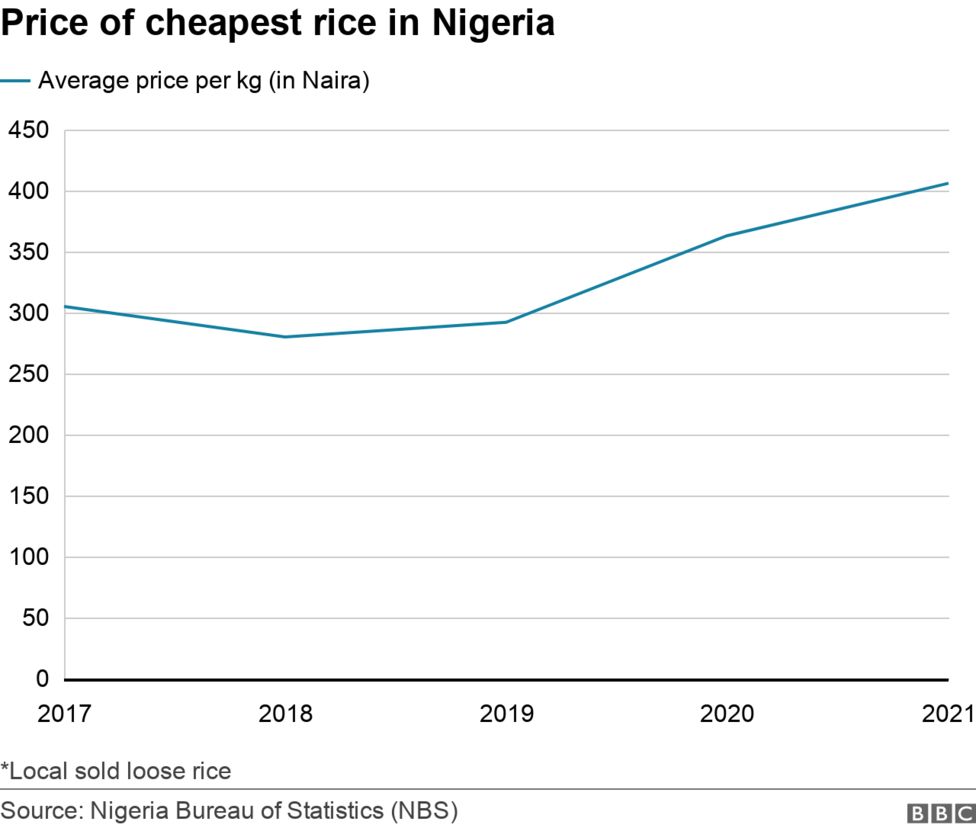
Government data also show the cost of producing rice in Nigeria has been rising, which would translate into higher prices.
And while the production of rice has nearly doubled in a decade, the demand for rice has also been growing.
"The increase in the quantity of rice [produced] is also being met with increasing demand due to population growth," says Khadijat Amolegbe, from the University of Ilorin.
Conflict between herders and farmers in the north-west and central parts of Nigeria in recent years has also affected prices, by displacing rice farmers from their farms.
"Previously cultivated lands are not used due to fear of being killed or kidnapped," she says.
However, it is not clear how many farmers have been affected or how great an area of rice production has been lost because of insecurity.

Challenges in transportation because of bad roads have also pushed up prices.
Domestic consumption is currently estimated at seven million tonnes, according to US data, leaving the country with a shortfall of two million tonnes.
Rice is being imported
To meet the shortfall, the country has been importing rice, which in some cases appears to come in through smuggling.
Mr Buhari last month denied that rice was imported. "Now [in] Nigeria we produce the rice we need and we even export," he told a local TV station.

There is no official data for exports, and we could not establish from the government what the evidence is for that.
As for imports, Nigeria has had restrictions in place since 2015 in a bid to boost local production. These included:
- denying importers access to foreign currency
- banning rice imports from neighbouring countries
- slapping a 70% tax on rice imported from elsewhere
Latest Stories
-
PKO trio eye victories at Odwira Festival
2 hours -
346 Ghana Navy recruits pass out after 26 weeks of intensive training
2 hours -
Newsfile to discuss EOCO-MP arrest, drug trafficking, speech arrests and $235m water debt
3 hours -
JoyNews gets results as listeners raise GH¢40,000 to help 17-year-old student with cerebral palsy attend SHS
3 hours -
Vice President calls for stronger local pharmaceutical production to reduce medicine imports
4 hours -
The brewing tension at KNUST; Beware the Ides of October….
4 hours -
Health Ministry moves to integrate traditional medicine into mainstream healthcare
4 hours -
550 pupils in Kintampo South get educational lifeline as ‘Seeds of Hope’ reaches farming communities
5 hours -
Opoku Mensah urges Christian Council, House of Chiefs to speak up on democratic freedoms
5 hours -
Teacher unions’ strike: Minority demands immediate payment of teacher arrears, 20% deprived area allowance
5 hours -
The Accra-Kumasi Expressway: Building it right
5 hours -
Beyond gold exports: Building value and economic resilience from Ghana’s gold
5 hours -
2027 AFCONQ: Ghana under pressure as Gambia beat Somalia 2-1
5 hours -
Eastern NPP Women’s Organiser calls on AG, Police to secure bail for Salomey Baffoe
6 hours -
Poverty, illiteracy driving acceptance of vote-buying among women – Damongo Queen Mother
6 hours