

Audio By Carbonatix
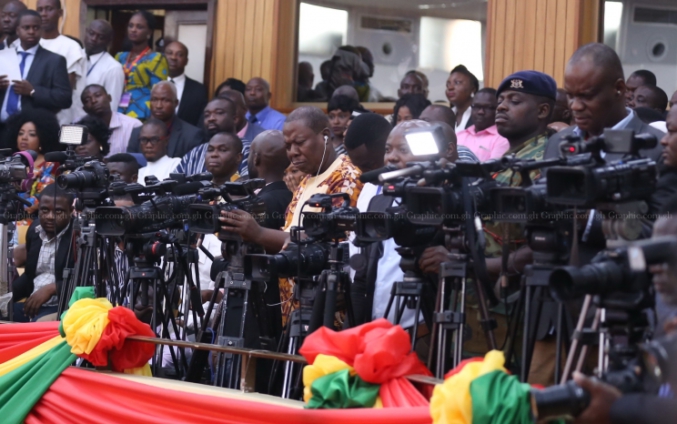
The State of the Ghanaian Media Report 2023 says the Ghanaian media is not financially viable.
According to the report, “the media industry is too heavily plagued by saturation, the cost of doing business in Ghana, dwindling advertising budgets [including capital fight onto social media platforms], the after-effects of the COVID-19 pandemic and fast-evolving technological changes to be considered financially healthy.”
The study noted that the financial health of the local media is patchy, at best.
It added that although there are clear signs of healthy indicators of financial potential, there are equally pressing challenges to viability.
“Factors situated within the structure of the local media scene, the COVID-19 pandemic, the state of the local economy and the fast pace of technological evolutions both hurt the financial health of the media in Ghana.”
It went on to state that while media strive to be financially viable, the efforts are also countered by the cost of doing business in Ghana’s post-COVID-19 economy.
“Like all businesses in the country, media organisations are finding themselves at the mercy of forex rate-induced rising fuel, utility and retooling costs which have become a constant drain on incomes. As these and other costs increase, the capacity for media to adequately resource and remunerate employees to engender professional practice reduces.
“The high cost of doing business also has implications for content diversity. Indeed, as we find, it costs more to generate local content than to import and do voice translation sound inserts. This explains the increasing levels of imported Asian and Southern American telenovelas which are gradually weaning local audience tastes off local films and drama. The long-term implications for financial viability are dire.”
According to the report, although the media encounter financial challenges, it is not helpless to the challenges they face, because they are resorting to innovative revenue strategies to turn the tide.
The innovative revenue strategies that media resort to augment their revenues are derived from non-advertising sources. The strategies relate to content innovations, digitisation, diversification and innovative solicitation.
Meanwhile, the report recommended ways by which the media can take to ensure it is financially viable.
For media organisations:
- Cost-cutting measures such as working from home [with savings in utility consumption and transport budgets] deserve larger-scale adoption by media organisations to reduce their costs and increase their financial viability.
- Media organisations must also continue to innovate new revenue strategies to reduce their heavy reliance on advertising revenues, a model that is increasingly threatened by the influence of global social media giants.
- An important way to ensure viable media is trust and credibility… Media organisations must guard their credibility. High editorial standards must be maintained to avoid the risk of serious media evolving into tabloids in an effort to garner the attention that generates income.
- The media must keep looking at the digital.
For media development organisations
- Capacity building to enable media organisations, particularly smaller, rural-based ones, to diversify revenue sources and strategies was recommended.
- The NCA should, as a matter of urgency, consider freezing the issuance of more broadcast licenses and take steps to audit and restructure the broadcasting space to reduce the glut and improve the financial prospects of media organizations.
The State of the Ghanaian Report is a study conducted by the Department of Communication of the University of Ghana and the Media Foundation for West Africa (MFWA).
The launch of the report on Wednesday was part of the activities marking the 50th anniversary of the Communication Department.
Latest Stories
-
Multiple unions threaten strikes at Barrick’s flagship Mali gold mine, documents show
21 minutes -
Infantino invited to African summit as he faces challenge to FIFA leadership
32 minutes -
NPA boss flags ‘recalcitrant’ transport operators raising fares arbitrarily
40 minutes -
GPRTU fare hike put on ice after talks with government – NPA boss reveals
1 hour -
I’m greatly worried – NPA boss on threat of higher transport fares
1 hour -
We are largely import-dependent – NPA boss on Ghana’s fuel vulnerability
2 hours -
Ghana’s fuel market is built for turbulence – NPA’s Edudzi Tamakloe explains why
2 hours -
Postponement not an option as Kenya races to be ready for Afcon 2027
2 hours -
ICE agent shoots and wounds man in Texas as locals demand answers
2 hours -
Ed Sheeran admits ‘mistakes’ at first show since Macklemore controversy
3 hours -
We are ready for the turbulence – NPA boss on Ghana’s fuel crisis
4 hours -
Lady I wanted serious relationship with said she’s not ready – Rema
4 hours -
I’ll never discuss my finances with man, even if he’s my husband – Nancy Isime
4 hours -
Wizkid, Wande Coal advised me on how to leave school for music – Davido
4 hours -
Senegal job an ‘absolute dream’ for new boss Vieira
4 hours