

Audio By Carbonatix
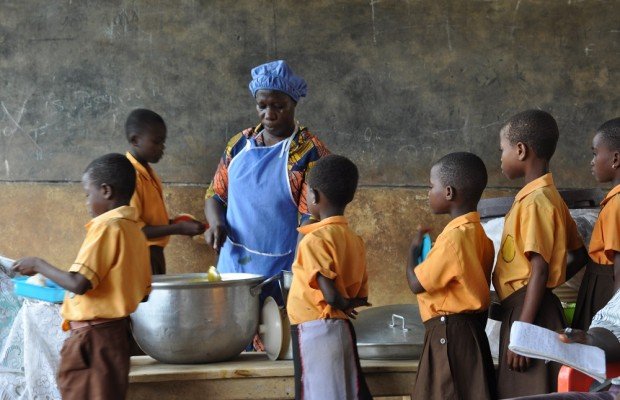
The National Coordinator of Ghana School Feeding Programme, Madam Gertrude Quashigah says her Secretariat will soon train caterers to spend less on cooking nutritional foods for school children.
She said the training would help them to rake in profits by cutting down on costs and food wastage in their pantries.
Madam Quashigah who was addressing a day's workshop on the 'Dissemination of Landscape Analysis Report on Rice Fortification,' stressed that this would help them to put to good and sufficient use the GHS1.00 per child they receive.
This workshop shared findings of a comprehensive report on rice fortification and discussed strategies to enhance the nutritional value of school meals through rice fortification.
The dissemination workshop is the commencement of a two-and-a-half-year project by the World Food Programme, with funding support from the Rockefeller Foundation and Royal DSM, to improve the nutritional needs of school children through the Ghana School Feeding Programme.
The project seeks to improve the nutritional value of rice for the school children to meet their nutritional needs since rice was a staple.
Madam Quashigah said, though the amount they received needed to be increased, they could still cook nutritious foods for the school children with it.
She said they had recently agreed on a proposed increment from GH₵1.00 they received per child head to GH₵1.20 pesewas, saying they were still engaging the Finance Ministry on further increment.
She added that such training would be certificated through which they would be able to sort and assess their work.
Madam Patience Asiedu, Head of Nutrition, World Food Programme (WFP) Accra, said the project supported the Government’s efforts to boost local production of rice.
The capacity of 5,000 smallholder farmers and 10 rice millers will be enhanced to support local rice production for the School Feeding Programme, she said.
She said under the project, caterers and cooks would be trained to cook nutritional foods for the school children.
The Ghana School Feeding Programme as an intervention by the Government of Ghana, started in 2005 to provide food to children in public basic schools from kindergarten to primary six.
The Programme aims to increase school enrolment, attendance and retention, reduce short-term hunger and malnutrition and boost domestic food production.
The Programme has 3,801,491 beneficiary pupils, 34,350 cooks and caterers and covers 10,832 public basic schools nationwide.
Latest Stories
-
Mahama announces rehabilitation of Pwalugu tomato factory, $5bn boost for agriculture
4 minutes -
MTN Ghana’s growing economic footprint puts spotlight on telecom sector
7 minutes -
Free Primary Health Care to reach all districts by 2028 – Health Minister
8 minutes -
Mahama commissions Paga SHS E-Block, promises facilities to end double-track by 2027
10 minutes -
Zambia resumes vote counting after security concerns halt electoral process
11 minutes -
Overall unemployment decline shows government policies are working – Opare-Addo
14 minutes -
GHS boss calls for stronger commitment to make Free Primary Health Care work
15 minutes -
Instagram accounts accused of luring migrants to Ceuta with misleading crossing videos
17 minutes -
Government targets local changfan manufacturers, suppliers in expanded galamsey fight
18 minutes -
Over 4,000 excavators held at ports under new galamsey control measures – Lands Minister reveals
22 minutes -
Mahama announces five-year plan to cut Ghana’s reliance on imported medicines
24 minutes -
Cocoa farmers’ economic realities must be addressed to curb deforestation – Prof Asante
25 minutes -
Prosecution biggest challenge in galamsey fight – Lands Minister
27 minutes -
Ghana loses 8,900 hectares of forest reserves to illegal mining
28 minutes -
Mahama summons TDC, TMA officials over Community 1 Site 3 dispute
29 minutes