

Audio By Carbonatix
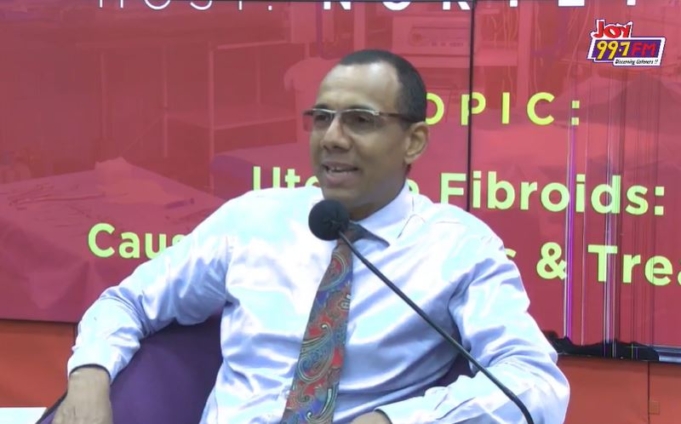
A consultant obstetrician and gynaecologist at the Sinel Specialist Hospital in Tema, Dr Michael McCarthy says just having fibroids does not make one infertile.
"Some women have fibroids but are giving birth easily," he said.
Dr McCarthy was speaking on "Uterine Fibroids: Causes, Symptoms and Treatment" on Ultimate Health hosted by Nortey Dua on JoyFM on Sunday.
According to him, having fibroids alone does not mean a woman could be automatically infertile although it is significant in causing fertility challenges, especially if located in places where they are not allowing the endometrium to develop properly, or maybe causing some blockages in certain places, or they may cause recurrent miscarriages or give complications during pregnancy.
Describing what fibroids are, Dr McCarthy explained that they are masses of cells that grow in the uterus.
"It's quite common but not normal condition of the uterus, where normal cells of the uterus change and start to behave the way they are not programmed to behave, growing into masses of cells," he explained further.
The gynaecologist noted that most often, fibroids are much smaller and can multiple. However, the biggest one he has removed was an 11kg mass from one uterus.
According to him, the main underlying cause of fibroid is genetic. However, there are other risk factors that may predispose women to it.
"As your age increases, your risk of uterine fibroids also increases to the time of menopause and the highest percentage will be women 30 years and above."
"Even though we found out that it occurs in women in their 20s, it's not common. So it's normally not strange to find a woman with fibroids first presenting when she's in her early or mid-30s," he asserted.
Dr. McCarthy also stated that obesity can put women at risk of getting uterine fibroids.
Moreover, women who have never given birth also tend to have an increased risk of getting fibroids, he revealed, adding that some studies indicate that having a child between ages 25 and 29 years has some protective effect on getting fibroid.
The gynaecologist also added that fibroids are more of an African race type of disease.
Dr. McCarthy mentioned that women who had their menstruation before age 10 could have some increased risk of getting uterine fibroids.
"Fibroids occur in the environment where the normal female hormones are very active. And it's normally from puberty until menopause. That's the big window where you see fibroids developing."
Discussing what the symptoms of fibroids are, the gynaecologist mentioned, having severe pain and bleeding, especially during menses and after menses, increased discharge, urinating more frequently and with not too much volume, and sometimes, feeling a mass - something moving around in your belly, or feeling something growing in your belly.
He stated emphatically that a woman may have fibroids and yet not know because there may not be any signs that these fibroids are there.
"Remember, not all fibroids will give symptoms. In fact, only 10 per cent of people who have uterine fibroids come with symptoms."
In view of this, it's always advisable for women to undergo gynaecological checks every year to physically examine the uterus and also do an ultrasound scan to stay safe.
Dr McCarthy agreed that fibroids in pregnancy can cause severe pain and preterm contraction and make it difficult for the baby to position itself properly for delivery and also compete for space.
"In fact, fibroids could also turn the uterus in a way it's not supposed to be and could reduce blood flow to the uterus and even after delivery, they could cause excessive bleeding especially if the placenta is implanted especially where the fibroids are."
Dr. McCarthy explained that fibroids cannot be prevented from growing but when it comes to treatment, doctors and patients must decide on what they want to achieve.
"If it's pain, we just treat the pain. If it's bleeding, we treat it. If it's anaemia, we treat the anaemia. So it depends on what's going on, and then we can draw that treatment plan."
He cited an example where a study was done in Italy that proved that exercise could help in uterine fibroid prevention and treatment.
"Those who did 7 hours exercise a week or more had slower growing fibroids as compared to those who did 2 hours or less exercise a week."
He, therefore, encouraged everyone to be mindful of their lifestyle choices and eat well (less salt, sugar, alcohol), and do more physical exercise for healthy growth.
Latest Stories
-
Ghana has 48 legitimate entry points but over 300 illegal crossing points – Interior Minister
7 minutes -
Ghana is much safer now than in 2025 – Muntaka
22 minutes -
Bawku has gone 150 days without gunfire – Interior Minister
27 minutes -
It still surprises me GAUA is on strike after signing MoU – Fair Wages CEO
46 minutes -
Kumasi Hospital removes 880-gram bladder stone in rare surgical case
53 minutes -
Ghana lacks sufficient power generation redundancy – Energy Minister
1 hour -
CPA assures consumers of safety of registered sanitary towels on the Ghanaian market after complaints
1 hour -
‘They all point decisively to guilt’ – AG urges court to reject Adu Boahene’s no-case submission
2 hours -
Documents falsified to evade tax on Abramovich’s wealth, BBC finds
2 hours -
Today’s front pages: Monday, October 12, 2026
2 hours -
BoG proposes new rules to ensure banks can always pay customers when they need their Money
3 hours -
Hotline Documentary: ‘Silent Football’ to air on JoyPrime and JoyNews today
4 hours -
NDPC examines how evidence shapes Ghana’s development planning and policy decisions
4 hours -
Education Ministry calls urgent talks to break GAUA strike deadlock
4 hours -
NCCE engages women in North East Gonja on rule of law, anti-corruption
4 hours