

Audio By Carbonatix
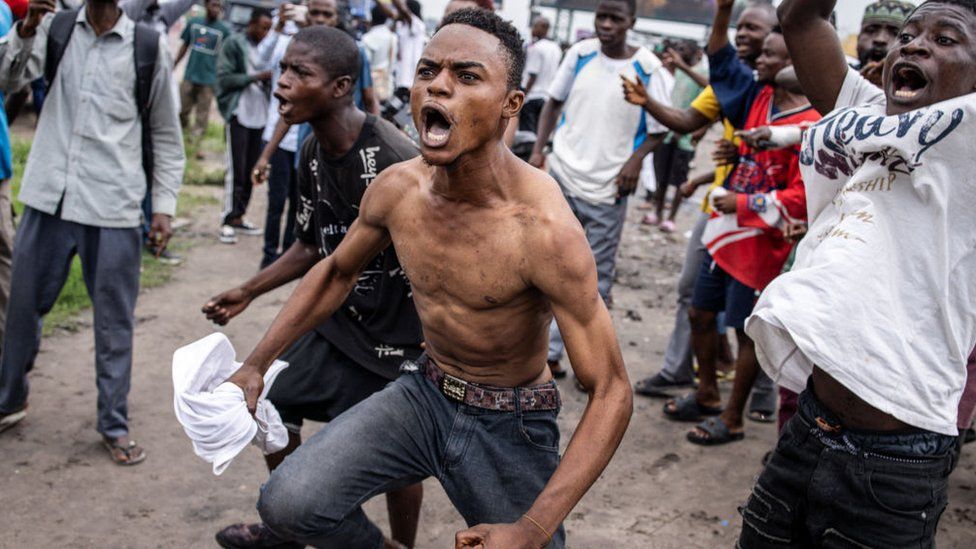
Police in the Democratic Republic of Congo have clashed with opposition supporters demanding that last week's presidential poll be annulled.
Leading opposition candidates have denounced the election as a sham and have demanded a rerun.
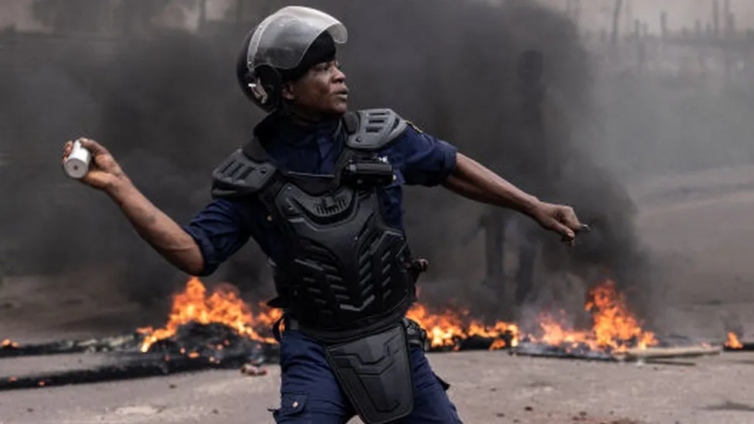
Several people were wounded as police fired tear gas and threw stones back at protesters in the capital, Kinshasa.
The government banned the protest, saying it would not tolerate attempts to undermine the electoral process.
Election officials have so far not said exactly how many polling stations opened or how many people voted in the 20 December election.
About 44 million people were registered to vote at about 75,000 polling stations.
With just over nine million ballots counted so far, President Felix Tshisekedi is in the lead with almost 80% of the vote as he seeks a second term.
Football tycoon and mining magnate Moïse Katumbi is trailing him with about 16%.
Former oil executive Martin Fayulu, who claims he was robbed of victory in the 2018 election, is in third place with about 4%.
Mr Fayulu's supporters burnt tyres and clashed with police outside his campaign headquarters in Kinshasa.
Police took up positions on key roads in the city and thwarted an attempted march to the headquarters of the electoral commission.
Mr Fayulu said that 11 of his supporters were injured, while police reported two injuries on their side.
GETTY IMAGES
The election was marred by logistical delays and administrative chaos, forcing voting to be extended to a second day in some parts of the country.
The opposition has also accused the electoral commission of orchestrating fraud and ballot stuffing in order to pave the way for Mr Tshisekedi to be declared the winner.
The commission has denied the allegations.
DR Congo is roughly four times the size of France but lacks basic infrastructure. Even some of its main cities are not linked by road.
About two-thirds of the country's 100 million population live below the poverty line, earning $2.15 (£1.70) a day or less.
Voters also chose parliamentary, provincial and municipal representatives, with about 100,000 candidates in total.
The elections were not held in parts of the East because of insecurity.
Dozens of armed groups have been competing to control parts of the region, home to much of the country's vast mineral wealth.
This includes vast reserves of cobalt, a vital part of many lithium batteries, seen as essential to a future free of fossil fuels.
Latest Stories
-
CSR must be measurable commitment, not a gesture of convenience – Ga Mantse tells mining companies
45 seconds -
Ga Mantse urges mining industry to protect communities beyond the life of mines
16 minutes -
Empowerher in Upper West region
36 minutes -
Ga Mantse challenges mining stakeholders to consider long-term impact of Ghana’s mineral wealth
45 minutes -
Afenyo-Markin accuses GoldBod of mismanaging Ghana’s gold resources
46 minutes -
Non-interest banking products must meet required standards – BoG Governor to NIFAC
47 minutes -
Social licence to mine can be withdrawn – Ga Mantse warns mining companies
48 minutes -
X1 Energy Drink Division One Super Cup: Attram De Visser secure third place after late own goal
48 minutes -
‘A mine may close, but the community must not’ – Ga Mantse calls for sustainable mining
50 minutes -
UG Pro VC calls for an integrated risk management approach to tackle Ghana’s perennial flooding
57 minutes -
Parents can buy additional NaCCA-approved textbooks for children – Deputy NaCCA boss
1 hour -
Youth must have a real voice in national issues beyond jobs, creative arts – EU
1 hour -
AGTC: How women-led initiative is turning golf into jobs and tourism opportunities
1 hour -
Exporters call for single-digit interest rates to boost Ghana’s horticulture sector
1 hour -
Young political leaders must look beyond party lines to strengthen Ghana’s democracy – EU
1 hour