

Audio By Carbonatix
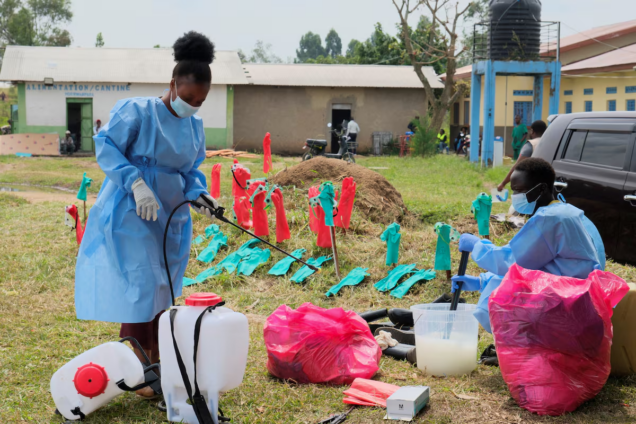
Ebola response workers in northeastern Democratic Republic of Congo staged protests outside three treatment centres on Thursday, saying they had not been paid all they were owed for their work.
The outbreak has infected 1,759 people and resulted in 600 confirmed deaths since it was declared almost two months ago, according to the latest government data released on Wednesday.
The World Health Organisation (WHO) said this week transmission of the rare form of Ebola was continuing; it kills 30% to 50% of those infected and has no vaccine or cure.
Dozens of members of Ebola response teams gathered on Thursday outside the Centre Medical Evangelique (CME), Elikya and Salama treatment centres in Bunia, the capital of Ituri Province, which is the hardest hit.
Police dispersed one of the protests, outside the CME.
It was not immediately clear whether the protests had disrupted operations at the treatment centres.
Speaking to journalists in Bunia, Health Minister Samuel Roger Kamba acknowledged there had been problems with "the human resources pillar of the response", namely with ensuring that the lists of people who needed to be paid were updated and accurate.
An official at Africa's top public health agency said at an online press conference that it was working with Congolese authorities to speed up payments to frontline health workers.
"This is very important to keep (up) the morale," Africa CDC official Wessam Mankoula said. He said the Africa CDC had provided Congo with about $2 million to support its Ebola response, some of which could be used to make "delayed payments" to health workers.
A Congolese health official, who asked not to be named as he was not authorised to speak to the press, told Reuters that talks were under way with workers who were threatening to go on strike, but that no strike had begun so far.
WORKERS SAY PAY IS LATE, DOES NOT REFLECT WORKLOAD
In a letter dated July 5 and addressed to Ituri's governor and health officials, Ebola response workers said they had not been paid for services rendered since the start of the latest Ebola outbreak, which was announced on May 15.
The letter said this had resulted in "significant socio-economic difficulties" and severely affected the workers' living conditions.
The workers also complained that compensation rates were too low relative to the risks and workload involved in the Ebola response.
They demanded an increase in daily allowances and called for the removal of income tax deductions, arguing that allowances constituted bonuses rather than salaries.
Latest Stories
-
‘Bamba’s message was clever, very clever’ – Akomea on NPP election upset
1 hour -
Nana Akomea reveals why he was disappointed after placing third in NPP election
1 hour -
Saudi Arabia urged to spare man sentenced to death over Facebook post
2 hours -
NPP to deliberately select candidates for orphan constituencies ahead of 2028 election
2 hours -
NPP wants early profiling of parliamentary candidates to avoid costly campaigns – Nana Akomea
2 hours -
At least 22 dead after two boats collide on Congo river, official says
2 hours -
Heavy rains lead to Senegal floods, government reports several deaths
3 hours -
FTBLRLIFE targets Ghana in expansion of global grassroots football network
4 hours -
NPP has secured the ‘blessing of time’ for 2028 election – Nana Akomea
4 hours -
NPP says early flagbearer selection has helped stabilise party reorganisation
5 hours -
Kennedy Agyapong disciplinary case awaits committee report, says Nana Akomea
5 hours -
Former ‘American Idol’ contestant sentenced to life without parole for wife’s murder
5 hours -
Education Ministry commends Ghanaian teachers on World Teachers’ Day 2026
5 hours -
NPP can reconcile with aggrieved members who want to return – Nana Akomea
6 hours -
Tamale Child Deaths: Vehicle owner arrested as IGP deploys homicide team
6 hours