

Audio By Carbonatix
Ghana's Extractive Sector Multi-Stakeholder Group (MSG) has urged Parliament to summon state agencies over delays in disbursing mineral royalties to mining host communities.
The group said the delays were stalling development projects, disrupting local planning, and undermining the objectives of the Minerals Development Fund Act.
Dr Emmanuel Steve Asare Manteaw, a member of the MSG, made the call at a media engagement to disseminate the findings of the 2023 Ghana Extractive Industries Transparency Initiative (GHEITI) Report in Accra.
He attributed the persistent delays to weak oversight, saying Parliament should ensure compliance with the Minerals Development Fund Act, 2016 (Act 912), by holding state institutions accountable for the timely release of approved funds.
"A lot of development projects in some of these beneficiary communities have come to a standstill, and the uncertainty over the timing of disbursements makes it difficult for communities to plan development activities with any confidence.
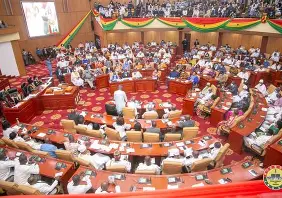
"What is more worrying is the role of Parliament in all this because they passed the law mandating that certain percentages of mineral royalties be disbursed to mining host communities," Dr. Manteaw said.
He said Parliament should ensure that information on delayed payments, including the institutions responsible and the amounts outstanding, was made public to strengthen transparency and accountability.
In a speech read on his behalf, Patrick Nomo, Co-Chair of the GHEITI Multi-Stakeholder Group and Chief Director at the Ministry of Finance, said reforms to the mineral royalty regime had improved the management of extractive revenues.
He said GHEITI advocacy had contributed to reforms, including changes to the mineral royalty regime and the institutionalisation of subnational royalty transfers through the Minerals Development Fund to enable mining communities to benefit more directly from mineral resources.
Mr Nomo, however, said revenue leakages and weak inter-institutional coordination continued to constrain the sector's contribution to national and local development.
He called for stronger institutional collaboration and improved data management to enhance transparency and ensure that resource revenues translated into tangible benefits for mining communities.
Mr Nomo reaffirmed the government's commitment to using evidence generated through GHEITI to inform policy reforms and strengthen accountability in the extractive sector.
Under the Minerals Development Fund Act, mineral royalties are distributed through a statutory formula, with district assemblies receiving 55 percent of the allocation to local government, mining-affected communities 25 percent, and traditional councils 20 percent.
Latest Stories
-
New York Times executive fatally shot allegedly by elderly in-laws
1 hour -
Teacher Payment Crisis: GES races to protect academic calendar
1 hour -
US prosecutors reopen case of alleged gang rape at Cornell University
2 hours -
Journalist to be crowned king in Uganda after bitter succession dispute
2 hours -
OpenAI scraps rollout of new model over safety concerns
2 hours -
Nigerian attempts to break world record by dancing non-stop for seven days
2 hours -
GES urges government agencies to end blame game over teacher payments
4 hours -
GES sets Oct. 5 deadline to resolve teachers’ payment dispute
4 hours -
GES working around the clock to get teachers back to class, says Daniel Fenyi
5 hours -
French PM warns against escalation of school protests after 164 arrested
5 hours -
UK tries to stop Trump’s diesel export ban
5 hours -
Late Olise goal gives France win over Belgium
5 hours -
Mancini enjoys first win since return as Italy boss
5 hours -
Interest payments to average a high 20% of government revenue over next 4 years
6 hours -
Anthropic warns AI may pose ‘existential risks to humanity’ in IPO filing
6 hours