


Audio By Carbonatix
Only 4.0% of total bank lending in Ghana went into agriculture in the last five years.
According to C-Energy Global Holdings, the constrained access to funds from most banks can be traced to the perceived risks of poor record-keeping practices which affect the assessment of farmers’ creditworthiness, extremely low level of agriculture mechanisation coupled with post-harvest losses.
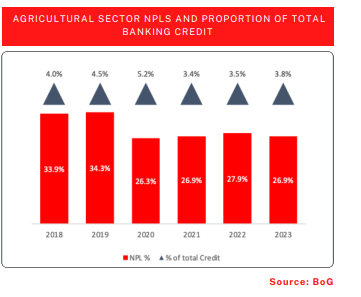
The outturn of these risks, it said can be seen in the sector’s deficient performance and high credit defaults. Non-performing loans for the sector averaged 30% over the last 5 years relative to the 17% averaged by the banking industry across all sectors, evidencing banks’ hesitation to fund the agriculture sector.
“Until the funding gaps are fully plugged, food insecurity remains a threat to the nation”, it added.
It also expressed worry about the abysmal performance of food production in the country.
Therefore to reverse this trajectory, it is calling for access to sustainable financing is needed to improve productivity and scale up production to support the rest of the region.
Ghana witnessed slight improvements in productivity in the initial stage (Phase 1) of the Planting for Food and Jobs Initiative and other government intervention programmes.
However, the country saw an unprecedented rise in food prices in 2022 evidenced by the national food price index which increased by 23.8% in 2022.
C-Energy Global Holdings said this widened the country’s exposure to food security risks.
The country ranked 83rd amongst food-secure countries in the world according to the Global Food Security Index- 2022 report with a score of 52.6%.
In the wake of climate change, the country’s food security is also at risk. Ghana is one of the top 10 countries impacted severely by climate change despite contributing the least to global warming.
Agric economy valued at $12.6bn
Ghana’s agriculture economy is valued at about $12.6 billion.
The sector contributed an average of 20% to GDP in the last Five years. Cash crops and other commodity exports from agriculture account for 20-25% of total export revenues for the nation.
The sector is also responsible for employing over 35% of the total employed labor force. Agriculture
however remains rainfed and on a subsistence basis with only 15% of farms in Ghana commercialized.
Low mechanization, poor farm recordkeeping, inadequate storage & processing capacities, poor rural transportation infrastructure and post harvest losses are the core challenges affecting agriculture
sector performance and disincentivizing financing for the sector.
Latest Stories
-
Christa Pike discharged from hospital and returned to prison, her lawyers say
46 seconds -
Ghana’s BRICS move requires clear strategy to manage risks – Godfred Bokpin
2 hours -
Pay teachers realistic income – Duncan Amoah to gov’t
2 hours -
Bechem to become chicken capital of Ghana – Mahama projects
2 hours -
Gov’t targets recruitment of 16,500 health professionals in 2026
2 hours -
Two-week strike will not derail academic calendar – GNAT President
3 hours -
Headmaster detained after BBC investigation into alleged sexual abuse of students
3 hours -
GNAT pushes for clear implementation procedures of teachers’ conditions of service
3 hours -
Recurrent strikes threaten quality of education and academic calendars – Prof Bokpin
3 hours -
‘Cockroach’ group leaders among hundreds detained in Delhi protest
3 hours -
Don’t let speed of information become your judgement – CJ tells new lawyers
4 hours -
World Cup visa scandal: People have leveraged public office to facilitate fraud – Senyo Hosi
4 hours -
Glut! Farmers count losses as prices crash, customers happy
5 hours -
GSA postpones auction of unserviceable vehicles
5 hours -
Man charged with attempted murder after stabbing
5 hours