

Audio By Carbonatix
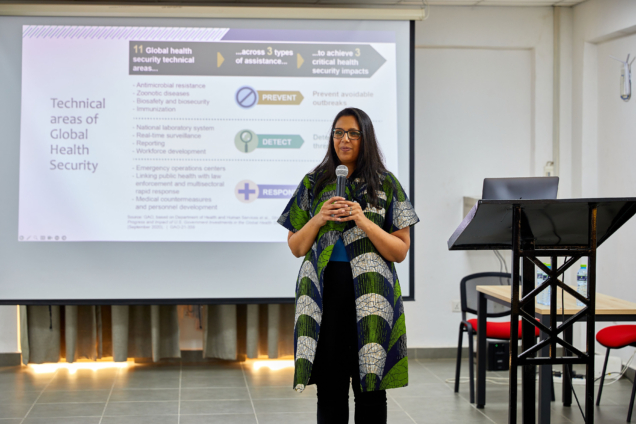
Dr Bhakti Hansoti, Director for the Centre of Global Emergency Care, Johns Hopkins University is highlighting the critical role preparedness and investment in health systems play in improving local and global health security.
She explains that COVID-19 "was not just a global health emergency, but a demonstration that there is no health security without a resilient health system".
“If we build resilient health systems and a health system that is informed by these determinants of health, we can be strengthened against future threats,” she added.
Dr Bhakti Hansoti was delivering a lecture on “The Global Health Security: Implications for LMICs” at the Kumasi Center for Collaborative Research in Tropical Medicine to a diverse audience of professionals, scientists, students, clinicians, laboratory technologists and others.
According to the U.S. Department of Health and Human Services (HHS), “Global health security is achieved when all countries possess strong and resilient public health systems that can effectively prevent, detect, and respond to infectious disease threats, ensuring the health and well-being of populations globally”.
Today, global health security risks include emergence and spread of new infectious diseases; ever-increasing globalisation of travel and trade, enabling disease to spread; rise of drug-resistant, disease-causing pathogens; potential for accidental release, theft, or illicit use of dangerous pathogens among others.
The COVID-19 pandemic underscores the need for robust global health security measures, collaboration, and ethical responses to protect humanity.
Dr Bansoti explained that global health security requires intersectoral collaboration with active participation from countries to shape future response activities.
She said, “There is a need for intersectoral collaboration, communication, and investment. Countries must bring themselves to the table so that they can shape the dialogue for future response activities and future treaties such as the pandemic treaty.”
“We need to learn from the lessons of our past. We need to learn from Ebola, COVID-19, and HIV.
“What worked? How were communities engaged?
“What were the challenges, was it around capacity or optimisation?”
“How can those lessons be acknowledged, reflected upon, and scaled so our next response is stronger.”

Dr John Amuasi, Head of Global Health Department at the School of Public health and Leader for the Global Health and Infectious Disease Research Group was excited to have his students attend the lecture.
“This lecture was very important because the topic is one that is not usual but then very important.
“It is important that people in science, especially students, understand the global health architecture and the role Global Health Security plays in there.”
He further explained, “I am excited that students from the School of Public Health could be a part of this.
“It broadens their horizons, and it opens their minds to the global way of thinking about issues particularly around emerging and re-emerging infectious diseases and what that means for low middle-income countries in positioning ourselves well, so we are not short-changed in Global discussions like the pandemic treaty.”
Charles Lwanga Tengan, a member of the Global Health MPH class said, “I have learnt that there is no health security without a resilient health system.”
“I am truly pleased to have attended this lecture. Dr Bhakti Hansoti was quite inspirational."
“We are very grateful to have had this lecture coming through and it has given us a lot of insight into global health security," said Dr Joseph Bonney, president of the African Federation for Emergency Medicine and research fellow with the Global Health and Infectious Diseases research group.
He added, “As people that are building capacity, it was very great to know that capacity built in hospitals through basic emergency care and through other training programmes, can actually have a space in building a stronger ecosystem for global health security.”
Latest Stories
-
Tema native petitions EOCO over GH¢889,000 payment
22 minutes -
VIP Jeoun Service opens new terminal in Ho, expands transport network
26 minutes -
Tema Fire Commander calls for private-sector support
30 minutes -
Adaklu is not a safe haven for environmental degradation – DCE
34 minutes -
Judiciary urged to expedite corruption cases
38 minutes -
Adenta-Accra travel time improves significantly under contra-flow – GAPTE
42 minutes -
Government reviews diesel subsidy as transport fare increase takes effect
44 minutes -
SEND-Ghana, UCC students march for mandatory food warning labels
49 minutes -
Auditor-General vows tough surcharges, unveils tracker, AI audits
55 minutes -
Government vows no political protection for drug trafficking suspects
1 hour -
Government clarifies Interior Minister’s ‘involvement’ comment in drug probe
1 hour -
Mahama orders security agencies to make Ghana’s ports ‘ironclad’ against drug trafficking
2 hours -
Government admits turf war among security agencies is undermining port security
2 hours -
Government rejects ‘Cocaine Coast’ label, says drug busts show security agencies are working
2 hours -
Banks NPL ratio of 16.1% is still too high – S&P
2 hours