

Audio By Carbonatix
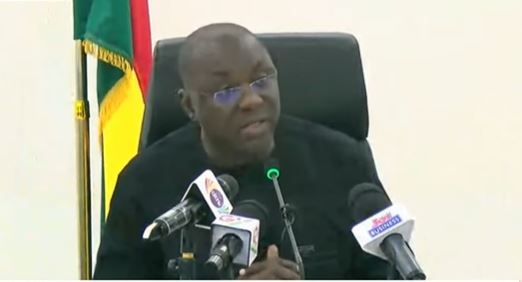
Ghana has made “significant progress” in debt-restructuring negotiations and the latest snag that sent its eurobonds tumbling on Monday will be ironed out in further talks with bondholders, Finance Minister Mohammed Amin Adam said.
Negotiations that started mid-March resulted in an interim deal last week with international investors holding about 40% of Ghana’s $13 billion of defaulted eurobonds. Still, Adam conceded in an interview that agreement breaches the International Monetary Fund’s debt sustainability parameters “slightly.”
“This is not a failure but an ongoing process to arrive at an agreement consistent with debt thresholds” under the IMF’s debt sustainability analysis, or DSA, Adam said. The government will “regroup with our bondholders to continue to tweak the terms until we have final terms that work for all parties,” he said.
Ghana’s eurobonds plunged by the most since Dec. 2022, with notes due in June 2035 falling as much as 3 cents to 47.55 cents on the dollar before paring the decline.
The IMF said in a statement that the “working scenario” presented by the government of Ghana “is not in line with program parameters.”
“The IMF will continue to support the ongoing restructuring negotiations between the authorities and their external commercial creditors with the view to reach an agreement that is consistent with program parameters,” the lender said.
The latest development brought more clarity on the broad outline of the eurobond restructuring, though the terms of an agreement would have to be “fine-tuned” to meet the IMF thresholds, said Samir Gadio, head of Africa strategy at Standard Chartered Plc. Bond prices are now not far from recovery levels implied by the restructuring proposal, he said.
International bondholders had agreed to a 33% effective nominal haircut, according to one of two options provided for the restructuring.
Above Target
To meet its IMF target, the $77 billion economy needs to reduce debt to 55% of gross domestic product by 2028, compared with a burden of 109% that was projected for the year before Ghana began restructuring. The current bondholder agreement would leave debt slightly above that target.
Ghana’s economy fared better than the IMF expected, expanding 2.9% in 2023 compared to an initial IMF target of 1.5%. That means a revised DSA would accommodate the agreement with bondholders, Adam said.
Ghana began working to revamp its debt a little over a year ago as part of a deal with the International Monetary Fund, reaching an agreement in principle with bilateral creditors in January to rework $5.4 billion of obligations under the Group of 20 Common Framework for Debt Treatment. That agreement set the tone for the restructuring of eurobond debt.
Latest Stories
-
GBA not politically aligned, we criticise all governments – Deputy Secretary
3 minutes -
Environmental groups demand National Park status for Atewa Forest over illegal mining
4 minutes -
Three players in line to replace Partey in Queiroz’s next Ghana squad
8 minutes -
GBA leadership’s independence and consistency leave much to be desired – Deputy AG
15 minutes -
Deputy AG accuses GBA of selective criticism over Chief Justice’s comments
27 minutes -
Africa must remove visa restrictions to unlock jobs, opportunities – Gabby Otchere-Darko
30 minutes -
87-year-old man remanded over alleged defilement of 9-year-old girl at Ofankor
48 minutes -
Visa restrictions costing African businesses opportunities – Gabby Otchere-Darko
49 minutes -
Body of missing runner found in South Africa
49 minutes -
CANAL+ and LaLiga sign landmark anti-piracy agreement
55 minutes -
AshantiGold’s David Gyamfi Junior shines as 8 outstanding performers win GPL Matchweek 2 NASCO awards
1 hour -
The small lessons changing how Ghana’s restoration champions plant trees
1 hour -
Government must not perpetrate galamsey, it campaigned against – GBA President
2 hours -
PRIMER must ensure women return home safely with their babies – Vice President
2 hours -
LEAP payments begin nationwide as government targets 450,000 households
2 hours