

Audio By Carbonatix
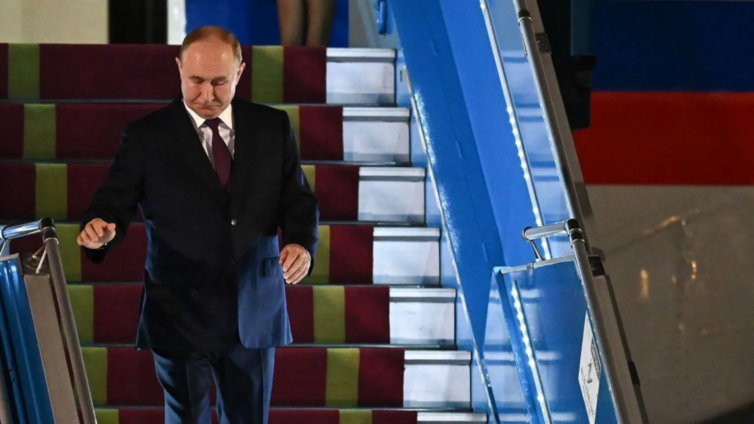
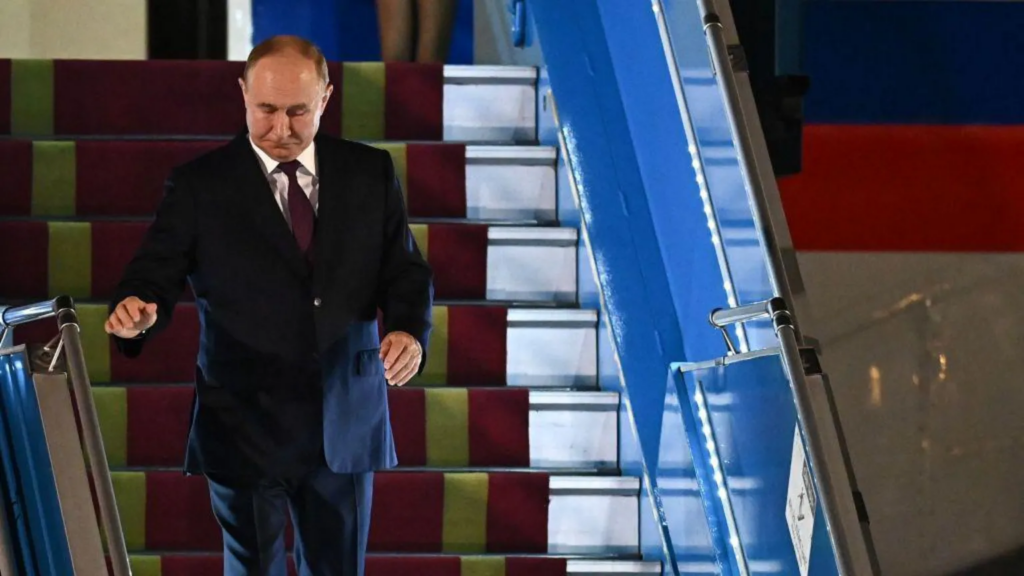
Russian President Vladimir Putin has arrived in the Vietnamese capital Hanoi on the second stop of an East Asian tour.
The trip, which comes on the heels of his lavish visit to North Korea, is being interpreted as a demonstration of the diplomatic support Russia still enjoys in this region.
The United States has criticised the visit for giving a platform for President Putin to promote his war of aggression in Ukraine.
Vietnam still values the historic ties it has with Russia even as it works to improve its relationship with Europe and the US.
Looming over a small park in Ba Dinh, Hanoi’s political quarter, a five-meter-high statue of Lenin depicts the Russian revolutionary in a heroic pose. On his birthday every year, a delegation of senior Vietnamese officials solemnly lay flowers and bow their heads before the statue, a gift from Russia when it was still the Soviet Union.
Vietnam’s ties to Russia are close and go back many decades, to the vital military, economic and diplomatic support given by the Soviet Union to the new communist state in North Vietnam in the 1950s.
Vietnam has described their relationship as "filled with loyalty and gratitude". After Vietnam invaded Cambodia in 1978 to throw out the murderous Khmer Rouge regime, it was isolated and sanctioned by China and the West and depended heavily on Soviet assistance. Many older Vietnamese, including the powerful communist party secretary-general Nguyen Phu Trong, studied in Russia and learned the language.
Today Vietnam’s economy has been transformed by its integration into global markets. Russia has fallen far behind China, Asia, the US and Europe as a trading partner. But Vietnam still uses mainly Russian-made military equipment, and relies on partnerships with Russian oil companies for oil exploration in the South China Sea.

The invasion of Ukraine presented Vietnam with a diplomatic challenge, but one it has so far managed to meet. It has chosen to abstain on the various resolutions at the United Nations condemning Russia’s actions, yet maintained good relations with Ukraine and even sent some aid to Kyiv. They also share a legacy from the Soviet era; thousands of Vietnamese have worked and studied in Ukraine.
This is all in keeping with Vietnam’s long-held foreign policy principles of being friends with everyone but avoiding all formal alliances - what the communist party leadership now calls ‘bamboo diplomacy’, bending with the buffeting winds of great power rivalry without being forced to take sides.
It is why Vietnam has so readily upgraded its relations with the US, a country against which its older leaders fought a long and destructive war, in the interests of seeking lucrative markets for Vietnamese exports and balancing its close ties with its giant neighbour China.
The US has objected to President Putin's official visit to Vietnam on the grounds that it undermines international efforts to isolate him, but it can hardly be surprised. Aside from the special historical links with Russia, public sentiment in Vietnam on the war in Ukraine is more ambivalent than in Europe.
There is some admiration for Putin as a strongman who defies the West, and scepticism, fuelled partly by social media commentary, of the US and European claims to be upholding international law.
This is also true in other Asian countries, where the Ukraine war is seen as a faraway crisis. In Thailand, for example, a historic military ally of the US which was on the opposite side to Russia during the Cold War, public opinion is just as divided as in Vietnam. Thais too value the even older links between its monarchy and the pre-revolutionary Tsars of Russia, and the Thai government maintains close ties with Russia today, valuing the contribution millions of Russians make to its tourist industry.
How long Vietnam maintains its camaraderie with Vladimir Putin is less clear. It is already seeking alternative sources of military equipment, but ending its current dependence on Russia will take years.
A series of high-level resignations inside the communist party recently suggest intense internal rivalries over the next generation of leaders, and, potentially, over which direction the country will take. But there is no talk yet of abandoning the ambition of being friends to all, and enemies of none.
Latest Stories
-
Harry and Meghan’s media treatment echoes what happened to Diana, Earl Spencer tells BBC
3 hours -
Nvidia boss rejects AI extinction fears as ‘doomsday narratives’
3 hours -
Workers came across human remains – and unearthed a mass grave of 572 people
4 hours -
Each Jehovah’s Witness member now decides whether to accept or donate main blood components
4 hours -
Trump says US will form ‘AI Force’ and appoint an artificial intelligence tsar
4 hours -
Google’s Gemini AI hacked three companies in security test
4 hours -
Converse pulls ‘deeply upsetting’ advert after backlash
4 hours -
Warren Buffett steps down after six decades at Berkshire – ‘Father Time always wins’
4 hours -
Billionaire Man United owner says he has lost confidence in the UK
5 hours -
I have experienced racism a thousand times – Lamine Yamal
5 hours -
Ipswich Town investigates racist abuse of Fatawu
5 hours -
Man City battle past Sunderland in eight-goal thriller
5 hours -
Neville calls Man Utd ‘pathetic’ – but Carrick maintains belief
5 hours -
Cunha rescues point for Man United at Fulham
5 hours -
Government has improved sanitation in one-and-a-half years — Salaga South MP
5 hours