

Audio By Carbonatix
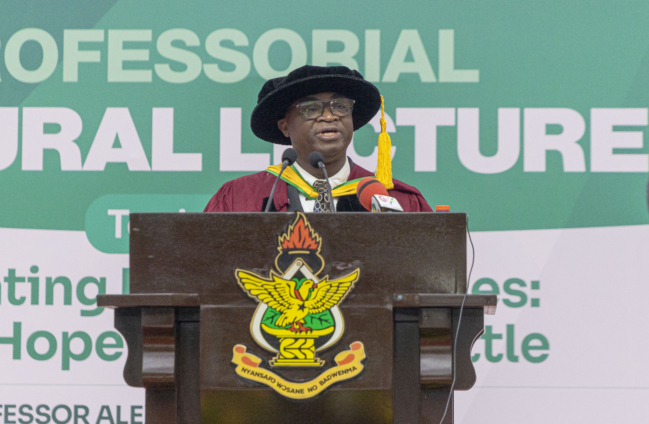
KNUST Parasitologist, Professor Alexander Yaw Debrah has emphasized the importance of prioritizing Neglected Tropical Diseases (NTDs) control within national health plans.
Speaking at his professorial inaugural lecture, he stressed that adequate funding should be allocated for NTD control programs, including surveillance, treatment, and research.
"Local and endemic country governments, including the government of Ghana, must commit some percentage of health funds to fight NTDs," he stated.
The lecture, themed "Eliminating filarial diseases: A new hope for an old battle," highlighted how local and collaborative partnerships have led to combating filarial diseases in Ghana. It also covered the development of human and infrastructure capacities to sustain research and control efforts.
While advocating for the inclusion of elephantiasis patients in the National Health Insurance Scheme (NHIS), Prof. Debrah urged the government to allow victims to benefit from the Livelihood Empowerment Against Poverty (LEAP) program.
"LEAP is a social protection intervention of the Government of Ghana aimed at reducing extreme poverty among the poorest and most vulnerable in Ghana. Our research data shows that the little help we gave to the patients actually improved their quality of life. If the government extends LEAP to elephantiasis patients, it will definitely improve their quality of life," he asserted.
Professor Debrah also highlighted the need for regular assessments to ensure the effectiveness of interventions.
"Our experiences from the Yaws Eradication Program and other NTD programs, both local and international, teach us that the last 1% of patients left is as equally important as the first 99% we successfully treated. Therefore, we should be very careful not to close the books on 'eliminated NTDs.' If you are certified to eliminate a disease, it does not mean it is completely eradicated from the country. It means it is no longer a public health threat. However, if care is not taken, recrudescence can set in, and fighting to control it will be very difficult due to factors such as donor apathy and disengagement," he explained.
As digital technology continues to grow, Prof. Debrah called for expanding the use of digital and mobile technologies by community health volunteers (CHVs) to identify new and old cases.
A crucial part of his recommendations is fostering collaboration among policymakers, researchers, academic institutions, international communities, and public-private partnerships to eliminate NTDs.
Latest Stories
-
Power restoration fault suspected in Kumasi Central Market fire
3 hours -
The 7-foot giant of Ngleshie Amanfro: Seven-foot Ghanaian Ephraim Saawa dreams of joining the national basketball team
4 hours -
Government promises support for Kumasi Central Market fire victims
4 hours -
Vibes The Movie: Big Ghun’s Ghanaian film earns five nominations at 2026 REFFA
4 hours -
MamaCare CEO warns unresolved conflicts among health workers could undermine maternal and neonatal care
5 hours -
Health professionals urged to translate medical knowledge into practice to save mothers
5 hours -
Conflicts among care providers linked to maternal, neonatal deaths – Expert
6 hours -
GIS marks 10th TIME conference, champions improved teaching practices
7 hours -
BRICS Or Balance? What Ghana’s bid really means
7 hours -
GPRTU wants full TRAFFITECH-GH implementation to start in 2027
7 hours -
Mahama announces plans to import electric wheelchairs for PWDs
7 hours -
KGL U17 Colts 2026: Western beat Prempeh Elite Academy to set up final final with Greater Accra Region
8 hours -
Late Solanke strike salvages 10-man Spurs draw at Man United
8 hours -
Gender Ministry to monitor welfare of Nana Akua Addo’s children amid domestic violence case
8 hours -
Benedict Okyere Yeboah: Ghana’s football problem goes beyond sacking a coach
8 hours