

Audio By Carbonatix
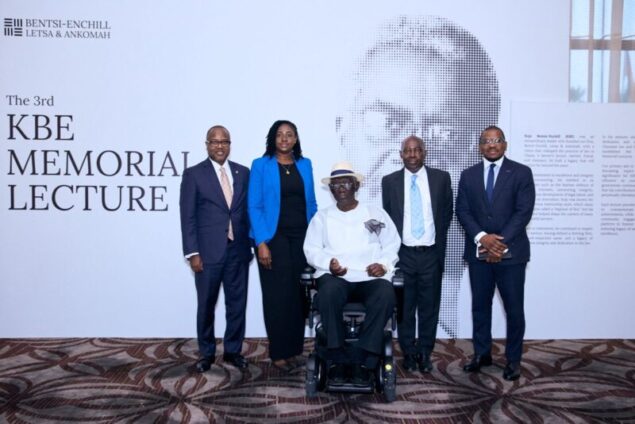
The 3rd Kojo Bentsi-Enchill (KBE) Memorial Lecture was held in Accra on September 5, 2024, focusing on the history and evolution of monetary policy in Ghana and its impact on economic development. Organised by Bentsi-Enchill, Letsa & Ankomah, a leading law firm in Ghana, the lecture honours the memory of the late Kojo Bentsi-Enchill, a visionary, who contributed significantly to the transformation of law practice in Ghana.
The annual lecture series aims to foster dialogue on critical national issues by bringing together academics, legal professionals, government officials, and technocrats. This year’s lecture focused on Ghana’s monetary policy, addressing this often-complex area that plays a crucial role in the country’s economic stability, particularly in light of the current economic downturn and challenges.
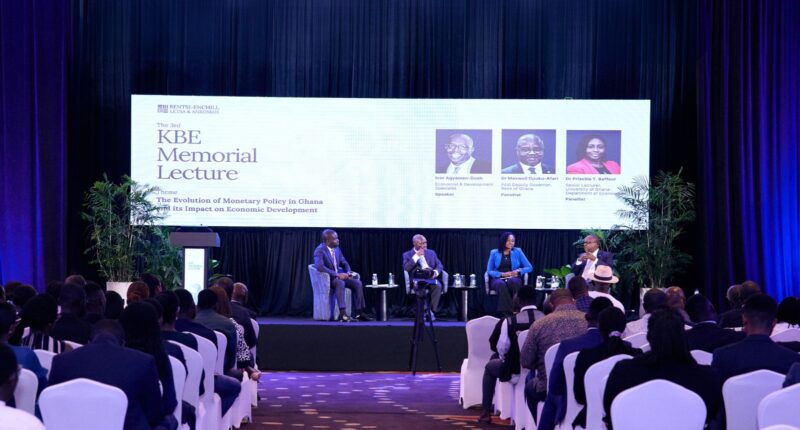
The lecture held under the theme: “The Evolution of Monetary Policy in Ghana and its Impact on Economic Development,” was delivered by Ivor Agyeman-Duah, a renowned historian of economics with extensive expertise in the history of Ghana’s economic policies. Mr. Agyeman-Duah delved into the various theories that underpinned the development of monetary policy in Ghana and its evolution.
The lecture aimed to clarify the often-misunderstood topic, particularly amidst Ghana's current economic challenges, fuelling various speculations among the public.
In his presentation, Mr. Agyeman-Duah highlighted that monetary policy, which involves actions taken by a nation’s central bank to regulate the money supply, aims to achieve specific economic goals, such as controlling inflation, managing interbank lending rate levels, and maintaining financial stability. He highlighted that different models are used across the world to meet these public interest goals.
He emphasised that, regardless of the model implemented, monetary policy plays a crucial role in the economy and has far-reaching implications on its overall stability and growth. He also highlighted key areas such as inflation control, exchange rate, financial market stability, credit availability, and economic growth as factors impacted by monetary policy.
The lecture set the stage for a panel discussion which featured Dr. Maxwell Opoku-Afari, the First Deputy Governor of the Bank of Ghana; Dr. Priscilla Twumasi-Baffour, a Senior Lecturer at the Department of Economics of the University of Ghana; and Mr. Agyeman-Duah.
The session was intellectually invigorating, explaining the various models of monetary policies and how they correlate with fiscal policy and their impact on the economy.
Dr. Twumasi Baffour argued that strong coordination between fiscal policy and monetary policy is required to deliver the intended results of controlling inflation and addressing currency volatility. Therefore, if the fiscal policy handled by the executive arm and the monetary policy seem not to speak to each other as expected operationally, then regulation may be needed to enforce that.
She added that the Ghanaian economy cannot continue as it has since independence, relying on imports and exporting raw materials, yet expect different outcomes solely through changes in monetary policy.
“Even though the country’s monetary policy models have changed over the years to the current model of ‘inflation targeting’, because the economy is still importation reliant, inflation is still high and the currency is volatile. We need to move into value addition and industrialisation” she stressed.
In his contributions, Dr. Opoku-Afari highlighted that price stability is the core mandate of the central bank and its monetary policy objective is to achieve that. He reiterated that the current inflation targeting model helps to focus on every sector of the economy in policy implementation. This he said, has resulted in the recording of the highest growth without volatility and the longest period of stability in currency.
Nonetheless, he echoed that monetary policy alone cannot solve all the problems in the economy in terms of price control and needs other policies functioning collaboratively.
The panel concluded that transitioning from the export of raw materials and an import-dependent economy to the export of value-added goods is a vision that must be carried out by the executive to diversify the economy.
His Excellency John Agyekum Kufuor, the former President of the Republic, who graced the occasion, urged the public to refrain from the attacks on the Bank of Ghana, warning that such actions could have severe economic consequences.
He stressed that the executive arm of government is the central brain of economic and fiscal policies and should be held accountable for economic challenges rather than undermining the central bank’s independence, which could lead to instability and erode investor confidence, ultimately harming the economy.
Mr. Divine Letsa, who chaired the event, in his closing remarks said: “The KBE Memorial Lecture series is dedicated to honouring Kojo Bentsi-Enchill's legacy by exploring critical issues affecting our nation. We believe that by examining monetary policy's impact, we can contribute to informed decision-making and economic stability” he said.
Latest Stories
-
Precious Mawunya-ko appointed PRO for 5th Praise Achievement Awards
3 minutes -
Don’t let poor English define your potential – Prisons Service DG to Ghanaians
3 minutes -
GRIDCo’s operating profit plunges 89% despite net profit surge in 2025
5 minutes -
IGP summons Volta Police Commander over alleged extortion of traders on Aflao–Accra route
7 minutes -
Amin Adam: Gold programme lost money despite 62.9% rise in prices
9 minutes -
Amin Adam challenges GoldBod’s GH¢5.45bn surplus
18 minutes -
Ghana’s power sector losing 27% of electricity supplied – Electrical Engineer
22 minutes -
GH¢1.5m raised to renovate historic Wa Naa’s Palace
26 minutes -
‘Still a work in progress’ – Eric Tinkler admits Kotoko have plenty to improve
27 minutes -
Travellers can take up to GH¢500 in Ghanaian currency out of the country – Customs
30 minutes -
Thousands gather at Glorified 2026 as Perez Musik leads worship
30 minutes -
Mahama renews Ghana’s call for end to US economic embargo on Cuba
31 minutes -
Drive to Inspire – Africa challenges UESD students to build resilient, sustainable futures
34 minutes -
Mahama challenges Non-Aligned Movement to move from declarations to action
34 minutes -
GRA: Permit from Interior Ministry required to import arms, ammunition
36 minutes