

Audio By Carbonatix
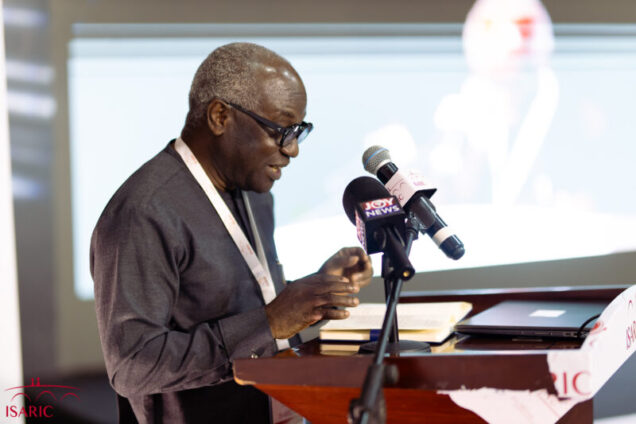
A Ghanian public health specialist, Professor Anarfi Asamoah Baah, argues that the disconnect between academic research and practical policymaking is hindering societal progress and the sustainable development of research initiatives.
"Research is often misunderstood," Professor Baah stated in a recent address at the International Severe Acute Respiratory and emerging Infection Consortium (ISARIC) Members Assembly Meeting in Ada, Ghana.
"We must demystify research and translate the useful information we have generated from our data into applicable wisdom that can capture the attention and interest of politicians and policymakers,” he said.
He is worried that politicians unlike scientists, do not make decisions based on research evidence
“This creates a disconnect between the world of scientific research and political decision-making, as many politicians struggle to grasp and act upon the nuances and importance of scientific findings,” he said.
ISARIC collaborates on clinical research aimed at enhancing patient care and enabling a coordinated and flexible research response to infectious disease threats.
The consortium is a worldwide coalition of investigator-led clinical research networks with more than 60 member networks across 141 countries. It encourages south leading initiatives and has 50% of its networks headquartered in low-and middle-income countries (LMICs).
For over ten years, the consortium has produced clinically relevant research findings for diseases such as COVID-19, dengue, Ebola, Lassa fever, Nipah, mpox, and bubonic plague.
Professor Anarfi Asamoah Baah emphasized that integrating health research into health systems and routine care is the future of health improvement and effective responses to outbreaks.
“To achieve sustainable clinical research, we must diversify funding sources and leverage domestic resources.
“Research should not be solely the responsibility of public health; it is essential to involve health workers, as we did during the COVID-19 pandemic. Their participation is vital for knowledge generation and the evolution of health practices.”
Dr John Amuasi, Principal Investigator for the Global Health and Infectious Diseases Research Group at KCCR, KNUST and lead for ISARIC’s Hub in Ghana, explained why sustainable integration of research into the health systems helps to effectively address an evolving outbreak.
“The research questions can change, and the answers can also change depending on how an outbreak is progressing. We need to be ahead of the game. We need to be asking newer and more relevant questions so that we can get the answers that apply to the current situation.
“If you look at COVID-19, we saw how there were new variants and new symptoms evolving as the pandemic progressed. We can only understand how the disease is progressing when you are continually on the ball, on the research. This way you can make the best clinical decisions, and hopefully have the best outcomes.”
While the hospital often benefits from new information from sustained research, the wider population is faced with challenges of misinformation and disinformation.
Dr. Fernando Bozza, Interim Chair of the ISARIC Executive Board, and lead of the ISARIC Hub based in Brazil points out that one of the main challenges during outbreaks is how to tailor communications to address the various stakeholders involved in the clinical research.
Dr Bozza explained, “Collaboration and communication with the public, communities, heath workers, and policy makers is enhanced by a consortium like ISARIC. Through its agile networks, ISARIC allows for generation of stronger scientific information which can be shared across the consortia and used not only to improve clinical outcome but for advocacy with government and policy makers.”
Professor Baah encouraged investment in science communication for greater impact.
He stressed that the future of effective response to outbreaks hinges on prioritizing heath research and creating of opportunities for young people to participate clinical research.
Latest Stories
-
ADB-UCC open new chapter of institutional collaboration
2 hours -
Reform of all social media should come with Meta changes, UN says
3 hours -
GMTF, Ho Teaching Hospital begin work on Volta Cardiology Centre
3 hours -
How Telecel M’ahitti promo is transforming lives nationwide
3 hours -
Mason jailed 35 years for defiling two daughters
3 hours -
Ayitey Powers remanded over alleged death threat to NSA boss
3 hours -
Court orders the state to file disclosures in Wontumi bank fraud case
3 hours -
Ghana among 8 countries selected to pilot WHO tool for stronger clinical trial systems
3 hours -
Selma Yudha joins race for 60th NUGS President with promise of student-focused leadership
4 hours -
NSMQ 2026: Botwe denies Wesley Girls’ seeded spot, secures quarter-final spot after fierce battle
4 hours -
Zoomlion begins disinfection and disinfestation exercise across Upper East Region
4 hours -
Ghana AIDS Commission strengthens community-level HIV data collection to track 2030 target
4 hours -
Parliament approves three new Supreme Court Justices
4 hours -
Zoomlion intensifies disinfection, disinfestation exercise across Ahafo Region
4 hours -
GHASALC income rises 89% to GH¢1.84m as sector prepares for 2027 reforms
4 hours