

Audio By Carbonatix
There are few stars whose impact on Bollywood is as enduring as that of Rekha. As the actor turns 70 on Thursday, film writer Yasser Usman explores her charm and legacy.
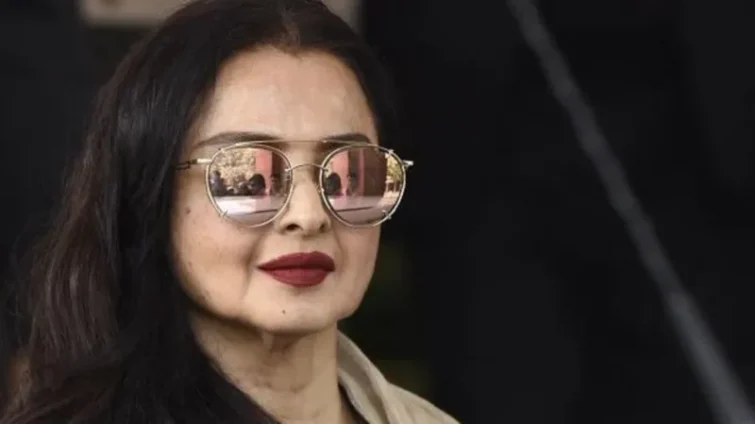
Rekha is one of India’s most glamorous icons - a woman who captured headlines and people's imaginations for decades while blazing a path for generations of female actors in India.
In the 1970s, she was widely covered for her transformation from a loud, gauche young girl from southern India who entered Bollywood with no knowledge of the Hindi language to a discerning National Award-winning actor who spoke impeccable Urdu and Hindi and brimmed with confidence.
But the unrelenting attention on her personal life took a toll as she withdrew from public life in the years since, choosing to fiercely protect her privacy.
Yet, time and again over the past few decades, Rekha has proved that the air of enigma surrounding her has only left audiences wanting more.
With almost every public appearance, she still captures hearts and creates viral moments on the internet.
Born in Chennai (then Madras) in 1954 as Bhanurekha, she was deeply affected by her mother's - actress Pushpavalli - struggles and hurt by the absence of her father, Tamil film star Gemini Ganesan.
She was still a teenager when she started acting, mainly because her family faced financial difficulties. In Bombay (now Mumbai), the home of Hindi cinema, she had to grapple with an unfamiliar language and a male-dominated industry.
“Bombay was like a jungle, and I had walked in unarmed. It was one of the most frightening phases of my life… Guys did try and take advantage of my vulnerability,” she once said.

As her early work garnered attention, she faced relentless body-shaming, with viewers, journalists and even other actors ridiculing her weight and skin colour.
In her later interviews, she also spoke about how, as a teenager, she was forced to do some scenes she wasn't comfortable.
Just as everything seemed to stack up against her, the young actor flipped the script.
With candid interviews and statements unheard of in 1970s India, Rekha became a headliner act for gossip magazines. The young starlet’s unapologetic frankness about her sexuality was nothing short of revolutionary.
Rekha was unflinchingly open about her relationships with her co-actors. But due to a lack of reciprocation in public by the men in question, she was often humiliated, with the press using unsavoury headlines to describe her.
In part challenged by the narrative around her, Rekha underwent a dramatic makeover in the mid-70s when she started fitness trends and learnt to pick the right make-up that worked for her.
An early pioneer of fitness trends, she brought liquid diets into popular conversations, became an ambassador for aerobics and embraced yoga long before it became a celebrity craze.
Once derided for her unconventional appearance, Rekha managed to redefine beauty and fitness standards and create a more democratic industry for actors of all skin tones.
But it was the re-invention of her craft that truly made her an ambassador of transformations.
Along with her appearance, she also honed her acting with meticulous attention to diction and technique.
Her performances were marked by a rare emotional depth in critically acclaimed films like Ghar (1978), where she delicately portrayed the trauma of a rape survivor. She effortlessly transitioned to comedy in Khoobsurat (1980) and her alluring performance in Silsila (1981) cemented her iconic mainstream appeal.
That same year, her career-defining role in Umrao Jaan elevated her to the ranks of India’s most celebrated actresses and earned her a national award.

Her foray into arthouse cinema showcased her immense versatility, with exquisite performances in Kalyug (1981), Utsav (1984) and Ijaazat (1987). Her versatility was on full display in the action-packed intensity of the blockbuster Khoon Bhari Maang (1988).
Her ability to seamlessly transition between genres and characters was the hallmark of her career.
Rekha heralded a new era in the Hindi film industry where she owned her narrative, built an aura around herself, and was rightfully crowned a diva.
In 1990, she married businessman Mukesh Aggarwal but the couple soon grew apart. The same year, when she was in the US for a programme, her estranged husband of just a few months tragically took his own life.
She returned home to lurid media headlines such as “The Macabre Truth Behind Mukesh’s Suicide” and “The Black Widow”.
Posters of her film Sheshnaag (1990) were vandalised, and she was shunned for a while by the film industry.
Being cast out overnight set off her final transformative phase.
For about a year, she put all her energy into the action-packed revenge-drama Phool Baney Angaare (1991), which did well at the box office.
But despite the audience’s love and her successful comeback, Rekha, once known for her fierce and candid persona, now presented a significantly toned-down, melancholic, and philosophical approach.
In an interview to BBC, she once said “[The media] would write whatever they want adding their own spicy takes… I was very angry and hurt. And whenever I am very hurt I tend to shut up. So that’s exactly what I did – I stopped talking.”
This was perhaps her final makeover, a metamorphosis which firmly established her as the enigmatic diva we know today.
Since then, not much is known of her personal life and her film appearances have grown sparser.
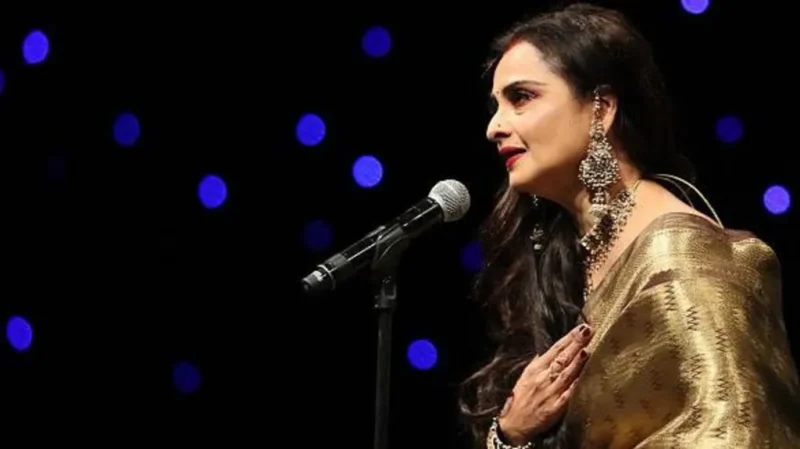
Yet, when she leans into her diva image, like in the sensuous song Kaisi Paheli Zindagani from Parineeta (2005), or when she takes to the stage to dance to one of her old hits, her fans are still glad to celebrate.
Latest Stories
-
I’m greatly worried – NPA boss on threat of higher transport fares
58 minutes -
We are largely import-dependent – NPA boss on Ghana’s fuel vulnerability
1 hour -
Ghana’s fuel market is built for turbulence – NPA’s Edudzi Tamakloe explains why
2 hours -
Postponement not an option as Kenya races to be ready for Afcon 2027
2 hours -
ICE agent shoots and wounds man in Texas as locals demand answers
2 hours -
Ed Sheeran admits ‘mistakes’ at first show since Macklemore controversy
2 hours -
We are ready for the turbulence – NPA boss on Ghana’s fuel crisis
3 hours -
Lady I wanted serious relationship with said she’s not ready – Rema
3 hours -
I’ll never discuss my finances with man, even if he’s my husband – Nancy Isime
4 hours -
Wizkid, Wande Coal advised me on how to leave school for music – Davido
4 hours -
Senegal job an ‘absolute dream’ for new boss Vieira
4 hours -
Harry and Meghan’s media treatment echoes what happened to Diana, Earl Spencer tells BBC
4 hours -
Nvidia boss rejects AI extinction fears as ‘doomsday narratives’
4 hours -
Workers came across human remains – and unearthed a mass grave of 572 people
4 hours -
Each Jehovah’s Witness member now decides whether to accept or donate main blood components
5 hours