

Audio By Carbonatix
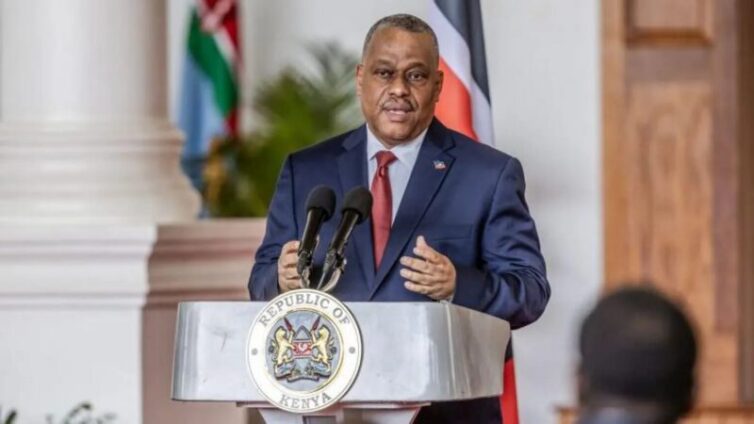
Haitian Prime Minister Garry Conille has been fired by the country's ruling council less than six months after he took office.
An executive order, signed by eight of the council's nine members, named businessman and former Haiti Senate candidate Alix Didier Fils-Aime as Conile's replacement.
Conille, a former United Nations official, was brought in to lead Haiti through an ongoing, gang-led security crisis and had been expected to help pave the way for the country's first presidential elections since 2016.
He described his ousting as illegal, saying in a letter - seen by Reuters news agency - that it raised "serious concerns" about Haiti's future.
Haiti currently has neither a president nor parliament and, according to its constitution, only the latter can sack a sitting prime minister.
Conille was sworn in on 3 June.
"This resolution, taken outside any legal and constitutional framework, raises serious concerns about its legitimacy," Conille's letter was quoted as saying.
Haiti's transitional presidential council (TPC) was created in April after Ariel Henry, Conille's predecessor, was forced from office by a network of gangs that had taken over parts of the capital Port-au-Prince.
Henry left Haiti to attend a summit in Guyana on 25 February 2024 and gang members subsequently seized the city's international airport, preventing him from returning.
The TPC was tasked with restoring democratic order to the Caribbean country, where such violence is rife.
More than 3,600 people have been killed in Haiti since January and more than 500,000 have had to leave their homes, according to the UN, which describes Haiti as being one of the poorest countries in the world.
Two million Haitians currently face emergency levels of hunger, UN data shows, while almost half the population "do not have enough to eat".
One of the country's most powerful gang leaders, Jimmy Chérizier, also known as Barbecue, previously said he would be prepared to end the violence if armed groups were allowed to be involved in talks to establish a new government.
Presidential elections were last held in Haiti eight years ago, when Jovenel Moïse of the Tèt Kale party was elected.
Since his murder in July 2021, the post of president has been vacant.
Gangs in Haiti have capitalised on the power vacuum and expanded their control over swathes of the country, which has effectively been rendered lawless in places.
Last month, it was reported that hundreds of police officers had been deployed to Haiti from Kenya, with hundreds more set to join them.
Latest Stories
-
Cleveland police chief proud of force but being ‘let down’ by funding
18 minutes -
Black Sherif drops new 6-track EP ‘Sun Sherif’
1 hour -
GTA partners Africa’s Brain Bank for Medical City groundbreaking
1 hour -
How to check 2026 WASSCE results on mobile phone
1 hour -
President Mahama is a professional comedian – DKB
2 hours -
Final day of Joy FM Back-to-School Fair: Come shop, save and prepare for the new school year
2 hours -
GSE showed strong performance in August 2026 despite recording more stock losses
4 hours -
If CJ needs ethics law to know SOE comments were wrong, he may not be worthy of office – Arthur Kennedy
5 hours -
Stop touring state agencies and focus on the Judiciary’s problems – Arthur Kennedy to CJ
5 hours -
Apologise and don’t do it again – Arthur Kennedy to Chief Justice over SOE comments
5 hours -
Chief Justice remains committed to judicial independence, justice and equality – Judicial Service
6 hours -
Ghana concludes evacuation of citizens from South Africa; total returnees reach 1,900 – Ablakwa
6 hours -
Africa must define its own green transition path – Prof Fatima Denton
7 hours -
WASSCE 2026: English Language performance falls to 62.4% – WAEC
7 hours -
WASSCE 2026: Social Studies records sharp rebound as Maths, Science also improve
7 hours