

Audio By Carbonatix
When handbag designer Sherrill Mosee learned that roughly 2,700 purses and backpacks she had ordered from her Chinese manufacturing partner would not make it onto one ship this autumn, she was initially content to wait.
Then Donald Trump was re-elected as US president.
"I'm like, okay, we've got to bring those in," said Ms Mosee, founder of MinkeeBlue, a small business based in Philadelphia. Her firm is one of the many thousands across the country preparing for the potential impact of Trump's promises to impose stiff new tariffs on all goods coming into the country.
Those efforts gained urgency this week as Trump said he would take action on his first day in office. He aimed the measures - a kind of border tax - at China, Mexico and Canada, America's top three trade partners.
Writing on social media, Trump said he planned to impose a 25% levy on goods from Canada and Mexico and "an additional 10% tariff, above any additional tariffs," on imports from China.
The post followed his campaign pledge to impose across-the-board tariffs of at least 10% on all imports coming into the US, and 60% or more on goods from China—many of which already face steep duties left over from actions taken during his first term as president.
Some experts have said that Trump's policies may ultimately prove less aggressive than promised and that his statements should be understood as opening salvos in bigger negotiations of migration and drug policy.
But regardless of how policy shakes out, the threats are already having economic consequences, as firms like MinkeeBlue start to stockpile, shift supply chains, rework contracts, and take other steps to guard against the possible impact.
Chris Caton, managing director for global strategy and analytics at warehouse giant Prologis, said his firm had already seen an uptick in activity "on the margin" as businesses respond to possible tariffs by looking for space to stock up.
"There's economic impact whether it's bluster or not," said economist Wendy Edelberg, director of the Hamilton Project and a senior fellow at the Brookings Institution.
In the days after the election, footwear giant Steve Madden told investors that it was moving forward with plans to shift manufacturing outside of China, with the aim of cutting its imports from the country in half over the next year.
Tool and hardware maker Stanley Black & Decker also said it had initiated conversations with its customers about price hikes tied to the tariffs.
Executives at retail giants such as Walmart have discussed similar plans.
Even if Trump's policies remain just talk, Ms Edelberg said the public could see higher prices, as well as possible shortages of some items, as hoarding left some firms scrambling.
Just the simple fact that firms were unsure about what was going to happen was also likely to reduce economic growth in the months ahead, she added.
"Even if firms don't think that these tariffs are going to happen with 100% certainty, it's not zero, so they should be responding," Ms Edelberg said.
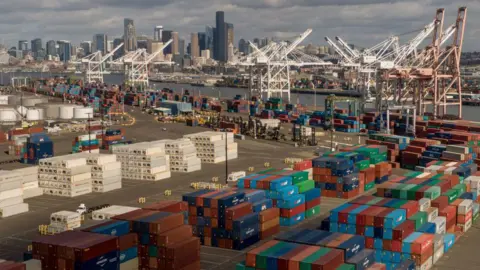
Trump and his advisers have argued that tariffs will help revive US manufacturing and drive a new US jobs boom.
But that can come at a cost, business owners and economists warn.
Martin Pochtaruk, chief executive of Canadian solar panel maker Heliene, said his firm was nearly wiped out in 2018 when Trump imposed tariffs on foreign-made solar panels and it had to absorb the fees.
The firm now does all of its manufacturing in the US, where it employs 400 people. Many of its suppliers have also set up shop in the US, lured by government incentives for renewable energy introduced by President Joe Biden.
Mr Pochtaruk's firm has learned from its experience, changing the design of its contracts so that customers are responsible for unexpected cost changes - whether due to tariffs or the kind of price spikes that hit during the pandemic.
But despite these protections, the possibility of renewed trade tension between countries as closely connected as Canada and the US was worrying, Mr Pochtaruk said.
Some key materials - such as glass - still come from overseas and face likely price hikes. The new administration could also bring other policies that slow growth in the industry.
"We are talking to all of our clients," Mr Pochtaruk said. "There is a lot of anxiety."
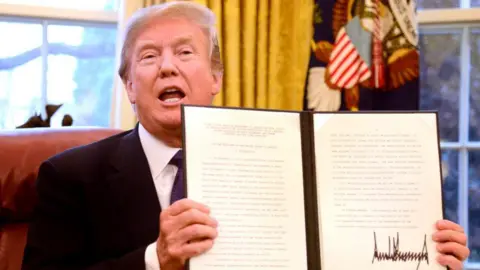
Economists say the evidence from existing tariffs - which have been present for decades in sectors such as clothing and footwear - suggests that while they can protect some firms, the cost is high and they do little to boost overall employment while raising prices for US companies and consumers.
The National Retail Federation (NRF) has warned that tariffs along the lines of Trump's campaign proposals would cost US consumers between $46bn (£36.6bn) and $78bn more annually for apparel, toys, furniture, household appliances, footwear and travel goods.
By NRF estimates, a $40 toaster, for example, would rise in price to $48-$52, while a $50 pair of athletic shoes could jump to $59-$64.
Trump's move on Monday to target Mexico - a key supplier of grocery staples such as fruits and vegetables and historically protected by a free-trade agreement - underscores the tension between his tariff promises and other pledges on the campaign trail to bring down prices for Americans.
Viktor Shvets of Macquarie Capital said that although Trump's ideas were in conflict with each other, he believed in the end Trump's fear of disrupting financial markets would limit his trade actions.
"Risks are high, but we remain convinced that 'guardrails' are sufficiently robust to avoid the worst outcomes," he wrote in a note to clients on Tuesday.
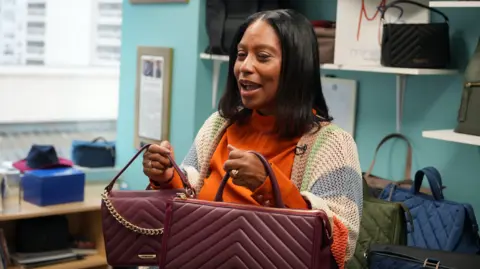
Such bets are little comfort to small business owners like Ms Mosee, who have little extra financial cushion to weather uncertainty.
As a small brand facing significant competition, Ms Mosee said she was not in a strong position to raise prices on her bags, which typically sell for about $180 a piece.
She has been looking in Cambodia and India for a new supplier.
But after a decade on her own, Ms Mosee - a former engineer who has decorated her office with motivational posters promising that "something wonderful is about to happen" - said she probably needed to find a business partner if her business, with its two employees, was to survive the expected changes ahead.
"It's going to be hard," she said. "It's going to be hard all the way around."
Latest Stories
-
Ziope undertakes initiative to build a technologically inclined community, commissions self-help ICT lab
4 minutes -
ECG announces power outage in parts of Tema, Central Region due to network fault, maintenance
31 minutes -
When the Gospel Becomes a Weapon: The church, blackmail and the abuse of faith
57 minutes -
JoyNews’ Jacqueline Ansomah Yeboah selected for UK Media Excellence for Emerging Technology Fellowship
1 hour -
Mental Health Alliance urges government to operationalise Mental Health Fund
1 hour -
Ghana–Holy See agreement heads to Parliament after Cabinet approval
2 hours -
Luv FM Corporate Games 2026: Kumasi Central Prisons, Amanfiman Bank win big amid fun
2 hours -
WAFU B U17: Ghana top Group A after win over Togo
2 hours -
Ho Central Mosque reopens amid unresolved leadership dispute that led to closure
3 hours -
Minority caucus questions GH¢16.4m in Ablakwa’s SA evacuation spending, demands independent audit
4 hours -
Gender Ministry meets Nana Akua Addo’s husband over domestic violence after hospital discharge
5 hours -
UG Vice-Chancellor urges swift operationalisation of National Research Fund
5 hours -
Pope Leo to have surgery after lump found in lung
5 hours -
Joseph Cudjoe writes: Ghana must break free from the dangerous mindset that natural resources are the foundation for wealth
5 hours -
Children among 109 dead after boat capsizes off Djibouti, UN says
5 hours