

Audio By Carbonatix
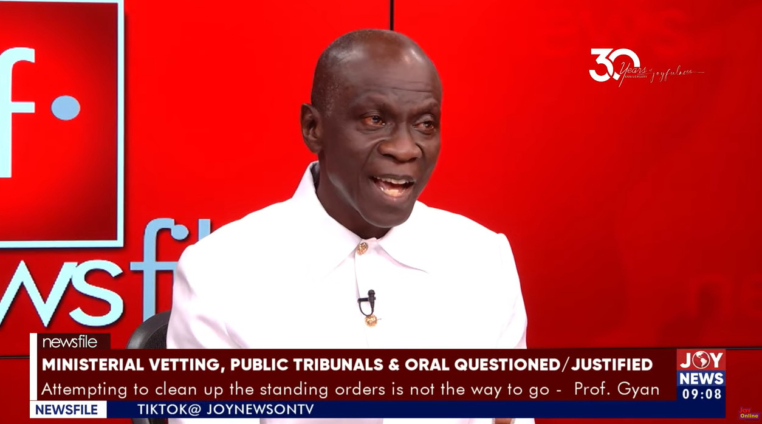
Law professor and legal expert, Prof Kwame Gyan, has criticised Ghana’s current system of vetting ministerial nominees, describing it as inadequate and ineffective in assessing the competence and suitability of nominees.
Speaking on JoyNews’ Newsfile on Saturday, January 18, with Samson Lardy Anyenini, Prof Gyan called for reforms to ensure a more rigorous and transparent process.
“We are looking at the technical competence, integrity, and overall suitability of nominees for the roles they’ve been chosen to perform. Yet, the current vetting process does not sufficiently address these criteria,” he remarked.
He emphasised the significance of the process, noting that the collective competence of the 60 ministers to be appointed will shape the destiny of Ghana’s 35 million citizens.
“These 60 people will determine the future of our country and that of unborn generations. If their collective competencies are inadequate, then we are doomed,” he warned.
Prof Gyan highlighted the critical role vetting plays in reassuring the public and international markets. “When nominees like a finance minister are vetted, their responses should demonstrate competence and inspire confidence in their ability to manage key areas like the economy and the cedi. If this doesn’t happen, the markets and speculators will question their capability,” he said.
However, he criticised the current system, which he described as a mere formality. “In Ghana, once the president nominates you, you are essentially a minister. We do not have a history of rejecting vetted nominees. This defeats the purpose of vetting as a rigorous process to assess competency, integrity, and suitability,” he noted.
He also expressed concerns about the omnibus appointments committee, calling it outdated and ineffective. “The omnibus approach is not the way to go. Even with the new standing orders, the process remains flawed. We need to adopt a system that brings out not just integrity but also competency, as seen in the American system,” he suggested.
Prof Gyan advocated for a complete modernisation of the vetting process, proposing that it be treated as a serious job interview.
“These are top-level jobs, and we must ensure the nominees are capable. The rule that allows only two members to ask one question each is insufficient. This process needs to be revised to reflect the seriousness of the positions being filled,” he concluded.
Latest Stories
-
Total revenue & grants stood at GH¢144.5bn in July 2026, lower than targeted amount – BoG
9 minutes -
Ghana Sports Fund urges sports federations to submit credible proposals and measurable targets
12 minutes -
Musk says US government may be behind slowdown of Ukraine drone speeds
30 minutes -
Picking Chief Justices nearing retirement could give Mahama immense power – Bentil
40 minutes -
Netflix to shed 1,000 jobs in steepest cuts since 2022
1 hour -
Burnham had two hospitality dinners with Man City chairman, deleted records show
1 hour -
Semenyo ‘froze’ after alleged racist abuse, court told
1 hour -
‘Shameless’ – Mourinho critical of Vinicius Jr ban timing
2 hours -
Loyalty can outweigh competence in Chief Justice selection – Bentil
2 hours -
Man City suffer as PSG masterclass sets up Champions League win
2 hours -
Customer Service Africa CEO urges business leaders to observe staff and customer interactions
2 hours -
On night of mayhem for Liverpool, Barcola arrives in style
2 hours -
Muzic Mensah finds healing and renewed love in new single ‘WayƐ Late’
2 hours -
FIFA to offer extra £2.6bn for football development
2 hours -
Government backing is no EPA permit – Authority warns GoldBod, ministries
3 hours