

Audio By Carbonatix
Erythrosine, also called Red Dye No. 3, is used as a colourant in various foods, including toffees, candies, and drinks. On the labels of these products, it may simply appear as "Number 3."
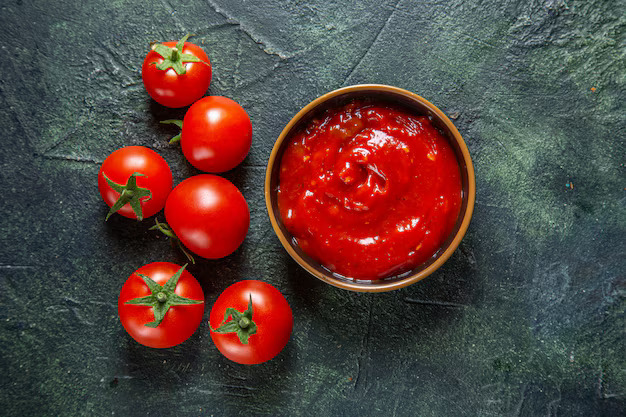
The Ghana Food and Drugs Authority (FDA) does not permit the substance to be used in the production of tomato paste.
This is because it has been found to cause various health conditions and is not allowed in tomato paste production. Starch is also prohibited in tomato paste formulations.
However, a study by the Kwame Nkrumah University of Science and Technology (KNUST) on tomato paste sold in Ghana has found traces of both starch and erythrosine in some samples.
Tomato concentrate, which can be classified as either tomato paste or tomato mix, has become a convenient food item commonly used in Ghanaian homes, fast food outlets, and restaurants.
It offers a relatively cheap and quick alternative to fresh tomatoes, especially when tomatoes are out of season. Over the years, concerns have arisen over the safety of tomato concentrate brands on the Ghanaian market.
The study, conducted in Kumasi and Accra, aimed to assess the quality of tomato concentrates being sold. Eight different brands that conformed to standard labelling requirements were selected.
The researchers found that all the samples had a colour range from red to dark red, a paste-like appearance, and the characteristic taste of tomato concentrate, conforming to standard physical requirements.
According to production standards, tomato paste should contain at least 24% natural tomato content.
However, the total natural tomato content in some of the sampled brands fell outside this recommended range.
Alarmingly, erythrosine was detected in two samples, even though it was not indicated on the labels. The study, published in the International Journal of Food Science, also found starch content ranging from 1g/100g to 24g/100g.
In January, the U.S. Food and Drug Administration (USFDA) completely banned erythrosine from food products due to its potential health risks and has given manufacturers two years to remove it from shelves and eliminate its use entirely.
The research led by Dr. Abena Boakye of the Department of Food Science and Technology states: “The Ghana FDA should not only focus on removing erythrosine from tomato products but also extend its regulations to include manufacturers of confectionery, candies, drinks, and other food products containing this harmful dye. These findings should fuel further research and inform policymakers on the necessary steps to ensure the safety of food products available to consumers.”
They again recommend that these findings be used to inform stakeholders and guide necessary steps to provide safe tomato concentrates and other food products for consumers on the market.
Latest Stories
-
“When I am gone, people will appreciate” – Kurt Okraku
11 minutes -
“I love people who are not only critical but constructive” – Kurt Okraku
15 minutes -
TECNO’s Modular Phone and TAURUS win gold at IFA 2026, recognising breakthroughs in mobile and gaming technology
29 minutes -
Youth Forum in Accra calls for debt cancellation, reparations and African economic independence
36 minutes -
Dr Abu Sakara urges African youth to seize global upheaval for economic emancipation
44 minutes -
Fulham booed off after third defeat in a row
57 minutes -
Joy FM Back-to-School Fair 2026 ends in massive success after two days of discounts and one-stop shopping
1 hour -
Man City maintain 100% start with win over Coventry
1 hour -
Kwesi Pratt urges African youth to reject ‘Gen Z revolution’, reclaim Africa’s resources
1 hour -
Forest and Tottenham both still looking for first win after scrappy draw
1 hour -
Inter Milan mount stunning comeback to beat Napoli
1 hour -
PPF urges African youth to demand debt cancellation and reparations
1 hour -
Kwesi Pratt says reparations must deliver equal rights, African self-reliance
1 hour -
Isaac Dogboe opens reveals mental health battles, calls for support for athletes
1 hour -
MTN Ghana webinar urges SMEs to get financial discipline right
2 hours