

Audio By Carbonatix
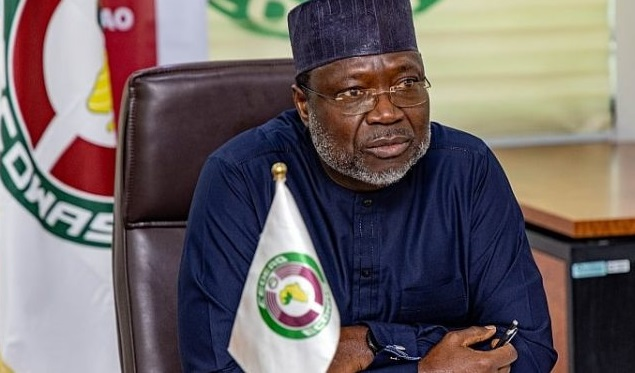
The 50-year achievement of the Economic Community of West African States (ECOWAS) in regional integration is something worth celebrating, Dr Omar Alieu Touray, the President of ECOWAS has said.
He has therefore urged citizens of West Africa not to discount the achievements in the midst of criticisms of the regional bloc.
Speaking in Accra on Tuesday at the official launch of ECOWAS’s 50th anniversary celebrations, Dr Touray acknowledged the difficult political and economic climate but insisted there is still much to celebrate.
“In the current context, many would be forgiven for asking if there is anything about ECOWAS that should be celebrated,” he said. “Our response to such citizens is an emphatic yes – and I have my reasons.”
He described ECOWAS as the most integrated regional bloc on the African continent, citing the Free Movement Protocol which enables citizens of member states to travel, reside and work across borders without a visa.
“Thank God, no ECOWAS member state is among the countries that require Mr. Dangote to hassle,” he said, referencing Nigerian billionaire Aliko Dangote’s recent complaints about travel difficulties across Africa.
Trade and Infrastructure Achievements
On trade, he pointed to the ECOWAS Trade Liberalisation Scheme (ETLS), which has registered over 15,000 companies and more than 50,000 products for duty-free access across the region.
Dr Touray also mentioned the Interconnected System for the Management of Goods in Transit (SIGMAT), now operational in seven countries, as a key initiative reducing customs delays and improving cross-border logistics.
Infrastructure, he said, remains a priority. He outlined a 25-year master plan featuring 201 projects across transport, energy, telecoms, and water, valued at $131 billion. Among the flagship initiatives is the 1,028km Lagos–Abidjan highway, estimated at nearly $15 billion and now ready for investment.
Other major projects include the Banjul–Dakar–Abidjan corridor, the Abidjan–Praia Maritime route, and energy efforts under the West African Power Pool. He also cited ECOWAS’s $340 million off-grid electricity access programme as part of efforts to close the region’s energy gap.
Human development and health
On social impact, Dr Touray praised the role of the West African Health Organisation (WAHO) in coordinating regional responses to Ebola, COVID-19, and Mpox. He added that initiatives in climate-smart agriculture, food security, and vocational training reflect the bloc’s commitment to human-centred development.
He reaffirmed ECOWAS’s record in promoting peace and democracy, citing its interventions in Liberia, Sierra Leone, Côte d’Ivoire, Guinea-Bissau, and The Gambia.
“It was ECOWAS that ensured the will of the people of The Gambia prevailed in 2016,” he said, referencing the bloc’s successful diplomatic and military intervention to end Yahya Jammeh’s rule after he rejected election results.
On maritime security, he noted that no piracy incidents had been recorded in West African waters so far in 2024 — an outcome he attributed to ECOWAS’s coordinated security efforts in the Gulf of Guinea.
Calls for reform
Dr Touray admitted that intra-regional trade remains low, hovering around 12%. He called for urgent reforms to dismantle non-tariff barriers, improve infrastructure, and boost productivity across member states.
He also appealed to local and international investors to tap into the region’s economic potential, underpinned by a population of over 400 million people.
Amid security challenges and the withdrawal of some Sahelian states from the bloc, Dr Touray underscored the importance of collective action. He said dialogue and mediation with Mali, Niger, and Burkina Faso remain ongoing.
“Despite the challenges, I remain optimistic that we will collectively preserve and build on the gains of regional integration — for our people who are united by blood,” he concluded.
ECOWAS
ECOWAS was established in 1975 through the Treaty of Lagos to foster economic integration across West Africa. Its 15 member states share a combined population exceeding 400 million.
Over the past five decades, the bloc has launched peacekeeping missions, facilitated cross-border trade and movement, and supported democratic governance.
However, its unity has come under strain in recent years following a series of military coups in Mali, Niger, and Burkina Faso, alongside rising terrorism threats and economic instability.
Latest Stories
-
Legal vacation does not halt urgent court cases – Chief Justice
10 minutes -
Keta residents react with mixed feelings to fresh fuel price hike
21 minutes -
Managing Director on GH¢150,000 bail over five dud cheques
32 minutes -
BOSTenergies reports strong 2025 performance, pays first-ever dividend to government
56 minutes -
Carlos Queiroz reappointed as Black Stars head coach
1 hour -
Gov’t targets TVET transformation with US$300m World Bank facility
1 hour -
Flying into Ghana with more than 2 phones may face commercial import charges – GRA
2 hours -
Education Ministry warns private schools against use of unapproved textbooks
2 hours -
Travelers with multiple new devices returning to Ghana to pay additional charges – Customs Commissioner
2 hours -
John Boadu: A lifetime of party service, experience and grassroots leadership
2 hours -
Ghana to host 16th African Economic Summit as Friends of Africa brings Global Investment Dialogue to Accra
2 hours -
“We have stabilised the present; now we must secure the future” — Deputy Finance Minister
2 hours -
Broadcast journalist and laboratory scientist Emmanuel Samani declares GAMLS General Secretary bid
2 hours -
Oppong Nkrumah questions Chief Justice’s ‘unprecedented’ tour of state-owned institutions
2 hours -
Online fraud accounts for 47% of Ghana’s cyber incidents – CSA
2 hours