

Audio By Carbonatix
The habit crept up on Kim. She would arrive at garage sales as they were ending to pick up what remained.
“I’d load my car full of the free stuff on the side of the road: clothes, things that needed to be fixed, projects,” she told CNN.
It was only once things spiraled that Kim, 53, who asked to be identified by her first name to protect her privacy, realized she had a problem that was all too familiar: hoarding, a disorder that she’d spent years urging her mother to seek help for.
“I used to get very frustrated and say, ‘Mom, we’ve helped you clean out this room 10 times, and we come back three months later and it’s completely full of sh*t ,” she said.
“I learned about hoarding disorder when I was younger but somehow didn’t recognize it in myself.”
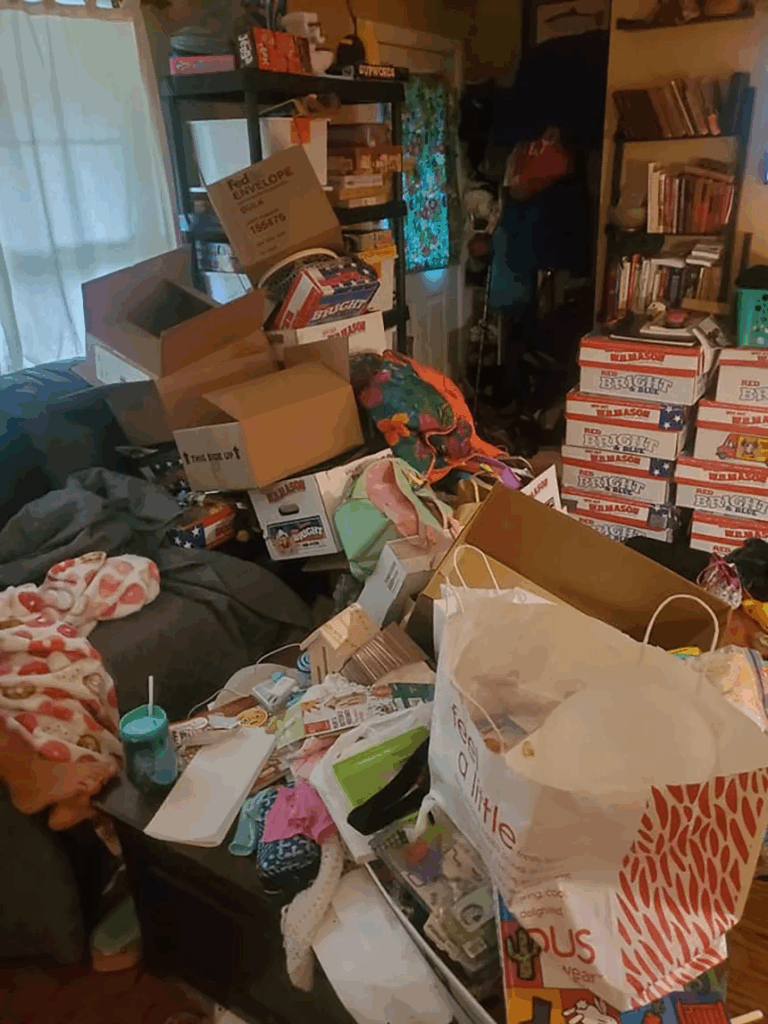
At first, Kim would pile the things around her bed and throughout her bedroom, eventually expanding into other areas of her home, including her living room and sunporch.
Besides the garage sales, she would collect stuff at thrift stores and stored goods she said family gave her “to hold and keep.”
What is hoarding?
Today Kim runs a Facebook support group for 2,100 people with hoarding disorder, which the World Health Organization categorized as a mental health condition in 2018, five years after the condition was added to the American Psychiatric Association’s Diagnostic and Statistical Manual of Mental Disorders. HD is characterized by excessive accumulation of possessions and difficulty in disposing of them .
Kim only sought help when things became unsafe. “The stuff starts piling up, the paths get narrower, and you start to trip (in your own house),” said the single mother.
“Putting things in the garbage is a big struggle — if we know it might go to the right home, that makes us feel better.“
She thinks that mindset dates back to what her grandmother used to say: “Use it up, wear it out, make it do or do without,” she said. “That was a phrase that was knocked into my head ever since I was little,” and it makes her worry about wasting anything.
What people hoard varies: Kim’s focus is books. “It would have taken me 10 lifetimes to read them,” she said of the many boxes she gave away after extensive therapy, including “500 Dr. Phil books.”
Two-thirds of people with the disorder have at least one other psychiatric condition, while physical comorbidities such as arthritis and diabetes are common, according to a 2024 US Senate report. Around 14 million Americans are affected by hoarding disorder, with similar rates across other Western countries.
Hoarding can trigger countless complications, experts say. Bathrooms and kitchens can become unusable, impacting diet and personal hygiene. Housing authorities can threaten eviction leading to homelessness, while in extreme cases children have been removed by social services.
There is also risk to life. Excessive stuff, especially books and paperwork, pose a serious fire hazard and can hamper rescue efforts by blocking escape routes.
Why do people hoard?
Collecting may be in our DNA, according to Dr. Nick Neave, a professor in the psychology department at Northumbria University in the United Kingdom and director of the university’s Hoarding Research Group.
“Throughout history possessions have always been very important — you see people buried with grave goods,” he said. “That urge to collect things, it’s part of your personality, your culture. So hoarding is normal — we’ve all got stuff we don’t need.”
What separates regular collecting from hoarding is often trauma, Neave said.
“All the people who hoard I’ve ever met had traumatic childhoods, whether it’s physical abuse, sexual abuse, neglect, chaotic backgrounds, lack of parents.”
This resonates with Kim, whose symptoms emerged after she experienced an abusive relationship, the death of a friend and a serious medical diagnosis.
“We call it the stuff under the stuff,” said Kim, who lives in New York state. “One of our therapists calls it the one, two, three punch. You can handle one trauma, maybe two, but after that, a lot of people will have hoarding disorder creep in.”
“I tried to fill the hole in my heart and soul with the stuff,” she added.
Neave says hoarding is a “coping strategy which starts off working very well” but can “spiral quickly into a severe addiction and mental health problem that is very difficult to resolve.”
Shame and stigma can then lead to further isolation, he said. “The obvious thing to do is get rid of the clutter, but that doesn’t solve the problem of why they’ve got it in the first place. If you’re not treating that issue, it’ll come back.”
Latest Stories
-
Black Challenge unveiled with sights set on Amputee World Cup glory
14 minutes -
Pay striking teachers before expressway spending, Dr Kingsley Agyemang tells government
59 minutes -
Customs intercepts assault rifle, two pistols and 610 rounds of ammunition at Tema Port
1 hour -
PKO boxers secure wins at Odwira Festival
1 hour -
South Tongu Records Rise in Teenage Pregnancy
2 hours -
Cabinet threw out US health compact faster than anything I’ve seen – Mahama
2 hours -
MoFA urges Finance Ministry to reverse World Bank food programme withdrawal over GH¢643m commitments
2 hours -
NAGRAT demands signed timelines before calling off strike
2 hours -
National Investment Quiz: West Africa SHS, St. Louis SHS advance to semi-finals
2 hours -
Shatta Wale appeals to Mahama for balanced framework to tackle social media abuse without stifling free speech
2 hours -
Education Ministry urges data-driven talks to resolve teacher impasse
2 hours -
‘What we wanted was money to buy medications’ – Dr Nawaane on US health support
2 hours -
Osman Ayariga leads NDC team to vet constituency aspirants in Central Region
3 hours -
‘We shouldn’t allow their drugs in just because they’re giving us $100m’ – Dr Nawaane
3 hours -
US health deal medical records are a ‘no-go area’ – Parliament health committee
3 hours