

Audio By Carbonatix
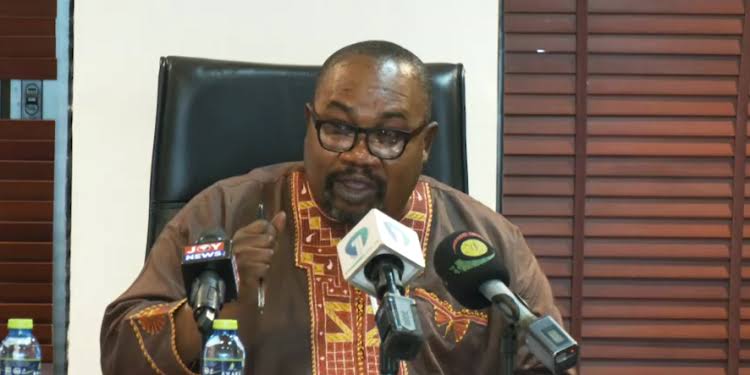
Ghana must retain control over any medical records shared with external partners under international health agreements, the Chairman of Parliament’s Select Committee on Health, Dr Mark Kurt Nawaane, has said.
He described medical records as a “no-go area” and said Ghana must first establish exactly what information an international partner is seeking before agreeing to any data-sharing arrangement.
Dr Nawaane said Ghana routinely provides international organisations with health statistics such as maternal and child mortality rates and life expectancy.
He, however, stressed that such aggregate statistics should not be treated in the same way as medical records.
“As a sovereign state, we decide what we put out there,” he said.
According to Dr Nawane, Ghana already shares health data with the international community, although some of the available information may not always be current.
He said the situation becomes fundamentally different when an agreement refers to specific medical records.
“Medical records are medical records. It should be a sovereign right to decide what to put out there for people to know and what not to put out there,” he stated.
Dr Nawaane said Ghana must carefully scrutinise the wording of any proposed agreement to determine exactly what is covered by a reference to “medical records”.
He questioned whether such a provision could potentially extend beyond national health statistics to information relating to specific groups.
“Is it that if they ask us for the aggregated medical records of politicians in Ghana, whether we should be able to supply them, or aggregated medical records of women?” he asked.
For him, the critical issue is not whether Ghana should cooperate with international health partners, but the scope, purpose and control of any information shared.
He said Ghana must be able to determine what information is released, who has access to it and how it can be used.
Dr Nawaane’s comments come after President John Mahama explained the government’s decision to reject a proposed US health compact intended to replace funding previously provided through the United States Agency for International Development.
He spoke on TV3.
President Mahama said the Ministry of Health reviewed the proposed arrangement and flagged provisions relating to pathogen information, medical records, counterpart funding and the inspection of medicines and medical products.
The President said Cabinet rejected the proposal after reviewing those provisions, describing some of the conditions as unacceptable.
The issue of health data has also featured in negotiations between the United States and other African countries. The Associated Press reported that Zimbabwe rejected a proposed health agreement in part because of concerns over a requirement to share sensitive health data.
For Dr Nawane, Ghana’s engagement with international partners should therefore be guided by clear limits on what health information can be shared.
He maintained that while health cooperation remains important, Ghana must preserve its authority over sensitive medical information and ensure that any data-sharing arrangement is clearly defined and subject to appropriate safeguards.
Latest Stories
-
NAGRAT demands signed timelines before calling off strike
3 minutes -
National Investment Quiz: West Africa SHS, St. Louis SHS advance to semi-finals
25 minutes -
Shatta Wale appeals to Mahama for balanced framework to tackle social media abuse without stifling free speech
28 minutes -
Education Ministry urges data-driven talks to resolve teacher impasse
30 minutes -
‘What we wanted was money to buy medications’ – Dr Nawaane on US health support
30 minutes -
Osman Ayariga leads NDC team to vet constituency aspirants in Central Region
35 minutes -
‘We shouldn’t allow their drugs in just because they’re giving us $100m’ – Dr Nawaane
39 minutes -
US health deal medical records are a ‘no-go area’ – Parliament health committee
46 minutes -
Teachers’ strike: Gov’t has shown no seriousness on Collective Agreement – GNAT
46 minutes -
GES to submit more data to CAGD to process outstanding teacher promotion arrears – Education ministry
57 minutes -
I wish to experience childbirth; I’m jealous of women – Okyeame Kwame
1 hour -
Manhyia South constituents demand apology from EOCO over attempt to ‘unlawfully’ arrest MP
1 hour -
Twelve women have been killed in one part of South Africa since July. Here’s what we know so far
1 hour -
OMJ Foundation commits to supporting transport, safety and livelihoods of commercial riders in Akuapem South
1 hour -
The Reciprocity crisis: Why Ghana welcomes British Professionals while the UK relegates ours
1 hour