

Audio By Carbonatix
The ATP will introduce an extreme heat rule from the 2026 season, which will allow players on the men's tour to take a 10-minute cooling break during best-of-three-sets singles matches.
The rule is similar to measures the WTA - which governs women's professional tennis - brought in more than 30 years ago to protect players in the heat.
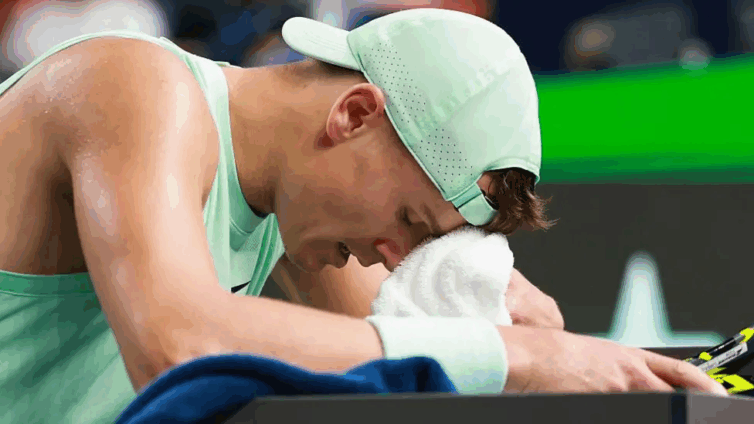
At the Shanghai Masters in October, temperatures were as high as 34 °C and the humidity at 80% in the daytime. After world number 15 Holger Rune needed medical treatment during his third-round match, the Dane asked an official: "Do you want a player to die on court?"
In a statement, the ATP said the policy was for "strengthening protections for players competing in extreme conditions".
The new rule is based on the Wet Bulb Globe Temperature (WBGT), which measures heat stress in direct sunlight. It involves observing temperature, humidity, wind speed, sun angle, and cloud cover.
If the WBGT reaches 30.1 °C or higher during the first two sets of a best-of-three match, either player can request a break of 10 minutes to cool off.
Under the supervision of ATP medical staff, players can hydrate, change clothing, shower and receive coaching.
Play will be suspended when the WBGT exceeds 32.2 °C.
"The new heat rule provides a structured, medically supported approach to managing extreme heat, with the objective of safeguarding player health, while also improving conditions for spectators, officials, ball persons and tournament staff," the statement added.
Players have spoken out about gruelling heat conditions at both men's and women's tour-level and Grand Slam tournaments in recent years, with this year's Shanghai Masters and Wuhan Open, also held in October, facing criticism over their sweltering conditions.
Britain's Emma Raducanu had to retire from her first-round match in Wuhan with dizziness. 24-time Grand Slam winner Novak Djokovic described the Shanghai heat as "brutal", Giovanni Mpetshi Perricard said he felt like he was "dying on the court" because of the humidity and Jelena Ostapenko revealed she had "suffered heat stroke" after retiring through illness from her match.
The women's WTA heat rule has been in place since 1992 and is used throughout the year at all tournaments.
Latest Stories
-
GCIF cautions public as criminals deploy AI in phishing attacks
58 seconds -
Mortuaries and Funeral Facilities Agency gives unlicensed mortuaries 10 days to regularise operations
14 minutes -
Five ‘last mile’ communities in the Upper West Region receive five ambulances after years of struggling to access healthcare
19 minutes -
Stephen Kojo Adjei
26 minutes -
Govt building pathways for Ghanaian youth to compete across African markets – Opare Addo
35 minutes -
DCOP Rtr Kwaku Ayesu Opare-Addo
35 minutes -
Epiroc urges businesses to deepen support for education in mining communities
40 minutes -
Jay-Z rape accuser says her allegation was false
41 minutes -
KNUST SHS, OWASS, YAGSS progress to national stage of Public Speaking Competition
44 minutes -
10 rooms destroyed in Bebianiha house fire
47 minutes -
Government repatriates 180 Ghanaians from Libya
51 minutes -
GNAT demands independent probe into death of teacher at Gindabour
53 minutes -
Mark Carney says he has considered possibility of US military action against Canada
53 minutes -
Gindabour: GNAT demands GES statement on death of teacher
53 minutes -
6th Western Gospel Awards unveils nominees ahead of November ceremony
54 minutes