

Audio By Carbonatix
A major push to strengthen Ghana’s response to the climate crisis was highlighted at the 2026 Climate Health and Education Conference held at the Department of Earth Sciences at the University of Ghana, as leading academics and education experts called for stronger integration of climate education into the national curriculum.
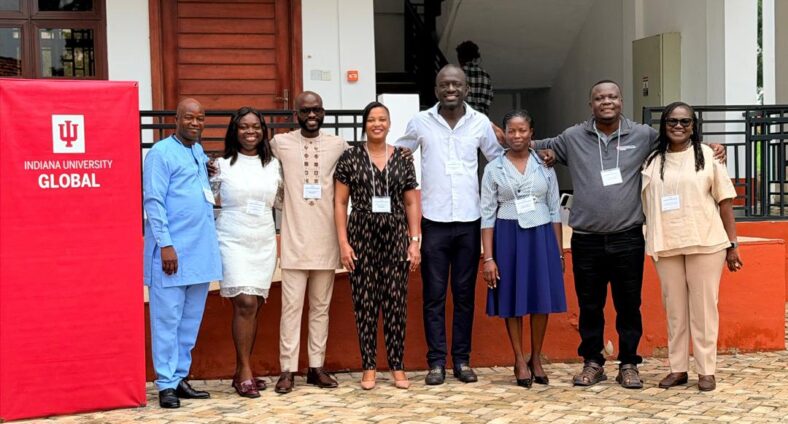
The conference, jointly organised by the University of Ghana, the University of Education, Winneba (UEW), and KNUST in partnership with Indiana University, brought together researchers, policymakers, and teachers to advance efforts aimed at strengthening Ghana’s climate action through education, research, and collaboration.
Delivering a key presentation, Assistant Professor of Earth and Environmental Sciences at Indiana University Indianapolis, Samuel Nyarko, raised concerns over persistent misconceptions about climate change among educators and students.
He said studies conducted over the past five years showed that although many teachers have a good understanding of climate issues, significant gaps and misconceptions still remain.
“In the past five years, we’ve been conducting a series of research looking at the ideas and knowledge that teachers and university students in Ghana have about climate change,” he explained. “We found that while a lot of them have very good knowledge about climate change, there also exist a lot of misconceptions and wrong ideas.”
He cited examples of misinformation, including the misattribution of climate change to unrelated health conditions.
“For example, a lot of teachers attribute climate change to ozone depletion and think of climate change as the main cause of cataracts and other diseases that are not really related to climate change,” he added.
According to him, the findings informed the development of a new curriculum designed to improve climate literacy among teachers.
“We came together and thought of developing a curriculum to help teachers understand these concepts and also teach them effectively in their classrooms,” he said.
However, Dr. Nyarko also expressed concern about government investment in climate education, arguing that teacher training has been largely overlooked.
“Of the $12 billion that they’ve spent on climate mitigation in Ghana, I tell you, not even a dollar has been put into training teachers to effectively teach climate change,” he stated.
He urged stronger action, including curriculum reforms at the basic education level. “Government should try bringing earth sciences, environmental science education into the basic curriculum,” he added.
Speaking at the conference, Program Manager of Indiana University Ghana Gateway, Dr. Abigail Mecry Opong Tetteh, highlighted the importance of bridging global expertise with local realities through teacher-focused training.
She explained that the programme is designed to empower educators across the country, not just in Accra, but in all regions.
“We always talk about climate change in conferences and workshops, but we do not involve teachers. Now the gap is that there’s a disconnect between what we hear on the radio and what teachers teach in the classroom,” she said.
Dr. Opong Tetteh noted that the workshop was intentionally designed around the Ghanaian context, with facilitators drawn locally to ensure relevance.
“It is not something imported from Indiana, but using Ghanaians and Ghanaian context. That is what the curriculum is about,” she said.
She added that the impact would extend beyond the 61 participating teachers, who were selected from across the country.
“They will go out there and also impact their communities,” she said, describing the initiative as a ripple effect aimed at improving climate education nationwide.
Also speaking at the conference, participant and Senior Lecturer at the University of Energy and Natural Resources, Dr. Benjamin Darko Asamoah, stressed the urgency of climate education in addressing human-driven climate change.
“Looking at the major cause of climate change, which is anthropogenic activities, it is very important that we receive some bit of training and education so that we as educators can go back to the classroom to impact our students,” he said.
He added that the workshop provides a valuable platform for knowledge exchange among experts.
“We believe it’s going to be an interactive session where we are going to share experiences, and they will add to our knowledge so that we can be thoroughly equipped to also go back and teach,” he noted.
The conference underscored growing concerns about climate impacts such as flooding and heat stress already being felt across Ghana, while reinforcing calls for stronger policy action, teacher training, and curriculum reforms as part of the country’s broader climate response strategy.
Latest Stories
-
Demand and savings deposits decreased in August 2026, but currency outside banks increased by 4%
24 seconds -
Fiscal policy implementation poses downside risk to inflation – BoG
35 minutes -
Organised Labour should seek fair adjustment, not excessive pay rise – Labour consultant
38 minutes -
BoG maintains medium-term inflation target of 8 ± 2%
46 minutes -
Sammi Awuku urges NPP Germany to unite ahead of 2028 elections
1 hour -
The Inconvenient Truth: We cannot pray for the cure while protecting the disease
2 hours -
MTN Ghana trains civil society organisations on artificial intelligence
3 hours -
GoldBod FX framework aims to make dollar supply predictable – Acheampong
3 hours -
How does a Ghanaian team make it to the BAL?
3 hours -
Ghana’s investment climate presents opportunities for industrial growth and job creation.
3 hours -
‘I paid thousands to a company for jobs that never came’
4 hours -
SSNIT intensifies informal sector enrolment drive with Techiman float
4 hours -
Ghana seeks long-term mining investments that benefit local communities – Armah-Kofi Buah
4 hours -
GHATOF demands compensation for 85 businesses affected by La Pleasure Beach demolition
4 hours -
Bono Regional Minister calls for investor education to drive economic growth
4 hours