

Audio By Carbonatix
It hangs in the air before most Ghanaians are fully awake. The smoke from burning rubbish at the end of a street. The exhaust from tro-tros and trucks sitting in traffic that barely moves. Dust lifted from unpaved roads, fumes drifting from fish smokers and roadside food vendors, emissions from factories and construction sites, all of it mixing, settling, and entering the lungs of millions of people who have no idea it is happening.
Air pollution in Ghana is not one problem. It is many problems arriving at the same time, from the same directions, every single day.
And it is killing people. The State of Global Air report estimates that approximately 32,000 Ghanaians die every year from causes linked to air pollution, making it one of the leading environmental health threats in the country. The World Bank has put a price on it too, estimating that Ghana loses billions of dollars annually in productivity and healthcare costs. Yet the issue remains largely invisible in public conversation, because unlike a flood or a fire, polluted air does not announce itself. It accumulates quietly, in lungs, in blood, in years shaved off lives.
It is into that silence that six young Ghanaians have decided to speak.
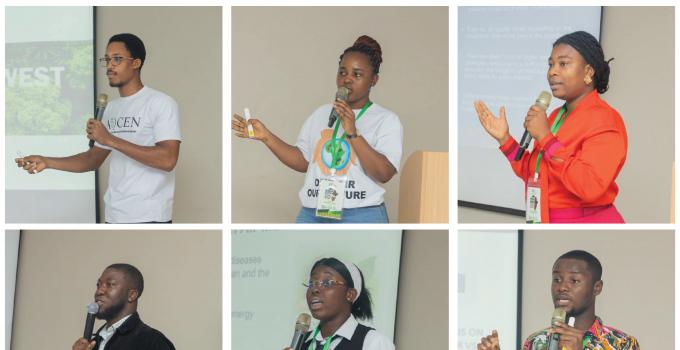
Selected as Air Quality Ambassadors under the African School on Air Quality and Pollution Prevention at the Kwame Nkrumah University of Science and Technology, Shaddai Empress Molson Gattor, Godwin Ebo Fosu, Mercy Mawunyo Apaw, Terry Kwame Azaglo, Amina Amponsah and BillChris Tetteh Ashiangmor each came to this work from a different direction, a personal loss, a research encounter, a community with no protection and no information. What they share is the same conclusion: the problem is serious, it is growing, and most people do not yet understand how close to home it already is.
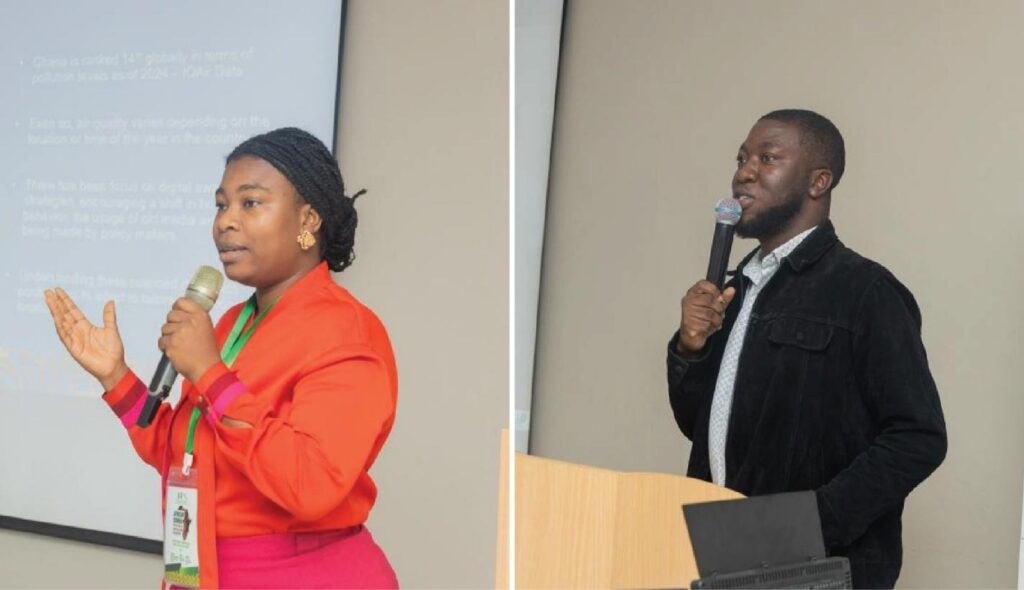
Miss Shaddai Empress Molson Gattor, Project Lead, Breathe Easy Live on West Africa (left), and Mr. Terry Kwame Azaglo, Project Lead, Coastal Champions for Clean Air: A Network & Knowledge Platform for Ghana's Fish Smoking Processors (right)
Shaddai Empress Molson Gattor knows that better than most. In 2018, she lost a friend named Franklina, a young woman with asthma who had an attack after someone burned rubbish outside her window and did not survive. That loss became the engine of everything that followed. She now goes into churches, schools and communities, training people to become what she calls air guardians, people who take responsibility for the air around them and pass the message on.
"Clean air is not a privilege, but then it is a right for everyone."
She is also writing a children's storybook on clean air, convinced that the surest way to change behaviour in a home is to put the right information in the hands of a child first.
"If we can really shape the minds of children now, then it means that we are building healthier homes."
And she is direct about what drives her past the grief of losing Franklina into sustained action.
"This has motivated me and then pushed me to want to let people understand why it matters for our air to be clean."
Godwin Ebo Fosu came to the same place through research. A research assistant with a background in agricultural and environmental engineering, he describes Ghana's air pollution reality not in data but in a scene most Ghanaians would recognise immediately, a mother burning rubbish with a baby strapped to her back, both of them breathing in the smoke, neither of them connecting it to anything that matters.
"Sister Afia herself is coughing. And her daughter at the back, most often are silent, because for them, they don't even know what's happening. And these are the risk factors."
Through his Catch Them Young initiative, he takes this into primary schools, giving children air tracker cards and asking them to spend a week observing sources of air pollution in their communities. The reflections that come back are striking.
"Some were much more emotional. This tells us that the children were much concerned when they got to know the real meaning and the figures behind air pollution."
He has also gone further upstream, submitting air quality data on PM2.5 and PM10 to the Volta Regional Coordinating Council, challenging a region that calls itself Ghana's Oxygen City to earn the name with evidence.
"If you are saying it's an oxygen city, if you are saying it's a clean air, there needs to be data that should back it."
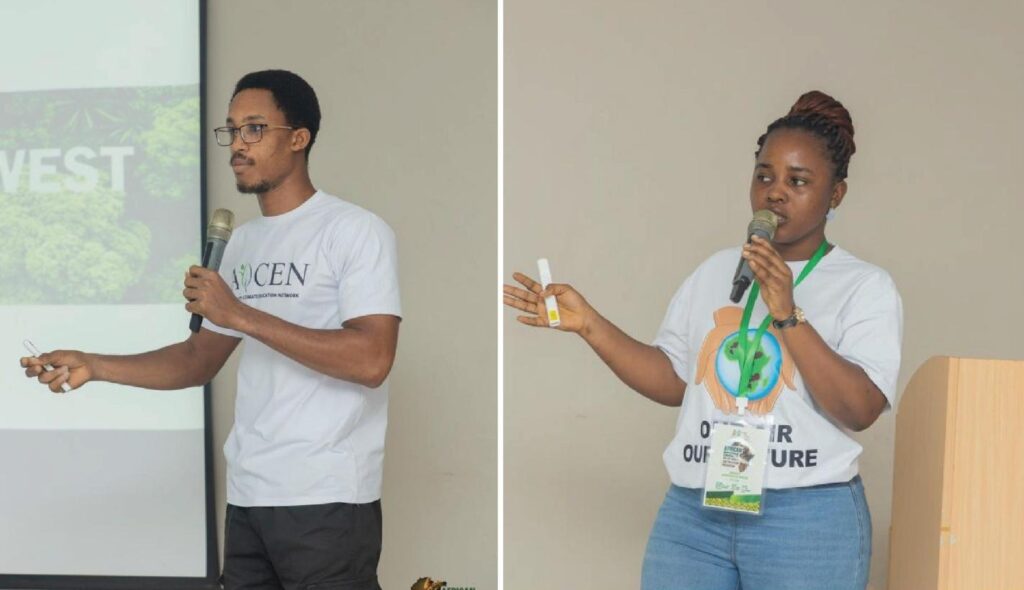
Mr. Billchris Tetteh Ashiangmor, AQCEN Team Lead, Breathe Clean West Africa (left) and Miss Mercy Mawunyo Apaw, Project Lead, Our Air Our Future Team (right)
The scientific infrastructure behind this advocacy is being built, in part, by Mercy Mawunyo Apaw. An MPhil student in meteorology and climate science at KNUST, she is working on the Ghana Air Quality Data Hub, a centralised platform developed in partnership with the EPA and the Clean Air Fund that aims to bring together air quality data currently scattered across institutions, projects and hard drives.
"Most projects have data, but after the project ends, it sits with them. What we aim to do is to bring these diverse data sets into one single centralised in-country platform, where it will be easier for everybody to access and use."
The hub is expected to be ready by the end of 2026. Her own research adds another layer to the picture, she studies how strong winds ahead of rainfall carry invisible dust and aerosols across cities, exposing people who are simply trying to get home before the rain.
"During this rush hour, people are trying to find shelter before the downfall, but they are not mindful of the air they breathe, because as at the time, the wind is strong."
She has watched people dismiss the issue even when they are surrounded by it, workers in polluted environments who have been there for years and see no visible effects yet.
"Those who have the knowledge about it feel like, you know, it's normal. I've been working in this environment for 20 years, for 10 years, and I don't see any effects on me. And that is where the shock is."
Terry Kwame Azaglo, a climate scientist who has worked with the EPA on climate action programmes, has spent time in Jamestown talking to fishmongers who spend hours each day surrounded by smoke. They know the air is bad, he found. What they lack is an alternative they can afford. A cleaner fish-smoking technology from CSIR costs thousands of cedis, far beyond the reach of most.
"The data translates into their skin burns, their eye problem, their lung cancers and all of that."
He saw the same pattern elsewhere, a car painter scraping surfaces without a mask in the airport area, particles visibly lifting into the air around him.
"I happened to speak to one. And then he told me that, oh, it's not a problem."
Progress is being made, he says. But not fast enough.
"Yes, we are making progress. The progress is not as fast, but we will eventually get there."
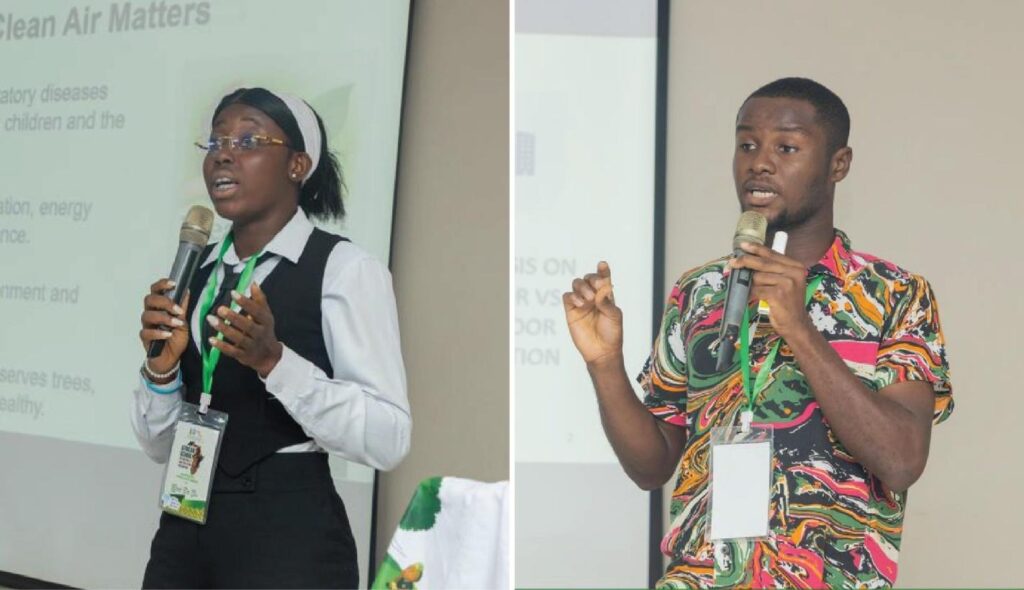
Miss Amina Amponsah Fordjour, Project Lead, Breathing Green (left) and Mr. Godwin Ebo Fosu, Project Lead, Catch Them Young: Clean Air Education for Kids (right)
In Tamale, Amina Amponsah has established air quality clubs in senior high schools and trained more than 100 student ambassadors through her Breathing Green initiative. She has watched students go home energised with what they have learned, and sometimes be ignored by parents who only trust what they hear on the radio or television.
"Students may learn about cleaner air, but when their parents in the house are still burning, cutting down trees and handling waste poorly, the problem still remains."
Her answer is to go wider, local radio, low-cost air quality sensors in communities, and a children's book she is developing. When she visits schools, she says, the appetite is there.
"Students are actively participating in awareness activities, discussion and peer education. They now know the danger of open burning, unnecessary cutting down of trees and poor waste management."
And the urgency, she believes, cannot be overstated.
"Awareness is improving, but people still underestimate how dangerous polluted air can be. This is why continuous awareness, research and community engagement is very important."
BillChris Tetteh Ashiangmor takes the campaign to where young Ghanaians already spend most of their time. His Air Quality Climate Education Network runs monthly webinars, community engagements and digital campaigns built on one clear-eyed observation about human attention.
"Averagely in a day, you and I spend not less than six hours on our mobile phone. We are taking awareness to where people already are, and that is on social media."
He is frank about why air pollution has struggled to break through as a public concern compared to climate change.
"Air pollution, they say, is a silent killer. And so once we don't see the effect of air pollution immediately, people don't tend to give attention to it. Unlike climate change where there are droughts, you can see that. But when it comes to air pollution, it takes a while."
He has engaged drivers, traders, hawkers and school children, and concluded that no single group worries him more than another, because the exposure is universal.
"Everybody, not one single aspect or group of people, but every single person is being affected. And so the focus should be on how can we prevent this to not affect everybody."
Taken together, these six represent a generation of Ghanaians who are not waiting to be invited into the clean air conversation. They are building it in fishing communities and farming villages, in school halls, church pews, research labs and social media feeds, one engagement, one data point, one storybook at a time.
The problem remains large, and the distance between what is being done and what is needed is significant. But Shaddai Gattor, who lost Franklina to burning rubbish outside a window and turned that loss into a movement, does not speak about this work in the language of hopelessness.
"If we can really shape the minds of children now, then it means that we are building healthier homes. We are going to build healthier schools and communities from now till the next 20 years. And we wouldn't really have to worry about our air being polluted so much."
"That is the goal."
This story was a collaboration with New Narratives. Funding was provided by the Clean Air Fund which had no say in the story’s content.
END.
Latest Stories
-
Ghana explores centre of excellence for hearing, communication and cochlear implant care
42 minutes -
Schizophrenia-related disorders lead mental health cases recorded in Ghana
1 hour -
Dutch authorities enlist Ghana in hunt for fugitive drug lord Bolle Jos
1 hour -
Ghana housing finance conference adopts communiqué to improve affordable housing access
6 hours -
Special Initiatives Minister urges Wa Technical Institute to enrol more girls as EU-backed solar training lab opens
6 hours -
In the matter of my first year at the Bar
7 hours -
ActionAid Ghana calls for an end to child marriage, greater investment in girls’ rights
7 hours -
Newsfile to tackle World Cup visa scandal, beach demolitions, education strikes, BRICS bid
7 hours -
UK-Ghana Trade & Investment Summit: Trade Resource Centre to help businesses maximise UK-Ghana trade opportunities
7 hours -
Embassy of Denmark celebrates World Maritime Day
7 hours -
Linking LEAP to productive inclusion could cut extreme poverty by 2030 – UNICEF
9 hours -
Trade Ministry backs use of creative arts to rehabilitate prison inmates
9 hours -
Negotiations with government to continue despite strike suspension – GNAT
9 hours -
‘Ghana cannot afford to waste public resources; every cedi has a job’ – Ato Forson
9 hours -
Ghana expects economic boost as World Assemblies of God Congress brings 10,000 delegates to Accra
9 hours