

Audio By Carbonatix
Many children find themselves singing at school in the run-up to Christmas - at a nativity play or carol concert, often with parents watching proudly on.
But new data suggest singing is much less common throughout the rest of the school year, especially after pupils leave primary school.
Now, an association of music teachers says every school should have a choir, to help pupils embrace music after a years-long decline in its popularity as a GCSE subject.
The government says it is investing in high-quality music teaching and that a "renewed curriculum" will encourage more people to study it.
In a recent survey, Teacher Tapp asked just under 10,000 teachers in England how often their whole school sang together in assembly.
Over half of state secondary school teachers (57%) said their pupils never sang together in assembly, while just 13% of private secondary school teachers and only 4% of primary teachers said the same.
Teachers were separately asked whether their schools had a choir. Just over a third (36%) of teachers at state secondaries reported having no choir at their school, compared to just 8% of private school secondary teachers.
Having access to multiple school choirs was much more common at private schools, with three-quarters (77%) of private secondary teachers saying their school had more than one choir, compared to 27% of state secondary teachers.
Jackie Bowen, head teacher at The East Manchester Academy, says secondary school pupils can feel "embarrassed - or that maybe it's not cool to sing like it was in primary school".
But she says singing and music are priorities at the school.
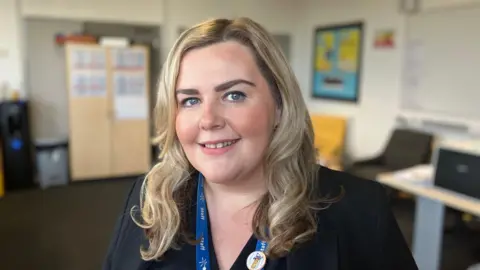
"We know the intrinsic value of music, but also what it does for students' development, mental health, and its impact on academic achievements," she says.
"So we've run lots of initiatives to try and break down barriers to music."
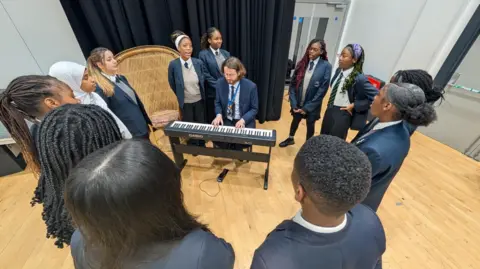
The school offers a music hub once a week, giving pupils time with specialist teachers from the Royal Northern College of Music.
At lesson changeover, students hear classical music instead of the traditional bell.
The school has also established its first gospel choir.
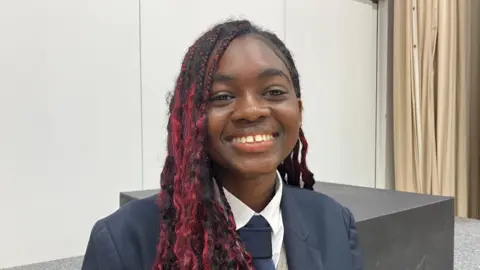
Year 11 student Mercy, who's part of the choir, says she always wanted to continue singing at secondary school.
"In primary, they say you have to sing, but when you come to secondary, it's a choice, so most people don't do it," she says.
"I feel like we should all release our voices to the world. Whether you're good or not, sing."
There has been a 25% drop in the number of pupils studying GCSE music in schools in England over the last 15 years, despite an uptick in the most recent figures.
That is partly due to the introduction of a progress measure for schools, the English Baccalaureate, in 2010, which assessed schools based on how many pupils took English, maths, sciences, geography or history, and a language, and how well they performed.
The government recently announced that it would be changing the school curriculum in England to make it easier for more schools to offer arts subjects like music.
There has been some improvement in recruiting new music teachers this year, but the levels still fall 35% short of government's target for trainee music teachers in the most recent stats.
James Manwaring, president of the Music Teachers Association, which represents music teachers across both state and private schools, says every school should have a choir.
"All you need is a room, and you need someone to lead it, and you need students," says James, who is also the director of music at Windsor Learning Partnership - a multi-academy trust of six state schools.
"It's a shame to think some state schools aren't capitalising on that."
He says changes to the school curriculum in England are "very exciting" for boosting music in schools, but says more funding and resources will be needed - "as well as retaining the wonderful music teachers we have out there".
A Department for Education spokesperson said the government was committed to ensuring art, music and drama "are no longer the preserve of a privileged few".
Ministers are "investing millions" to help schools invest in musical instruments and equipment, and "supporting high-quality music teaching through our Music Hubs, they said.
"Our renewed curriculum will also give every young person the skills, knowledge and experiences needed to achieve and thrive, including encouraging more people to study music and other creative subjects."
Latest Stories
-
Power restoration fault suspected in Kumasi Central Market fire
5 hours -
The 7-foot giant of Ngleshie Amanfro: Seven-foot Ghanaian Ephraim Saawa dreams of joining the national basketball team
6 hours -
Government promises support for Kumasi Central Market fire victims
6 hours -
Vibes The Movie: Big Ghun’s Ghanaian film earns five nominations at 2026 REFFA
6 hours -
‘I’m a fulfilled man’—Justice Korbieh on missing out on Supreme Court despite two nominations
7 hours -
MamaCare CEO warns unresolved conflicts among health workers could undermine maternal and neonatal care
7 hours -
Health professionals urged to translate medical knowledge into practice to save mothers
7 hours -
Retired judge Justice Francis Korbieh charges 1,568 new lawyers to uphold integrity
8 hours -
Conflicts among care providers linked to maternal, neonatal deaths – Expert
8 hours -
GIS marks 10th TIME conference, champions improved teaching practices
9 hours -
BRICS Or Balance? What Ghana’s bid really means
9 hours -
GPRTU wants full TRAFFITECH-GH implementation to start in 2027
9 hours -
How 10-mile walks for basic education birthed a 50-year legal career for Justice Korbieh
9 hours -
Mahama announces plans to import electric wheelchairs for PWDs
9 hours -
KGL U17 Colts 2026: Western beat Prempeh Elite Academy to set up final final with Greater Accra Region
10 hours