


Audio By Carbonatix
The Chair of the Research Committee of Tesah Capital, Professor Elikplimi Komla Agbloyor is calling for property tax payment to be embedded into electricity bills, rather than relying on courts or inspectors.
According to him, this is one of the most efficient methods to boost property tax collections.
He disclosed this in an article dubbed “Changing the Narrative: From Persistent Fiscal Deficits to Fiscal Surpluses Part II: Property Taxes”.
He explained that electricity already has near-universal coverage and established enforcement mechanisms, highlighting that ultimately, property owners are responsible for electricity accounts, even when tenants occupy the property.
Under this system, Professor Agbloyor, who is also a Professor of Finance and Risk Management Department of Finance, University of Ghana Business School, said the property tax component is added to the electricity bill, payments are automatically split between Electricity Company of Ghana (ECG) and tax accounts as well as revenue is apportioned between central government and Metropolitan, Municipal, Department and Agencies (MMDAs). “This transforms property tax from a legal enforcement problem into a routine billing process”.
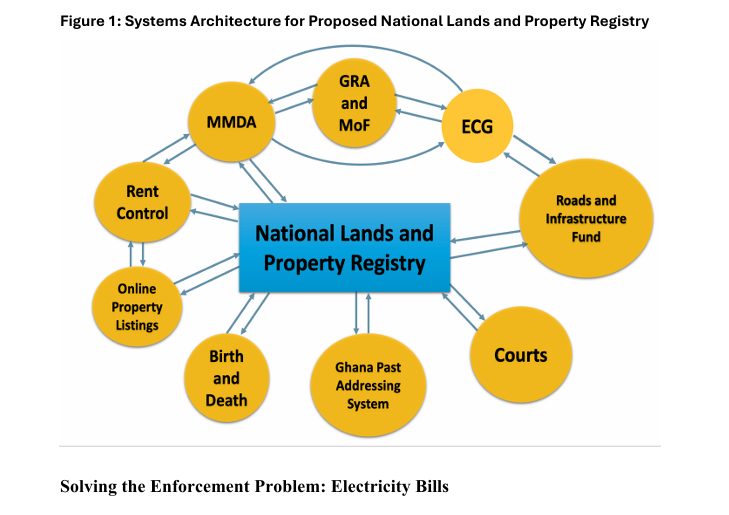
“If we fix the number of properties and rental rates, the compliance rate and the efficiency of collection by ECG or any other means of collection becomes critical. I’m aware of the operational inefficiencies of ECG which can directly impact the realised property tax revenues. Consequently, improving the operational efficiency of ECG is critical. Fortunately, the various stakeholders have a direct interest in ECG operating efficiently and could consequently push for more efficiency at ECG which benefits the entire country”, he added.
Sharing Revenue and Restoring Trust
To align incentives, Professor Agbloyor said property tax revenue should be shared.
These are 60% to MMDAs and 40% to central government.
According to him, the central government’s share should be ring-fenced into a Roads and Infrastructure Fund.
“One reason citizens resist taxes is the perception that revenues disappear into general budgets and that the funds may be siphoned away by corrupt politicians. Visible earmarking for roads and local infrastructure can help rebuild trust in the fiscal social contract”, he mentioned.
Using conservative assumptions, he pointed out that baseline estimates suggest annual property tax revenue of approximately GH¢14.5 billion.
“Region-level estimates based on the number of housing units and conservative rental benchmarks show that Greater Accra and Ashanti dominate, as expected, but every region contributes meaningfully.”, he added.
Latest Stories
-
Oil prices rise as latest fighting resurrects Middle East supply disruption risks
7 minutes -
Kenya airport staff strike delays thousands of passengers
16 minutes -
OSP Act lacked checks to rein in Special Prosecutor, Kpebu says
27 minutes -
Public trust crisis around Special Prosecutor is fueling attacks on OSP – Kpebu
46 minutes -
South African airline defends low-altitude aerial stunt over packed stadium
1 hour -
Special Prosecutor needs adult supervision – Martin Kpebu
1 hour -
Africa’s food systems must be judged by what farmers earn – AGRA
2 hours -
Raphinha & Lamine Yamal score twice as Barcelona beat Rayo Vallecano
3 hours -
Everton agree £40m fee for Monaco striker Balogun
3 hours -
Mudryk to Spurs as Chelsea’s Sanchez heads to Como
3 hours -
Saka scores agaian as Arsenal beat Aston Villa
3 hours -
Man City open talks with Chelsea over Enzo Fernandez move
3 hours -
Man City agree £65m deal for Everton’s Ndiaye
3 hours -
Kushner states regret over World Cup sell-off plan
4 hours -
50,000-litre LPG tanker fire contained on Tema Motorway as Fire Service averts disaster
4 hours