

Audio By Carbonatix
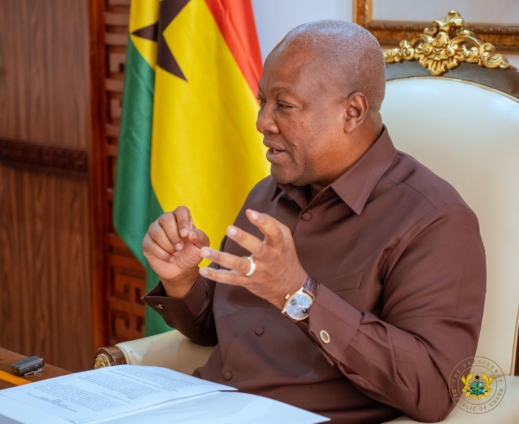
President John Mahama has called on African countries to invest boldly in skills, industrial capacity and unity, warning that the continent risks underdevelopment in a fast-changing global economy if it fails to act decisively.
Addressing global political and business leaders at the Accra Reset Davos Convening Event on the sidelines of the World Economic Forum on Thursday, January 22, President Mahama said the world was entering “an era where countries must compete, innovate, and build or be left behind ”.
Read full text below:
Your Excellencies and my disWnguished colleagues, friends, and partners in global transformaWon.
Let me begin by thanking the World Economic Forum for creating space for this Session, and to our various Strategic Partners, not least the African Development Bank, Global Fund, AfroChampions, Georgetown University, and the Rockefeller Foundation, for stepping forward at a moment when the world’s health and development systems are being tested by disruption, conflict, and a new atmosphere of intellectual retreat.
Of course, my appreciation goes to the Guardians’ Circle of the Accra Reset, led by President Olusegun Obasanjo, the Alliance for African Multilateral Financial Institutions and the Confederation of Indian Industry.
This aXernoon, I stand before you as an African leader born in the heady days of post-independence Africa.
Growing up, I could feel the excitement of my parents and their generaWon about the possibiliWes of our newly won freedom and the right to manage our own affairs.
My country, Ghana, will celebrate its 70th anniversary of independence from colonial rule in March next year.
In the relaWvely short span of seven decades, we have been through a lot.
We’ve seen coup d’etats and periods of democraWc governance. We lived through the Cold War and witnessed the fall of the Berlin Wall. We were excited about the advent of globalisaWon, and we came together as a global family to work on the MDGs and climate change.
Today, as I address you here in Davos, one thing is clear. Our world as we know it is at an inflexion point. The global mulWlateral governance system, universally agreed and accepted aXer the 2nd World War, is breaking down.
Bilateral relaWons among naWons are increasingly transacWonal, and many state and non-state actors are acWng unilaterally in pursuing their own naWonal and parochial interests.
Africa has lagged behind in the past decades, following liberaWon from colonialism, and has been trapped in cycles of conflict and mulWdimensional poverty. Africa has thrived on handouts and humanitarian assistance from the developed world.
While no specific name has not been coined yet for the new global system that will emerge, Africa intends to be at the table in determining what that new global order will look like.
Africa must pull itself up by its own bootstraps.
Global humanitarian assistance is shrinking. Many developed countries, including Europe, are compelled to cut ODA and increase defence spending by the new reality of an unpredictable ally across the AtlanWc.
The COVID experience was a wake-up call. Africa was the last continent to begin receiving vaccines amid a global pandemic. But for the immunological profile and resilience of the African populaWon, many millions would have died in the pandemic.
That is why I am very grateful, your excellencies, ladies and gentlemen, that you made the Wme to be a part of this aXernoon’s Davos Convening of the Accra Reset IniWaWve on the sidelines of the World Economic Forum.
Just months ago, at the UN General Assembly, I introduced the Accra Reset IniWaWve. Not as another declaraWon. Not as a wish list. But as a pracWcal answer to a quesWon millions of young Africans are asking: What should Africa’s response be in a changing global order?
Today, in Ghana, we're answering that quesWon. We're resefng our country— cufng waste, restoring hope, building systems that work.
In my first year of being back in the office, we've shown that democracy works and that change is possible when leadership is focused and accountable to the people.
From a debt-distressed, crisis-ridden economy, we have achieved an impressive turnaround, with a stable macroeconomy characterised by single-digit inflation, a strengthened currency, and increased business confidence.
But here's what keeps me up at night: Ghana's success alone is not enough.
However admirable Ghana’s turnaround story is, we cannot be a jewel in the dirt. We must work together as Africa. We must knit together the patchwork of success stories.
That's why we're here in Davos. To take what's working across many countries in Africa and the Global South and scale it across other countries. To move from resefng one country to resefng the enWre development model.
Let me be direct about what we're up against. Too many of our countries are caught in what I call triple dependency:
- We depend on others for our security choices
- We depend on donors for our health and educaWon systems
- We supply the world's criWcal minerals but capture almost none of the value This isn't sovereignty. It is a trap. And it is gefng worse.
In my quiet moments, as I try to find soluWons, here's what I've learned: Crisis creates Clarity. The clarity is this: We must build our own capacity to act.
There's precedent for what I am proposing.
Twenty years ago, UN Secretary General Kofi Annan and several courageous world leaders, including President Obasanjo here, made a simple, powerful case: HIV/AIDS was killing millions in Africa, and a global response was needed.
This courage created the architecture of the Global Fund, which saved millions of lives in Africa and across the world.
That fight succeeded because leaders decided to act together, with urgency and without excuses. Today, I am not so sure.
The US is cufng funding for the United NaWons system and other global organisaWons that have saved millions of lives. We face an unpredictable world.
This is why Africa must be responsible for its desWny. Today, we face a different pandemic: the pandemic of unfulfilled potenWal.
- Millions of young people have no jobs.
- Health systems that collapse at the first crisis.
- Economies that extract our resources but build nothing lasWng.
If we could mobilise the world to fight a disease, why can't we mobilise to fight poverty? To fight dependency? To fight the systems that keep brilliant young Africans locked out of the future.
In Ghana, we're proving something important—execuWon beats excuses. We're cufng government spending and have reduced the size of government to a record low: 58 ministers and deputy ministers.
We're digiWsing services to end corrupWon. We're training young people for the jobs of tomorrow, not yesterday. We have renegoWated our debt so we can invest in our people, not just service loans.
This is the "Resefng Ghana" agenda. And it's working because we stopped talking about transformaWon and started building it.
Now imagine this same approach across Africa and the global south.
The mulWlateral order and rules-based system may be under threat, but we can forge a new coaliWon of the willing based on a shared vision and mutual respect.
What if we pooled our negoWaWng power on criWcal minerals, so we capture value, not just extract raw ore?
What if we exercised more sovereignty over our natural resources to create prosperity for our people.
What if we built regional manufacturing hubs that create millions of jobs for our young people?
What if we produced our own vaccines, our own medicines, our own technology?
This is the Accra Reset vision. Not a talk shop. Not a declaraWon.
A pracWcal blueprint for how countries can work together to build real sovereignty, the kind you can measure in jobs created, children vaccinated, and young people thriving.
My fellow leaders, let me speak plainly.
In this fast-changing world, we're entering an era where countries must compete, innovate, and build or be leX behind.
Our young people are watching. They're brilliant, they're hungry, and they're running out of paWence.
So, here's what we must focus on:
First, invest in skills. Not just educaWon, but skills that match real jobs in the real economy. Digital skills. Green energy skills. Manufacturing skills. We need a generaWon of young Africans who can build, not just consume.
Second, build together. No African country can industrialise alone. We must create regional prosperity plarorms, manufacturing zones, energy grids, and digital infrastructure that give our businesses scale and our workers opportunity.
Third, negoWate as one. When we bargain separately, we're weak. When we negoWate together on minerals, trade, and climate finance, we're formidable.
Unity should not be a slogan; it must be the strategy.
Fourth, produce at home. From vaccines to semiconductors to solar panels, if we don't make it, we'll always be dependent on someone who does. Industrial policy isn't old-fashioned. It is what will make us survive.
And fiXh, hold ourselves accountable to our people. We cannot ask the world to invest in us if we tolerate corrupWon, waste, and systems that don't work. Reset means reform. And reform means results.
The Davos Commitment.
Friends, we didn't come here to ask for charity. We came to propose a global partnership of the willing, based on a shared vision and mutual respect.
The Accra Reset is building the architecture for a new kind of cooperaWon. One where Global South countries don't just receive programmes but co-design them with our partners in the global north. Where we don't just atract investment but shape it around our prioriWes.
We want to create Prosperity Spheres across regional plarorms where countries coordinate on investment, infrastructure, and jobs.
President Obasanjo oXen reminds me that "Leadership is about legacy. What will you leave behind?"
My answer is simple. We want to leave a conWnent where young people don't risk their lives crossing the Mediterranean, because they have opportunity at home.
We want to leave systems that work, industries that thrive, and naWons that stand tall. Ghana can't do it alone. Africa can't do it alone.
This is a call to every leader in this room. If you believe in a world where prosperity is shared, not just based on narrow interests, join us.
If you believe the Global South deserves partnership, not pity, join us. If you believe the next chapter of human progress will be writen in Accra, Nairobi, Kigali, Abuja, and Cairo, join us.
The Accra Reset is not seeking permission. We're building momentum. From the New York last September to this room in Davos, and to the African Union in Addis Ababa next month, and soon the Oslo Dialogues.
The quesWon is not whether the world needs this. The quesWon is whether we have the courage to build it.
Thank you.
Latest Stories
-
$30m China grant insufficient for Damongo university project – Haruna Iddrisu
2 minutes -
Food vendor recounts how she narrowly escaped New Winneba attack
7 minutes -
Military to secure James Town after massive waste evacuation – Ayariga
8 minutes -
Charlie Kirk murder suspect pleads not guilty as judge clears way for death penalty trial
10 minutes -
Signals Bureau case: ‘We were battle-ready’ – Atta Akyea fires at AG over absence of prosecution team
19 minutes -
NSA sets September 4 deadline for final rectification of biodata mismatches
21 minutes -
Gospel musician Bernice Offei reported missing
26 minutes -
IMF, former gold buyers uncomfortable with Ghana’s gold policy – Asiedu Nketia
29 minutes -
18 years, 66 plays Ebo Whyte has one more story to tell: “Honey trap”
30 minutes -
PHOTOS: McDan and Ayuda claim singles titles in 2026 JoySports Invitational
30 minutes -
IEA describes gov’t proposals on women, marginalised groups in Parliament ‘grossly insufficient’
31 minutes -
Ghana marks 2026 Children’s Day with call to amplify voices against abuse
32 minutes -
TEIN UK–Ireland engages Ghana High Commission on support for students, professionals
33 minutes -
Fire destroys five commercial containers at Kotobabi Down near Antrack Filling Station
36 minutes -
NCD Alliance Ghana urges government to accelerate action on NCDs and mental health
37 minutes