

Audio By Carbonatix
Ghana’s record foreign reserves position has sparked renewed debate about whether the country should prioritise external buffers or invest more aggressively in domestic production to reduce import dependence.
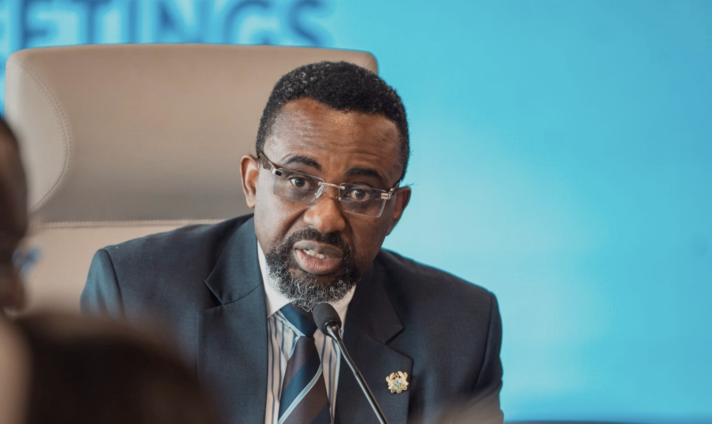
At the Ghana Exim Fireside Chat held in Accra in March 2026, Dr Johnson Asiama, Governor of the Bank of Ghana, addressed the issue directly, offering a perspective that reframes the debate rather than opposing it.
Ghana ended 2025 with US$13.8 billion in gross international reserves, the highest level in its history, equivalent to about 5.7 months of import cover, up from US$8.9 billion the previous year.
The improvement was largely driven by the Domestic Gold Purchase Programme, which processed more than 110 tonnes of gold, valued at approximately US$11.4 billion in foreign exchange, over the period.
As reserves have grown under the Ghana Accelerated National Reserve Accumulation Policy, which targets 15 months of import cover by 2028, questions have emerged about whether such resources could be better deployed to build domestic industry.
Responding to this, Dr Asiama said the issue was not a choice between reserves and investment, but rather how to create the conditions that make investment possible.
“That is exactly why lending rates have to come down. Because the way you build industry is by making it affordable to invest,” he stated.
He acknowledged the importance of building domestic productive capacity but explained that reducing the cost of capital was the key mechanism for achieving that goal.
He noted that when lending rates exceed 30 per cent, most industrial investments become unviable, as expected returns are unlikely to surpass the cost of borrowing.
This, he said, underscored the significance of the reduction in lending rates from above 30 per cent to below 20 per cent during 2025.
The Governor explained that the debate on reserves and industrial development should be seen as interconnected, as both influence the broader economic environment.
He observed that all countries import goods, noting that imports are not inherently a policy failure but part of global economic dynamics based on comparative advantage.
The critical issue, he said, was whether the composition of imports was shifting towards capital goods and specialised inputs that support long-term production capacity.
According to him, as domestic industry strengthens and credit becomes more affordable, Ghana’s import structure should gradually evolve in that direction.
Dr Asiama further explained that strong reserves help maintain exchange rate stability, which in turn reduces risk premiums and borrowing costs.
Lower borrowing costs, he said, encourage investment, which then expands productive capacity and reduces dependence on imports over time.
He warned that weak reserves expose economies to external shocks, often forcing higher interest rates and limiting investment.
He stressed that reserves should therefore be viewed as part of the infrastructure that supports sustained industrial development rather than as an alternative to it.
“Our reserve levels are comfortable. The contingency measures are in place,” he said.
The Governor said while the debate over resource allocation was valid, the real issue lay in ensuring favourable credit conditions to drive investment.
He noted that in 2025, the Bank focused on both building reserves and reducing lending rates, describing them as complementary goals essential to long-term economic transformation.
Latest Stories
-
No new denominations beyond GH¢200 under Heritage Series – BoG
7 minutes -
Police train 45 personnel ahead of Traffitech-GH rollout on October 1
9 minutes -
Asanko Gold expands agric support programme to 80 farmers in Ashanti Region
15 minutes -
DR Congo running short of health workers as Ebola outbreak intensifies, WHO says
16 minutes -
GBA condemns attempted arrest of Manhyia South MP at Accra High Court
26 minutes -
Richmond Amoateng Foundation drives youth development and community unity in Juaben
31 minutes -
AFCON 2027Q: ‘Why don’t we have VAR in Africa?’ – Queiroz reacts to controversial penalty
31 minutes -
Safe NCD care needs leadership, investment and patient involvement – PharmAccess
35 minutes -
Pope warns a ‘paradise of machines’ could undermine humanity as he opens France trip
37 minutes -
AFCON 2027Q: Hervé Renard declines to respond to Queiroz over controversial penalty
42 minutes -
Teacher unions declare nationwide strike over unpaid promotion arrears and delayed negotiations
1 hour -
Engage Now Africa and LDS church commission boreholes for five communities in Upper East
2 hours -
GPL 2026/27: Karela United bank on home form against Hearts of Oak
2 hours -
NPLs declined to 15.7% in August 2026
2 hours -
Existing Cedi notes to remain legal tender alongside Heritage Series – BoG
2 hours