

Audio By Carbonatix
British passengers on board a cruise ship with a confirmed outbreak of hantavirus will likely be asked to self-isolate for 45 days on returning to the country, a UK health official has said.
Prof Robin May, chief scientific officer at the UKHSA, told the BBC that they would probably be asked to self-isolate at home, but that "depends on individual circumstances".
Two Britons are currently self-isolating at home in the UK after potential exposure and a 56-year-old British man is in a stable condition after being evacuated from the ship on Wednesday.
Three people have died either on board or after travelling on the ship, which set sail from Argentina a month ago, after the hantavirus outbreak.
Contact tracing is under way in multiple countries for passengers who left the cruise ship before the outbreak was detected - including in the UK, Switzerland and the Netherlands.
The two Britons who are currently self-isolating left the MV Hondius at St Helena in late April before flying back to the UK via Johannesburg. Neither had symptoms but contacted health officials when they heard of the ship's cases.
In an update on Thursday, operator Oceanwide Expeditions said 30 people - including seven Britons - disembarked from the ship at St Helena on 24 April.
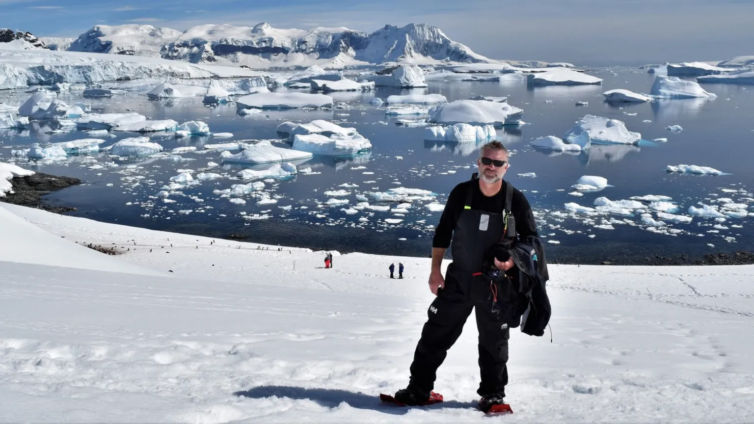
Meanwhile, 56-year-old Briton Martin Anstee, a retired police officer and an expedition guide on board the MV Hondius, is in a stable condition in a hospital in the Netherlands.
He is one of three people evacuated from the ship on Wednesday for treatment, Oceanwide Expeditions said.
He told the BBC he was "fine".His wife, Nicola, told the Daily Telegraph it had been "a very dramatic few days".
"He's relieved to be off the ship. He had it quite mild then it got a bit more serious and now he's stable again.
"The fear with this virus is it can deteriorate very quickly so it's been a bit up and down for him. I don't believe he's in imminent danger now but it was horrible."
May told BBC Breakfast it was his understanding that "he is doing well".
"He is going to be under investigation for some time. I'm very pleased he's now in hospital and receiving the treatment he needs," he said.
The other evacuees were a 41-year-old Dutch crew member and a 65-year-old German, according to the World Health Organization (WHO).
Oceanwide Expeditions said the German evacuee was "closely associated" with a German woman who died on board the ship on 2 May.
The origin of the outbreak is still unknown and it is not known if people other than cruise ship passengers have been infected with the disease.
Sources from Argentina's Ministry of Health told BBC Mundo that authorities are investigating the possibility that it may have originated from a couple of Dutch passengers who had been travelling through southern Argentina and Chile.
In its latest update, the WHO said eight cases of hantavirus - three confirmed and five suspected - have so far been identified in people who were on the ship.
Officials have said that one of the three deceased had the virus, while the other two deaths are under investigation.
One of the three deaths was a Dutch woman who left the MV Hondius when it stopped at St Helena on 24 April, and travelled to South Africa where she died two days later.
Her husband had previously died on board on 11 April, but is not a confirmed case of hantavirus.
The third fatality - a German woman - is not a confirmed case either. Her body remains on the ship.
The WHO has also confirmed a man who had travelled back to Switzerland after disembarking the ship tested positive and is receiving care at a hospital in Zurich.
Singapore authorities are isolating and testing two people who were on the cruise ship, and who also were on board the same 25 April flight from St Helena to Johannesburg as someone who later died.
Meanwhile, two US states - Georgia and Arizona - have confirmed to the BBC that they are monitoring three passengers who had returned to the US after disembarking. All are currently not displaying symptoms.
The US Department of State said it is in "direct contact" with affected passengers.
Dutch authorities say they will contact passengers on a KLM flight from South Africa to the Netherlands which was briefly boarded by a 69-year-old Dutch woman who later died.
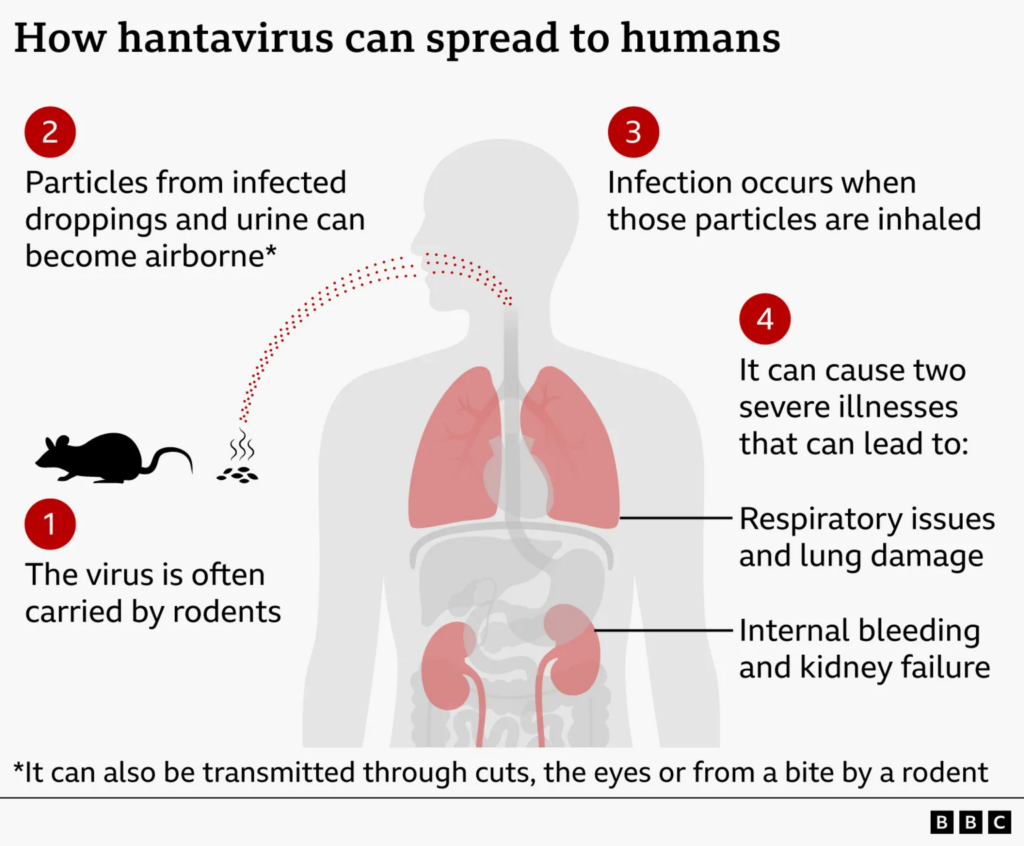
Hantavirus typically spreads from rodents, but health experts believe that in this case, it may have passed between humans that were in close contact.
The Andes strain of the virus has been confirmed in two of the ship's passengers, according to South Africa's health minister, and experts have observed the strain spreading between human patients in previous outbreaks, although very rarely.
It can take between one and eight weeks for symptoms to appear. May told BBC Radio 4's Today programme that "general expert consensus is now consolidating around six weeks" for the incubation period.
Both the WHO and the UKHSA have said the risk to the public is low. The UKHSA said there is "no need for concern among the general public".
About 150 people from 23 different countries are still on board the cruise ship under "strict precautionary measures", Oceanwide Expeditions has said.
They include 19 passengers and four crew members listed as British, according to figures released by the operator on Tuesday.
In an update on Thursday, it said "no symptomatic individuals are present on board."
Spanish authorities have given permission for the ship to dock in the Canary Islands, despite concerns from local officials.
The UKHSA said the Britons on the ship would be flown home on a charter flight, probably from the Canary Islands as long as they did not have symptoms.
They would then have to self-isolate or be put into quarantine potentially for up to six weeks, depending on the timing of their last potential exposure to the virus.
May said his officials would be getting in touch with the contacts of anyone who may have been exposed to the virus including family members, anyone who shared rooms on the ship with them or anyone who sat next to them on a long haul flight.
The contact tracing work has been "quite a mammoth effort", he told BBC Breakfast, and one "we will continue to do... for some time".
One passenger who disembarked earlier in the cruise said the ship's staff initially assumed the illness was not infectious.
Travel blogger Ruhi Cenet told the BBC: "I was very unhappy because they did not take the right precautions for the first couple of weeks.
"They didn't know as well, I cannot fully blame them, but they should at least have thought of the possibility of the contagious disease."
He shared a video with the BBC taken on 12 April, showing the ship's captain telling passengers that a man had passed away due to "natural causes".
In the video, the captain told passengers a doctor had said the individual was "not infectious".
Oceanwide Expeditions told the BBC the first report of hantavirus came "after disembarkation at St Helena" - over a week after the video was taken.
The operator said it "acted as we reported via our press updates" following the first identified hantavirus case on 4 May.
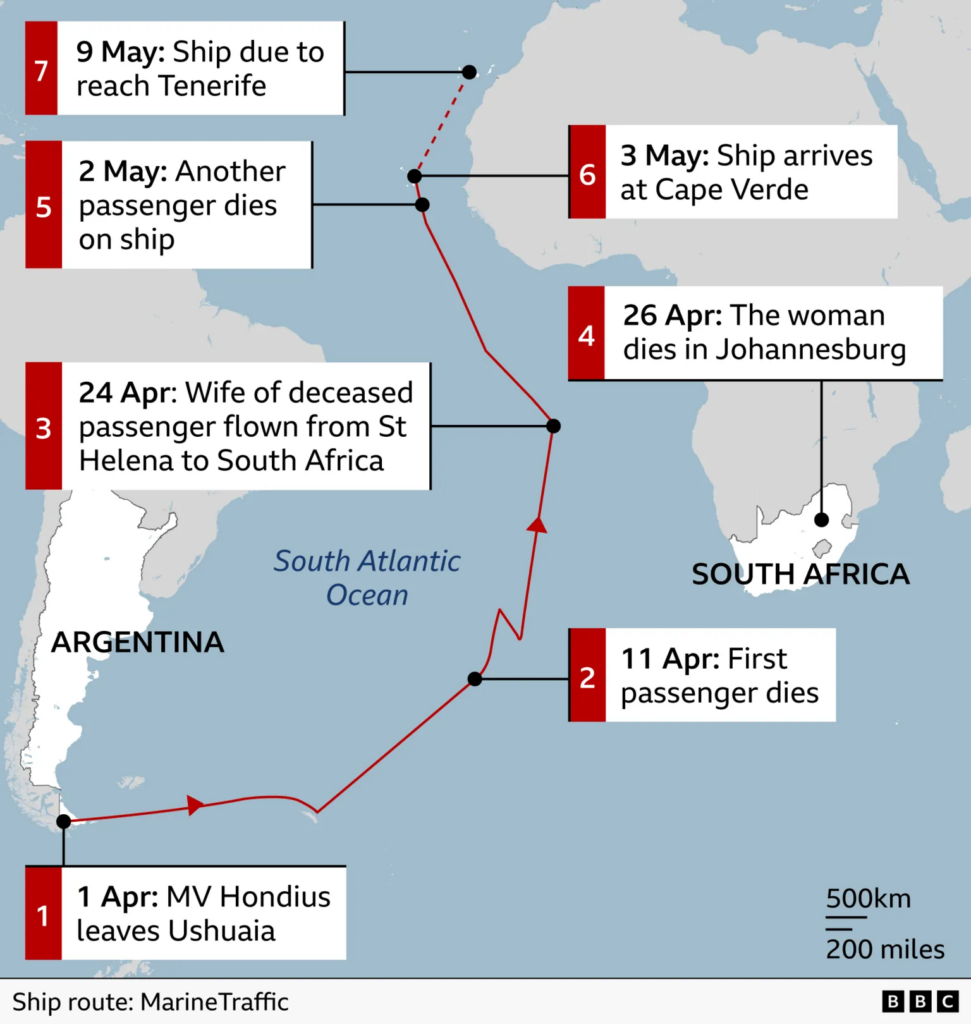
The vessel will sail to the Canary Islands where all passengers will be evacuated at Granadilla port in Tenerife, Spain's health minister Monica Garcia said on Wednesday.
Everyone on board will undergo a medical assessment when they arrive in Tenerife and, if fit to travel, those from abroad will be repatriated to their home countries, she said.
Garcia added thatSpanish passengers will be quarantined in Madrid.
Foreign Secretary Yvette Cooper said the situation was "very serious and deeply stressful for those affected and their families".
The Foreign Office said it was "working urgently" to get British nationals stuck on board the MV Hondius home safely and the UK response to the outbreak was being led by the UKHSA working with the WHO.
Consular staff are in contact with British nationals onboard the ship and the Foreign Office has been "working with other countries to facilitate the medical evacuations, to support our Overseas Territories and to get British nationals home safely as quickly as possible", Cooper added.
The UKHSA is also working with governments in St Helena, Tristan de Cunha and Ascension Island on isolation, contact-tracing efforts and response protocols.
Latest Stories
-
High court stops NPP constituency executive elections in Bibiani
8 minutes -
Xenophobic attacks in South Africa: Much Ado About the Wrong Threat?
12 minutes -
Chaos and confusion reign as Harry loses media battle
18 minutes -
Rex Omar advocates permanent sanitation culture, calls floods a national wake-up call
21 minutes -
New era for Ghana’s 5G as MTN, Telecel prepare to compete for licences
47 minutes -
BoG Governor urges traders to keep cedi notes clean as part of national clean-up drive
1 hour -
Beyond The Visible: A scientific and philosophical response to Feynman’s case against the existence of God
1 hour -
GUTA reverses stance on EasyPass following GSA clarification
2 hours -
One culvert from disaster: Sazie risks total isolation as DCE begs for road repair
3 hours -
Traders advised to bank their money for safety as Asokore Mampong Community Bank opens at Adum
3 hours -
Lammens’ error spells end for Belgium’s golden generation
4 hours -
EPA closes Kasoa fuel station over blocked drains amid intensified anti-flood campaign
4 hours -
This Saturday on Prime Insight: National cleanup, Abu Trica and Hanan troubles, and ‘Nkoko Nkitinkiti’ discussions
5 hours -
Top Boy actor Micheal Ward found not guilty of rape
5 hours -
Mikel Merino’s late winner against Belgium sends Spain into the semi-finals of the World Cup
5 hours