

Audio By Carbonatix
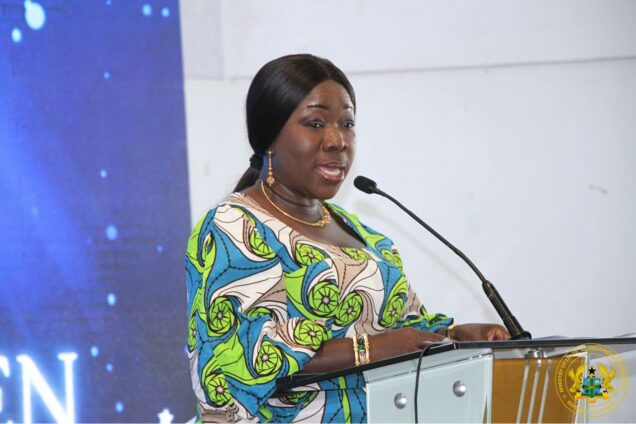
Minister for Trade, Agribusiness, and Industry, Elizabeth Ofosu-Adjare, has declared that the government is actively driving transformational policies aimed at expanding opportunities for women and positioning them at the centre of Ghana’s economic development agenda.
Speaking at the 2026 Ghana Female CEOs Summit held at the Kempinski Hotel Gold Coast City on Thursday, May 7, Mrs Ofosu-Adjare said the administration of President John Dramani Mahama is backing women’s empowerment with legislation, financing, and institutional reforms.
“We are not just inheriting it; we are driving it,” the Minister stated while speaking about the implementation of the Affirmative Action Law 2024.
Addressing an audience of female chief executives, entrepreneurs, and business leaders, she said the era of limiting women’s participation in national development must end.
“Women’s economic participation is not a gender programme. It is our national competitiveness strategy,” she stressed.
Mrs Ofosu-Adjare described the summit as an important platform for nation-building and applauded women leaders for their contribution to economic growth.
“You have built businesses, created employment, navigated economic headwinds, and refused to be the footnotes in Ghana’s growth story,” she told participants.
The Minister reflected on her own journey as a woman in leadership, acknowledging the pressures women face in positions of authority.
“I stand before you today wearing several identities all at once: Member of Parliament, Minister of Trade, Agribusiness, and Industry, and a woman who has navigated the full weight of leadership in rooms that were not always designed with us in mind,” she said.
According to her, women continue to face unequal standards in leadership despite their proven competence.
“I know the discipline, the resilience, and the quiet determination it takes to lead while being watched differently, judged differently, and held to a different standard,” she added.
Mrs Ofosu-Adjare argued that Ghana’s economic ambitions cannot be realised if women remain economically marginalised.
The Minister highlighted several policy initiatives being implemented to address barriers facing women entrepreneurs and professionals.
She disclosed that the Ghana Women’s Development Bank has been allocated GH¢401 million in the 2026 national budget to provide targeted financial support for women-led enterprises.
According to her, the institution would offer low-interest loans, mentorship, and flexible collateral arrangements designed specifically for women.
“When it launches, it will be the most targeted financial intervention for women in this country’s history,” she said.
Mrs Ofosu-Adjare also pointed to the 24-Hour Economy Authority Act 2026 as a major economic reform that would benefit women operating in sectors such as agro-processing, market trade, hospitality, and manufacturing.
“This law creates a dedicated authority to coordinate and incentivise round-the-clock business operations across key sectors,” she explained.
She said women entrepreneurs would gain access to tax incentives, reduced electricity tariffs, and financing support through EXIM Bank.
The Minister further highlighted the implementation of the Affirmative Action Law 2024, which mandates at least 30 percent female representation in decision-making roles by the end of 2026, increasing to 35 percent by 2028 and parity by 2034.
“The Act also provides tax incentives for private sector companies that meet gender equality targets and preferences in government contracts for compliant businesses,” she noted.
Mrs Ofosu-Adjare said Ghana’s export strategy under the African Continental Free Trade Area framework also presents significant opportunities for women-led businesses.
She explained that sectors targeted for expansion, including textiles, garments, palm oil, cassava processing, and pharmaceuticals, are areas where women already play leading roles.
“The policy architecture has been built. The question now is execution at speed,” she said.
The Minister urged collaboration among government institutions, the private sector, and development partners to ensure the success of the reforms.
“Government sets the framework and removes the barriers. The private sector invests and innovates. Financial institutions create products fit for purpose,” she stated.
She described the female CEOs at the summit as “partners in national transformation” rather than mere beneficiaries of government interventions.
“We see you. We are building for you. And we expect you to grow beyond what any of us can currently imagine,” she said.
Mrs Ofosu-Adjare concluded by calling for the creation of an inclusive and resilient economy driven by women’s leadership and enterprise.
“Let us build productive industries. Let us expand trade that is inclusive. And let us create an economy that is resilient, competitive, and worthy of the women who are leading it,” she said.
Latest Stories
-
Mobile Money Fintech LTD, UMB train hairdressers and beauticians
2 hours -
Asylum votes show people want help, says Kemi Badenoch
3 hours -
Badenoch welcomes expanded grooming gangs inquiry
3 hours -
GACL MD sues Samuel Buabeng over alleged Facebook defamation
3 hours -
Christa Pike in critical condition after surviving two lethal injections, lawyer says
3 hours -
Kemi Badenoch backs face covering ban at protest
3 hours -
Man City not ‘above the rules’, says No 10 after backlash to Burnham remarks
3 hours -
Real Madrid submit ‘substantial’ dossier in Barca payments case
3 hours -
Messi completes purchase of second Spanish club
4 hours -
Government must engage horticulturists on tomato crisis – GhIH
4 hours -
King Promise’s ‘Can’t Tame Us’ becomes official Chelsea anthem
4 hours -
Afenyo-Markin demands Baffour Awuah’s release from EOCO’s custody, end to alleged political intimidation
4 hours -
Rapper Rick Ross arrested on domestic violence charges
4 hours -
Minority demands security review of Ghana-Colombia visa waiver and port deals
4 hours -
Pursue drug kingpins, not persecute political opponents – Afenyo-Markin tells EOCO
4 hours