

Audio By Carbonatix
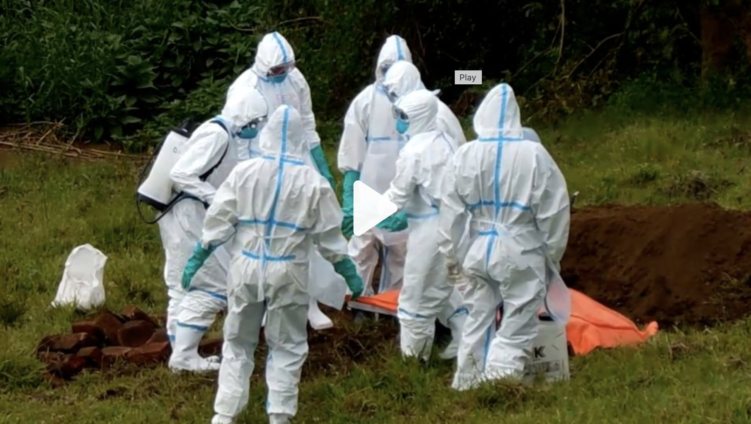
The World Health Organisation has stepped up emergency support to the Democratic Republic of the Congo following the confirmation of an Ebola Bundibugyo outbreak in the country’s north-eastern Ituri Province.
Health authorities say at least 67 suspected community deaths linked to the outbreak have already been recorded, raising concerns over the extent of transmission in affected areas.
Tests conducted by the National Institute of Biomedical Research in Kinshasa confirmed the virus in 13 out of 20 samples collected from suspected cases in the Mongbwalu and Rwampara health zones.
Patients experienced symptoms including fever, body weakness, vomiting, severe pain and, in some cases, bleeding. Several reportedly died shortly after falling ill.
The Bundibugyo strain of Ebola was first identified in Uganda in 2007 during an outbreak that killed 42 people.
WHO teams deployed to Ituri are now supporting investigations, surveillance, contact tracing and infection control efforts aimed at limiting further spread of the disease.
Additional specialists in epidemiology, laboratory testing, clinical care and risk communication are also being mobilised to reinforce the response.
“The Democratic Republic of the Congo has extensive experience responding to Ebola outbreaks,” said Dr Mohamed Janabi. “WHO is rapidly scaling up support to the ongoing response.”
WHO said it is airlifting five metric tonnes of emergency supplies, including protective equipment, laboratory materials and treatment support items, from Kinshasa to Bunia.
Health officials warn that response efforts may be complicated by insecurity, mining-related population movements and frequent cross-border travel.
In neighbouring Uganda, the WHO said, authorities confirmed Ebola Bundibugyo in a patient who arrived from the Democratic Republic of the Congo and later died while receiving treatment. Ugandan officials have since activated surveillance and preparedness measures.
According to the health organisation, this is the 17th Ebola outbreak recorded in the Democratic Republic of the Congo since the virus was first identified in 1976.
Ebola is a highly infectious disease spread through direct contact with the bodily fluids of infected people or contaminated materials. Health experts say early detection and rapid response remain critical to preventing further transmission.
Latest Stories
-
“I don’t see any rational basis” – Inusah Fuseini rejects proposed five-year term
6 minutes -
Constitution shouldn’t be amended simply because years have passed – IEA
7 minutes -
Access Bank, Visa launch ‘Visa Accept’ in Ghana
29 minutes -
‘Our young people must inherit story of what Africa created, not lost’ – Mahama
31 minutes -
Afreximbank, GIIF and 24-Hour Economy Authority pact marks real progress toward 24-hour economy agenda
60 minutes -
IMANI, Local Government Ministry discuss reforms on sanitation, local revenue and urban infrastructure
1 hour -
Ghana’s international reserves drop to US$11.04 billion in August as BoG pushes for significant build-ups in coming months
1 hour -
Four years enough for any government to deliver – IEA rejects five-year term
1 hour -
‘The most important players are here’ – Queiroz shrugs off Ghana’s injury crisis
2 hours -
Ayariga pledges stakeholder-led approach to Nzema, Kokomba Market redevelopment
2 hours -
Professional collaboration is key to Ghana’s land and property development – Western Regional Minister
2 hours -
‘When you play Ghana, it’s a derby’ – Kessié sets tone for AFCON qualifying showdown
2 hours -
Mahama urges global institutions to invest in Africa’s cultural infrastructure
2 hours -
Kuami Eugene joins UNICEF Ghana to promote universal birth registration
2 hours -
Renard warns Côte d’Ivoire against complacency Ahead of Ghana clash
2 hours