

Audio By Carbonatix
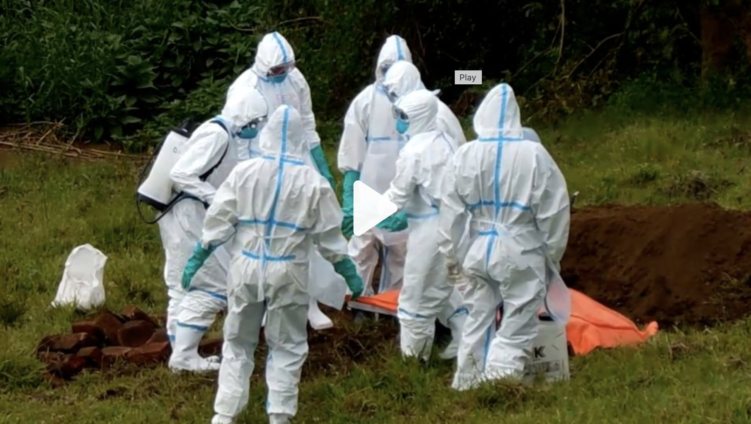
The World Health Organisation has stepped up emergency support to the Democratic Republic of the Congo following the confirmation of an Ebola Bundibugyo outbreak in the country’s north-eastern Ituri Province.
Health authorities say at least 67 suspected community deaths linked to the outbreak have already been recorded, raising concerns over the extent of transmission in affected areas.
Tests conducted by the National Institute of Biomedical Research in Kinshasa confirmed the virus in 13 out of 20 samples collected from suspected cases in the Mongbwalu and Rwampara health zones.
Patients experienced symptoms including fever, body weakness, vomiting, severe pain and, in some cases, bleeding. Several reportedly died shortly after falling ill.
The Bundibugyo strain of Ebola was first identified in Uganda in 2007 during an outbreak that killed 42 people.
WHO teams deployed to Ituri are now supporting investigations, surveillance, contact tracing and infection control efforts aimed at limiting further spread of the disease.
Additional specialists in epidemiology, laboratory testing, clinical care and risk communication are also being mobilised to reinforce the response.
“The Democratic Republic of the Congo has extensive experience responding to Ebola outbreaks,” said Dr Mohamed Janabi. “WHO is rapidly scaling up support to the ongoing response.”
WHO said it is airlifting five metric tonnes of emergency supplies, including protective equipment, laboratory materials and treatment support items, from Kinshasa to Bunia.
Health officials warn that response efforts may be complicated by insecurity, mining-related population movements and frequent cross-border travel.
In neighbouring Uganda, the WHO said, authorities confirmed Ebola Bundibugyo in a patient who arrived from the Democratic Republic of the Congo and later died while receiving treatment. Ugandan officials have since activated surveillance and preparedness measures.
According to the health organisation, this is the 17th Ebola outbreak recorded in the Democratic Republic of the Congo since the virus was first identified in 1976.
Ebola is a highly infectious disease spread through direct contact with the bodily fluids of infected people or contaminated materials. Health experts say early detection and rapid response remain critical to preventing further transmission.
Latest Stories
-
Nana B passport claims a diversionary tactic — Abu Jinapor
4 minutes -
Pope Leo diagnosed with cancer as doctors remove lobe of lung, Vatican says
4 minutes -
Legal Aid Commission takes free legal services to Techiman main lorry terminal
8 minutes -
Nana B denies seeking passport favour, accuses Ablakwa of failing to account for GH¢16.4m
13 minutes -
Young girls demand climate action, stronger protection against child marriage
25 minutes -
Ex-gang boss sentenced to 40 years for orchestrating Tupac Shakur’s murder
25 minutes -
From near-deferral to three awards: UMaT graduate’s academic journey
27 minutes -
Atta Akyea denies seeking presidential pardon for Wontumi in galamsey case
1 hour -
Photos: Mahama commissions 85-bed Police Hospital ward, donates two ambulances
1 hour -
GTEC directs Ghana’s public universities to reopen by October 16 and begin lectures on October 19
1 hour -
Star Oil donates GH¢1million towards construction of new CID facility
1 hour -
Court hands Adjetey Sowah, two others lifetime bans after Amputee Football legal dispute
1 hour -
NDC appoints Julius Kwame Anthony as a Deputy Communications Director
1 hour -
Ghana repatriates 120 Nigerians rescued from suspected cybercrime centres
2 hours -
NPP rejects Emelia Agbenyo’s appointment as Deputy EC Chair, demands withdrawal
2 hours