

Audio By Carbonatix
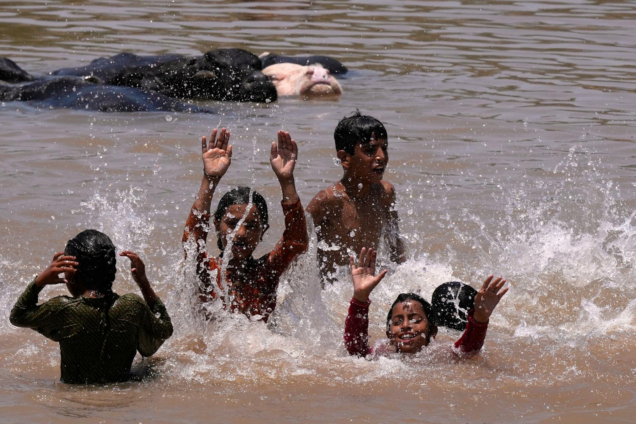
Almost all of the world's children are exposed to at least one climate hazard, with as many as 1.8 billion put in danger by droughts and 1.2 billion by extreme heat, the United Nations Children's Fund (UNICEF) said in a report on Tuesday.
UNICEF said children were "disproportionately affected" by a range of intensifying climate-related risks and governments urgently needed to invest in infrastructure, adaptation and disaster management capabilities to reduce their exposure.
Here are some of the details of UNICEF's Children's Climate Risk Report.
- The report looked at a broad range of climate hazards, as well as the impacts of air pollution and the risks of vector-borne diseases such as malaria. It also factored in data on access to water, healthcare, and social services across the world.
- As many as 1.1 billion children globally were exposed to at least three overlapping climate risks, the report said, warning of a "dangerous cascade of multiple, overlapping hazards" that could overwhelm governments and social services.
- "It's not just the exposure to the single hazards like floods or droughts or heat waves and extreme heat that children face, but it is the exposure to multiple hazards," said Rohini Sampoornam Swaminathan, UNICEF statistics manager and one of the authors of the report.
- As many as 662 million children were at risk from tropical storms, 337 million from riverine floods and 33 million from coastal floods, with 1 billion children also exposed to malaria, mostly in Africa.
- In 2024, 242 million children in 85 countries had their schooling disrupted by climate hazards.
- UNICEF identified Somalia, Madagascar, Myanmar, Cambodia and Pakistan as the most vulnerable countries.
- The highest numbers of drought-exposed children live in agriculture-dependent economies like Bangladesh, Indonesia, Nigeria, Pakistan and Tanzania.
- Children in landlocked nations were also facing "disproportionate" risks of drought, desertification, heat stress and flash floods, with water stress set to intensify in countries like Botswana and Burkina Faso.
DISCLAIMER: The Views, Comments, Opinions, Contributions and Statements made by Readers and Contributors on this platform do not necessarily represent the views or policy of Multimedia Group Limited.
DISCLAIMER: The Views, Comments, Opinions, Contributions and Statements made by Readers and Contributors on this platform do not necessarily represent the views or policy of Multimedia Group Limited.
Latest Stories
-
The job interview question you don’t have to answer
1 hour -
Trump unveils ‘Super Intelligence Force’ to oversee AI policy
1 hour -
Actress Chioma Chukwuka announces death of father in emotion-laden post
4 hours -
[Video]‘I have asked God to take me when it is time’ – Pete Edochie on health struggles
4 hours -
Manager remanded over $1m auto fraud
4 hours -
Mr President, Ghana was mentioned at the UN; why aren’t we talking about it?
4 hours -
US Marine arrested over murder of woman in Okinawa, Japan
4 hours -
Accra to convene Africa’s regulators and markets on tokenisation at AVAS 2026
4 hours -
Indian police accused of sexually harassing journalists at protest
5 hours -
Jeffrey Archer returns to his former school library
5 hours -
France to close up to 500 schools on Monday over student protests
5 hours -
The Paradox of Plenty — When every smartphone becomes a newsroom
5 hours -
Australia investigating Flydubai co-pilot’s links to country
5 hours -
GTA sensitises taxi drivers in ‘Know Ghana’ tourism campaign
6 hours -
Archbishop Agyinasare calls for responsible speech amid growing social media abuse
6 hours