

Audio By Carbonatix
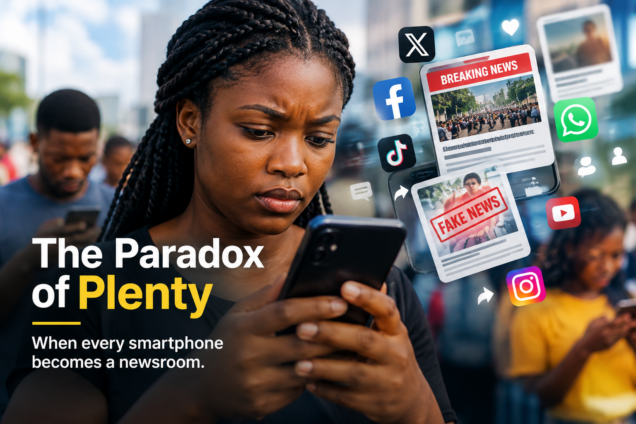
The newsroom is no longer the only place where a story can begin. Today, a smartphone, a microphone and the courage to ask questions can put an injustice before the entire nation and sometimes before the President himself.
There was a time when telling a national story required access to a newsroom, a television studio, a radio station, a printing press or a newspaper editor.
Today, that world has changed.
A smartphone with a camera, an internet connection and a social-media account can put an ordinary Ghanaian at the centre of a national conversation within minutes.
Welcome to the age of the citizen journalist, blogger and content creator.
And whether traditional journalists like it or not, these new voices are becoming an increasingly important part of Ghana's information ecosystem.
They are everywhere.
On busy streets. In marketplaces. At hospitals. In schools. At police stations. In communities where public officials rarely visit. At places where ordinary citizens feel ignored.
Sometimes, they arrive before the mainstream media.
Sometimes, they tell stories the mainstream media does not have the resources, time or editorial space to pursue.
And sometimes, they simply hold up a smartphone and ask a question that thousands or millions of Ghanaians have been waiting to ask.
That development deserves serious attention.
Ghana's media landscape has long been diverse, with private radio and television stations, online news platforms and state-owned media operating alongside one another. Reporters Without Borders describes Ghana as having a dynamic and diverse media environment and notes that the country's 1992 Constitution guarantees freedom of the press.
But the digital revolution has added an entirely new layer.
The phone has become a newsroom.
A Facebook Live broadcast can expose a problem.
A TikTok video can draw attention to an abandoned project.
A YouTube interview can give a struggling citizen an audience.
A blogger's post can force officials to respond.
And a short video recorded by an ordinary person can sometimes travel further than a carefully produced television report.
This is not necessarily a threat to journalism.
It can also be an opportunity.
Some content creators are helping people who previously had little access to powerful platforms to tell their stories. They are documenting alleged injustices, highlighting community problems and bringing issues to public attention.
Most importantly, they are sometimes helping citizens who feel that nobody is listening.
That is powerful.
And governments notice when citizens begin speaking directly to the public.
We have seen the Presidency respond publicly to claims circulating on social media. For example, in April 2026, President John Dramani Mahama directly addressed social-media claims about tricycles distributed under the Free Primary Healthcare Programme, explaining what the vehicles were intended for.
That example demonstrates something important: social media is no longer merely a place where people talk. It has become a place where public officials must sometimes answer.
But there is another side to this revolution.
With great communicative power comes great responsibility.
Not everyone holding a smartphone is a journalist.
Not every viral video is journalism.
Not every accusation is a fact.
And not every person who disagrees with a public official should be described as a victim of persecution.
The same freedom that allows a content creator to expose an injustice must also require that creator to exercise care with facts, allegations and people's reputations.
This is where the debate becomes complicated.
President Mahama and members of his government, like other public officials, can legitimately object to insults, personal attacks and abusive language directed at them and their families.
Criticism of government policy is one thing.
Calling out alleged wrongdoing is another.
But personal abuse, threats, deliberate falsehoods and degrading attacks are different matters.
We should be able to draw that line without destroying the fundamental principle of free expression.
Criticism is not the enemy of democracy.
Neither is responsible journalism.
The danger comes when criticism is answered with intimidation or when freedom of expression becomes an excuse for abuse.
The answer should therefore not be to silence Ghana's new digital voices.
The answer should be responsibility, evidence, accountability and the rule of law.
Where a content creator makes a serious allegation, let the evidence be examined.
Where a government official believes a law has been broken, let due process take its course.
Where a journalist or content creator is accused of an offence, let the courts determine the matter fairly.
And where a citizen raises a legitimate public-interest concern, the government should listen rather than dismiss the person simply because the message arrived through a smartphone.
That balance matters because Ghana's democracy depends not only on the right to speak but also on the public's ability to receive information and scrutinise those who exercise power.
Reporters Without Borders' 2026 assessment places Ghana 39th out of 180 countries in its World Press Freedom Index and describes Ghana as being in the “satisfactory” category, while also noting continuing concerns about attacks, obstruction and safety affecting journalists.
So, Ghana should protect the space for journalism, whether that journalism comes from a major television station, a newspaper newsroom, an online publication or a responsible citizen with a smartphone.
But the digital revolution must not become a licence for character assassination.
A blogger should be able to criticise a minister.
A content creator should be able to question the President.
A citizen should be able to document what appears to be an injustice.
But they should also be prepared to support serious claims with evidence and accept lawful accountability when they cross legal boundaries.
And government must exercise restraint.
Because when the state responds disproportionately to criticism, the message can become bigger than the original post.
The challenge before Ghana is therefore not whether citizen journalism should exist.
It is already here.
The real question is whether Ghana can build a digital public sphere where citizens can speak boldly, journalists can investigate freely, governments can be held accountable, and everyone, including the President, can be criticised without fear, while still respecting the law and the dignity of others.
The smartphone has given ordinary Ghanaians a voice.
That voice should not be abused.
But neither should it be unnecessarily silenced.
Let the citizen speak.
Let the journalist investigate.
Let the blogger question.
Let the content creator document.
And let the evidence, the law and the truth do the rest.
Because in today's Ghana, the next important national story may not begin inside a newsroom.
It may begin with someone standing on a roadside, holding a smartphone, saying:
“This is what is happening here. Somebody needs to listen.”
Latest Stories
-
Mr President, Ghana was mentioned at the UN; why aren’t we talking about it?
2 minutes -
Accra to convene Africa’s regulators and markets on tokenization at AVAS 2026
4 minutes -
The Paradox of Plenty — When every smartphone becomes a newsroom
38 minutes -
GTA sensitises taxi drivers in ‘Know Ghana’ tourism campaign
2 hours -
Archbishop Agyinasare calls for responsible speech amid growing social media abuse
2 hours -
‘It will be inexcusable for gov’t not to honour payment of teachers’ arrears by 30th October’ – Haruna Iddrisu
2 hours -
Forbes’ World’s Best Employers 2026: No Ghanaian firm ranked among 900 companies
2 hours -
Electronic processing of teachers’ data: ‘The decision is the Controller’s’ – GES boss
2 hours -
Teachers’ Strike: Haruna Iddrisu questions paper-based processing of promoted teachers’ data
2 hours -
Savannah Region: Kunfusi bridge collapses again, leaving nearly 4,000 residents cut off
2 hours -
Teachers’ strike: GES targets Monday deadline to submit promotion data to Controller
3 hours -
Inflation to average 11.3% in 2027 – Fitch Solutions
3 hours -
‘I didn’t campaign for NDC to come and do this nonsense’ – Kpebu on EOCO’s conduct
3 hours -
Fitch Solutions maintains policy rate forecast of 14% by December 2026
3 hours -
Diaspora Nasara Caucus congratulates Mohammed Ali Suraj, new NPP executives
5 hours